
What Is Egocentric Video Data Collection? A Guide for AI Teams

Most video datasets show the world from the outside.
Egocentric video data shows the world from the person’s point of view.
That difference matters more than it may seem. For AI systems that need to understand how humans move, work, interact with objects, complete tasks, and navigate real environments, third-person video often misses the most important details. It may capture the action, but not the lived perspective of the person performing it.
Egocentric video data collection solves this gap by capturing first-person video through wearable, head-mounted, chest-mounted, or body-mounted cameras. The result is a dataset that reflects how people actually see and interact with their surroundings.
For robotics, AR/VR, embodied AI, human activity recognition, and physical AI systems, this kind of first-person video data is becoming increasingly valuable.
What Is Egocentric Video Data?
Egocentric video data refers to video captured from the perspective of the person performing an action. Instead of placing a camera across the room or above a scene, the camera moves with the participant.
This can be captured through:
- head-mounted cameras
- wearable cameras
- chest-mounted or body-mounted devices
- smart glasses
- action cameras
- mobile or custom POV capture setups
The goal is to record tasks and environments from the viewpoint of the person experiencing them.
This makes egocentric video especially useful for understanding hand movements, object interactions, attention, navigation, and real-world task sequences. It helps AI models learn not just what happens in a scene, but how an action unfolds from the actor’s perspective.
For example, a third-person video may show someone making tea. An egocentric video can show how the person reaches for the kettle, opens the jar, handles the cup, pours water, adjusts the spoon, and responds to the environment in real time.
That level of detail is critical for AI systems that need to understand physical action.
How Is Egocentric Video Different from Regular Video Data?
Traditional video data is usually captured from a fixed or external camera angle. It is useful for many computer vision tasks such as surveillance, object detection, traffic analysis, and scene classification.
Egocentric video is different because the camera moves with the person.
This creates a more dynamic and complex dataset. The camera may shake, tilt, move quickly, or capture partial views. Hands may enter and leave the frame. Objects may be visible for only a few seconds. Lighting may change as the participant moves from one space to another.
That complexity is exactly what makes the data valuable.
Egocentric video captures:
- hand-object interactions
- task sequences
- body movement from the actor’s perspective
- object handling
- gaze-adjacent visual attention
- real-world context
- changing environments
- navigation and movement patterns
For AI models, this helps build a deeper understanding of human action and physical environments.
Why AI Teams Need First-Person Video Data
AI systems are increasingly expected to work in real-world environments, not just controlled digital spaces. Robots need to understand how people pick, place, sort, open, close, carry, assemble, and move around objects. AR/VR systems need to understand user perspective, spatial context, and interaction flow. Embodied AI models need data that reflects how action happens in the physical world.
This is where egocentric video datasets become useful.
They help AI teams train and evaluate models for:
- robotics and manipulation
- embodied AI
- AR/VR and mixed reality
- human activity recognition
- physical AI systems
- human-object interaction models
- task understanding
- action segmentation
- vision-language-action models
- workplace and environment understanding
Instead of training only on static images or third-person views, teams can use first-person video data to capture the sequence, timing, and context of human activity.
What Kinds of Tasks Can Be Captured?

Egocentric video data collection can be designed around specific use cases. The value of the dataset depends heavily on the tasks selected, the capture environment, and the metadata collected along with the video.
Common capture scenarios include:
- household tasks such as cooking, cleaning, organizing, or assembling
- workplace tasks such as packing, sorting, scanning, or quality checks
- retail tasks such as shelf handling, product picking, and inventory workflows
- industrial tasks such as tool use, inspection, and equipment handling
- healthcare-adjacent workflows such as assisted movement or procedural support
- mobility and navigation scenarios
- hand-object interaction tasks
- multi-step demonstrations for robot learning
For AI teams, the aim is not just to collect “more video.” It is to collect useful, structured, task-based video that can support model training, evaluation, and improvement.
What Makes Egocentric Video Collection Difficult?
Egocentric video data is powerful, but it is not simple to collect well.
Because the camera is attached to or carried by a participant, the footage can be unstable. Important actions may happen outside the frame. Lighting may vary. Participants may perform the same task differently. The environment may contain sensitive or personally identifiable information. Without strong capture protocols, the dataset can quickly become inconsistent.
Common challenges include:
- shaky or unusable footage
- incomplete task capture
- poor framing of hands or objects
- inconsistent participant instructions
- missing metadata
- privacy-sensitive information in the background
- unclear task boundaries
- lack of annotation readiness
- difficulty scaling across participants and environments
This is why egocentric video data collection needs more than participants and cameras. It needs planning, capture protocols, QA checks, and review layers.
What Should a Good Egocentric Dataset Include?
A strong egocentric video dataset should be designed around the model’s intended use case.
At a basic level, teams should define:
- what tasks need to be captured
- which environments are relevant
- what devices or camera setups will be used
- how participants should perform the tasks
- what metadata should be captured
- what quality checks will be applied
- whether annotation will be required later
- how privacy and consent will be managed
Metadata is especially important. A video file alone may not be enough. AI teams often need information such as task type, environment, participant category, object type, camera setup, capture duration, and quality status.
This makes the dataset easier to search, filter, annotate, and use for training or evaluation.
Privacy and Consent Matter
Egocentric video data can capture sensitive real-world details: faces, homes, screens, documents, personal items, voices, locations, and background activity.
That makes consent and privacy essential.
A responsible egocentric video data collection workflow should include:
- consent-based participant onboarding
- clear capture instructions
- defined spaces and task boundaries
- review for personally identifiable information
- optional blur or redaction workflows
- secure data transfer
- controlled access
- documentation of collection conditions
For enterprise AI teams, this is not a nice-to-have. It is a requirement.
Where Annotation Fits In
Egocentric video collection is often only the first step.
Depending on the use case, the data may need to be annotated for:
- actions
- objects
- hand-object interactions
- timestamps
- task stages
- gestures
- activity labels
- object states
- scene changes
- speech or audio cues
- segmentation or bounding boxes
For robotics and embodied AI, annotation helps connect what the person is doing with what the model needs to learn. A task like “making coffee” may need to be broken into smaller steps: pick up cup, open jar, pour, stir, place object down.
Without that structure, the video may be visually rich but difficult to use.
How IndiVillage Supports Egocentric Video Data Collection
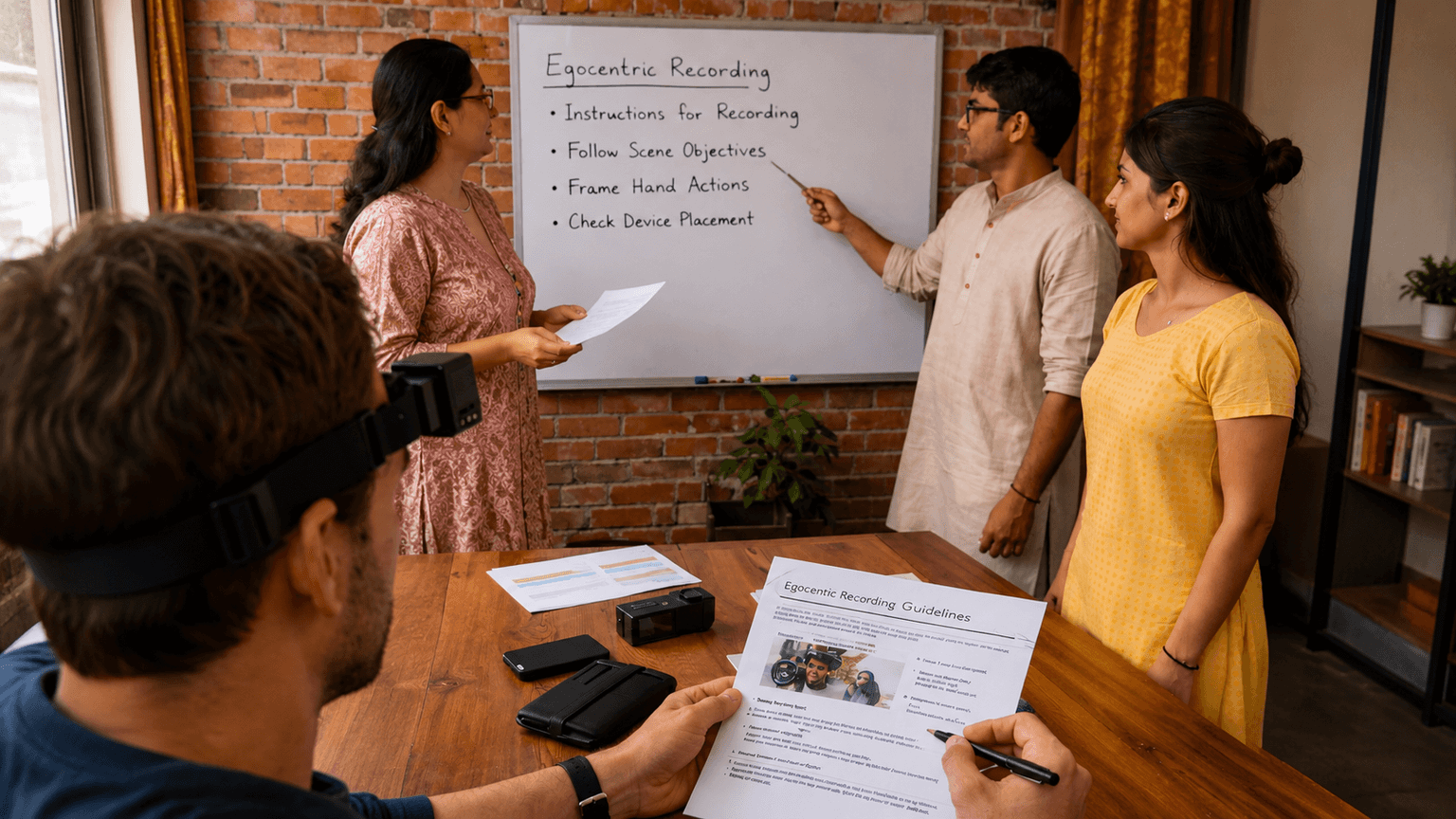
IndiVillage Tech helps AI teams design and execute structured egocentric video data collection workflows for robotics, AR/VR, embodied AI, human activity recognition, and physical AI systems.
Our approach focuses on:
- use-case aligned capture planning
- participant and environment preparation
- wearable and head-mounted video collection
- task-based capture protocols
- metadata-ready delivery
- privacy-aware review
- human-in-the-loop QA
- optional downstream annotation
- scalable project execution
We support teams that need first-person video datasets that are not only collected, but usable.
For AI teams, the question is not simply, “Can we collect video?”
The better question is: “Can we collect first-person video data that is structured, reviewed, privacy-aware, and ready for model development?”
That is where egocentric video data collection becomes a real data operations challenge.
Conclusion
Egocentric video data collection gives AI teams a closer view of how humans act in real environments. It captures perspective, movement, object handling, context, and task flow in ways that traditional video often cannot.
For robotics, AR/VR, embodied AI, and human activity understanding, this kind of first-person data can help models move closer to real-world performance.
But the value of egocentric video depends on how it is collected.
Good datasets require clear protocols, task planning, metadata, participant coordination, privacy review, and human-led QA.
For AI teams building systems that need to understand the physical world, egocentric video is not just another data type.
It is a way of teaching models how people actually see, move, and act.