Robotics has always had a data problem.
Not because there is too little visual data in the world, but because most visual data does not show machines what they actually need to learn. A static image can show an object. A third-person video can show an activity. But a robot that needs to act in the physical world must understand something more complex: how a task unfolds from the point of view of the person performing it.
That is where egocentric video data becomes valuable.
Egocentric video is captured from the first-person perspective, usually through wearable, head-mounted, or body-mounted cameras. Instead of watching a person from the outside, the camera moves with them. It captures what they see, how their hands enter the frame, how objects are approached, how tasks are sequenced, and how small decisions are made in real time.
For robotics and embodied AI, this perspective matters because action is not only about identifying objects. It is about understanding interaction.
A robot does not only need to know that a cup exists. It needs to understand how a person reaches for it, grips it, adjusts it, places it down, and responds if it shifts, spills, blocks another object, or appears in an unexpected position. These are the details that make physical intelligence difficult — and they are exactly the details that first-person video datasets can capture.
The Limits of Third-Person Video in Robotics
Traditional video datasets are useful, but they often observe action from a distance. They may show that a person opened a drawer, sorted an item, packed a box, or used a tool. But from a fixed external camera angle, important interaction details can be hidden.
The hand may block the object. The object may be too small to track clearly. The sequence of micro-actions may be difficult to understand. The camera may capture the task outcome, but not the working perspective.
For robotics teams, that gap is significant.
A machine that needs to learn from human demonstration must understand the order, timing, and physical logic of action. It must learn how people handle objects, move through environments, recover from small errors, and make adjustments while completing a task.
Egocentric video data gives AI systems access to this human operating perspective. It shows the world as the actor sees it — unstable, partial, moving, and full of context. That makes the data more complex to collect and annotate, but also more useful for models that need to operate beyond controlled environments.
Human Demonstration Data for Robots
One of the strongest use cases for egocentric video data for robotics is human demonstration.
Many robotics systems are being trained to perform tasks that people already do naturally: picking and placing objects, folding, assembling, sorting, packing, inspecting, navigating, cleaning, cooking, or using tools. These tasks may look simple to humans, but they involve layers of perception, planning, motion, and context.
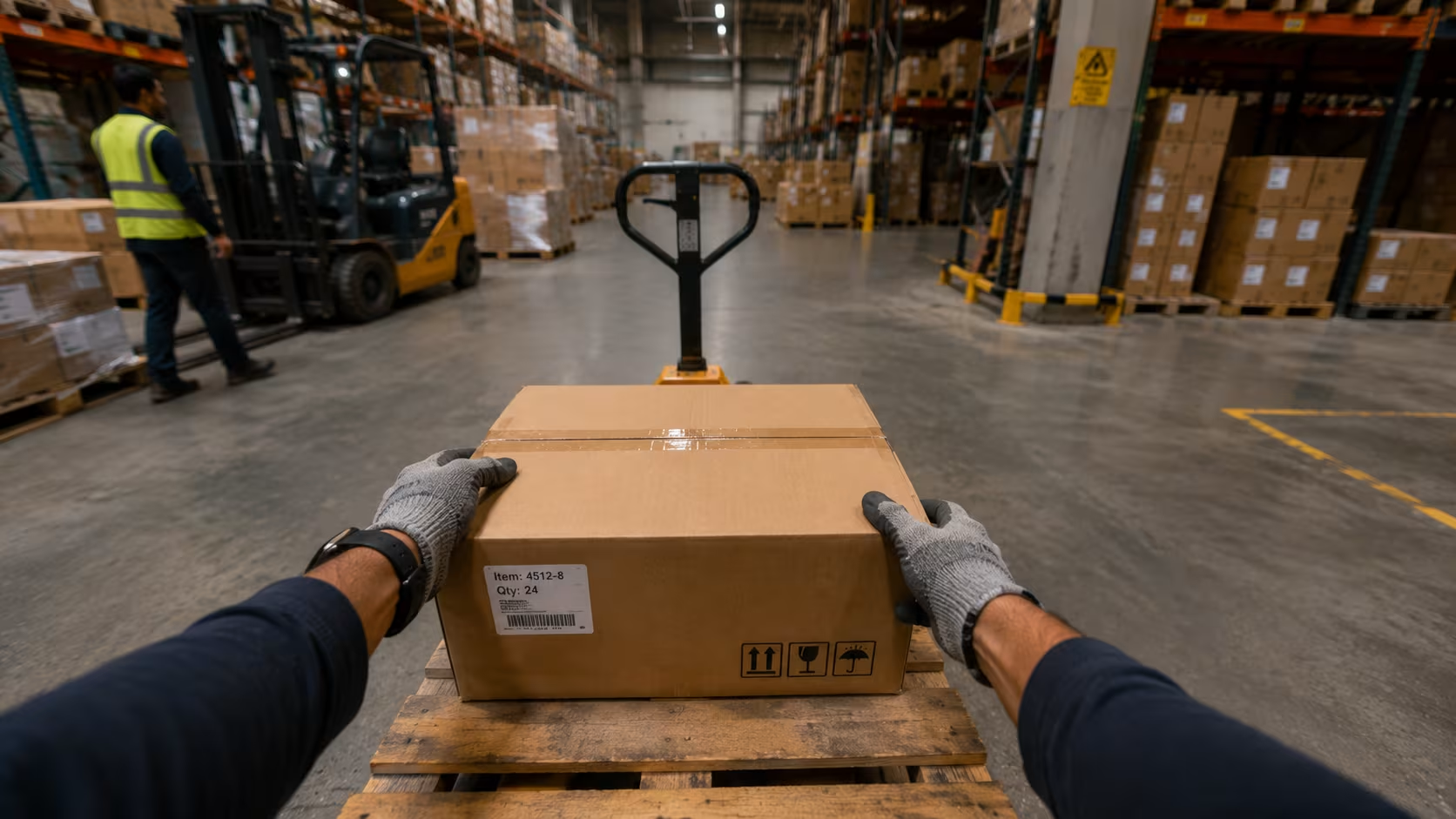
A first-person task demonstration can show the full flow of an activity. Consider a warehouse packing task. A person identifies the correct item, reaches for it, checks its orientation, places it inside a box, adjusts surrounding items, and moves to the next step. A third-person camera may capture the broad action. An egocentric camera can capture the details that matter for robot learning: what the person sees before acting, when the hand enters the frame, how the object is handled, and how the task changes moment by moment.
This is why first-person video datasets for robotics are increasingly relevant to teams working on robot learning from human demonstration. They help models connect visual perception with action sequences, object states, and environmental context.
Why Embodied AI Needs First-Person Context

Embodied AI systems are not designed only to classify or predict. They are designed to perceive, reason, and act within physical or simulated environments. That means they need data that reflects action in context.
For example, a model trained for household robotics may need to understand not only “plate,” “table,” and “hand,” but also what it means to pick up a plate from a cluttered table, avoid nearby objects, carry it across a room, and place it in a sink. A model for workplace automation may need to understand how tools are selected, how items are inspected, or how a task changes when the environment is not arranged perfectly.
Egocentric video helps with this because it captures the relationship between the person, the task, and the environment. The camera does not simply observe the world. It moves through it.
This movement creates valuable learning signals. It shows proximity, attention, object handling, navigation, interruption, adjustment, and task progression. For embodied AI and physical AI training data, these are not minor details. They are central to how models learn the physical world.
Human-Object Interaction Is the Real Data Layer
At the heart of many robotics problems is human-object interaction data.
A robot working in the real world must understand how objects behave when people interact with them. A bottle can be opened, lifted, tilted, dropped, or placed. A cloth can be folded, pulled, spread, or crumpled. A tool can be gripped in different ways depending on the task. A box can be pushed, packed, stacked, or rotated.
Egocentric video captures these interactions at close range. It allows AI teams to study how hands and objects relate to each other during real tasks. The model can learn not only object identity, but also object use, object state, and interaction sequence.
This is especially important for manipulation tasks. A robot that needs to assist in a kitchen, warehouse, hospital, factory, store, or home cannot rely only on clean object labels. It needs to understand how objects are used in practice.
That is why egocentric video is valuable not just as visual footage, but as task-level training data.
What Makes Egocentric Robotics Data Useful
Not every first-person video is useful for robotics. A large dataset can still be weak if the footage is poorly framed, the task instructions are unclear, or the metadata is missing.
For egocentric video to support robotics and embodied AI, it must be collected with structure. The task must be defined clearly. The participant must understand what needs to be captured. The camera setup must allow hands, objects, and task flow to remain visible. The environment must reflect the use case. The data must be reviewed for quality before delivery.
A good egocentric video dataset should answer practical questions: What task is being performed? What objects are involved? What environment is this happening in? Was the task completed? Is the footage usable? Are the hands and objects visible? Does the video contain sensitive information? Can this be annotated later?
This is where metadata becomes important. Without metadata, teams may have hundreds of hours of footage but limited ability to search, filter, segment, or evaluate it. With metadata, the same footage becomes more useful for training, testing, benchmarking, and error analysis.
The Annotation Layer: Making Action Learnable
Egocentric video collection is only one part of the data pipeline. For many robotics and embodied AI use cases, annotation is what turns video into structured training data.
A task such as “making coffee” or “packing an item” may need to be broken into action segments. The model may need labels for object interaction, hand movement, task stages, timestamps, success states, object state changes, or tool use. In some cases, teams may also need bounding boxes, segmentation, gesture labels, transcription, or narration aligned to the video.
This matters because robots do not learn from footage in a human way. They need structure.
Annotation helps connect visual action with machine-readable labels. It makes it possible to identify where a task begins, where it changes, which objects matter, and what action is being performed at each stage.
For robotics teams, the strongest egocentric datasets are not just recorded. They are designed for downstream annotation and model use from the beginning.
Privacy and Consent Are Part of Dataset Quality
Egocentric video data can be sensitive because it captures the real world from a person’s perspective. Depending on the capture environment, it may include faces, homes, screens, documents, voices, personal objects, location cues, or workplace information.
For enterprise AI teams, privacy and consent cannot be treated as an afterthought. They need to be part of the data collection workflow.
This means participants should know what is being captured and why. Capture boundaries should be clear. Footage should be reviewed for personally identifiable information. Sensitive details may need to be blurred, excluded, or redacted. Access should be controlled, and data transfer should follow secure processes.
A privacy-aware workflow does not reduce the value of egocentric video data. It makes the dataset more usable for serious AI teams.
IndiVillage’s Approach to Egocentric Video Data for Robotics
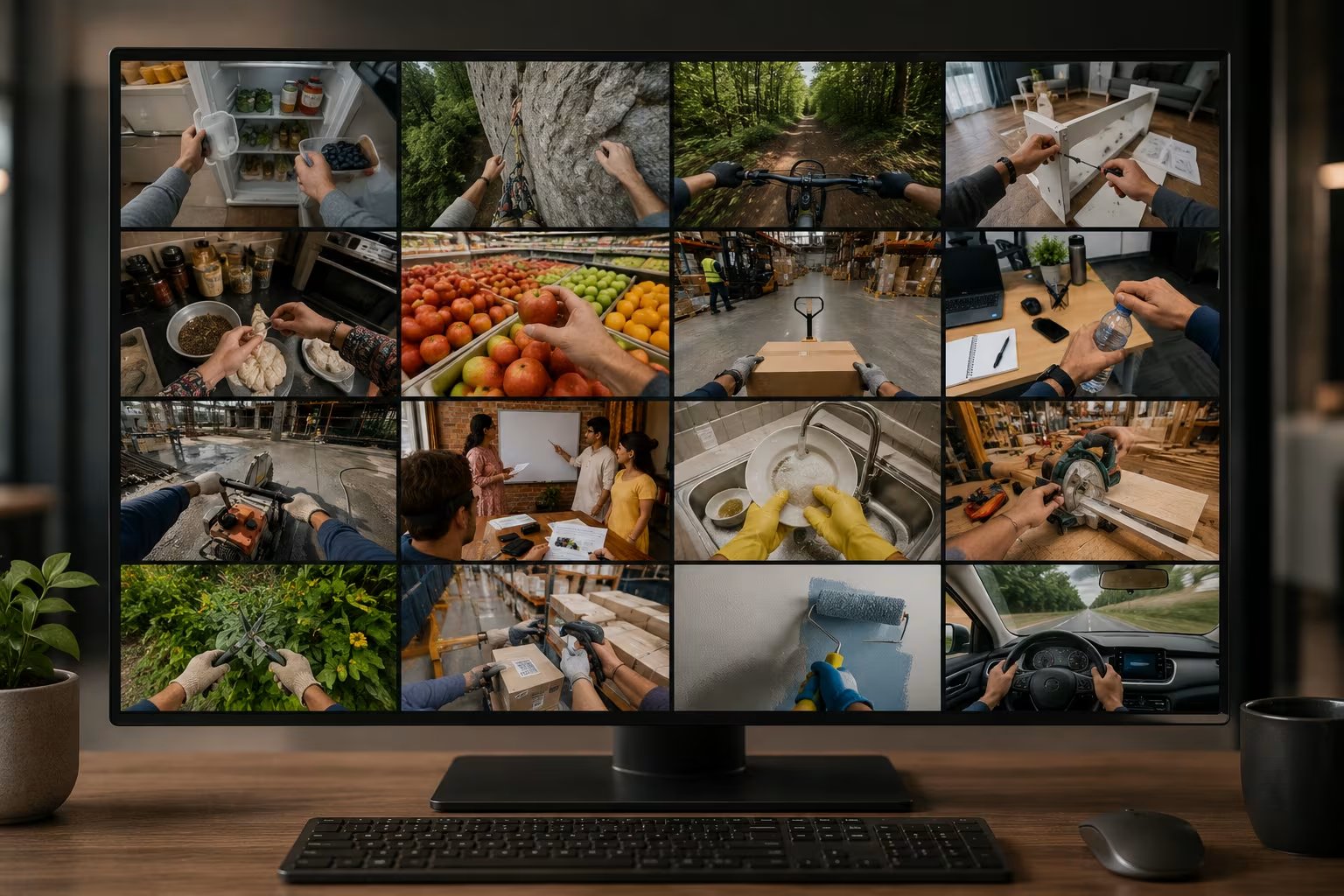
IndiVillage Tech supports AI teams with structured egocentric video data collection for robotics, embodied AI, AR/VR, human activity understanding, and physical AI systems.
Our focus is not only on collecting first-person video. It is on building data workflows that are clear, usable, and aligned to model requirements. That includes capture planning, participant coordination, task-based recording, metadata-ready delivery, privacy-aware review, human-in-the-loop QA, and optional downstream annotation.
For robotics teams, this operational layer matters. The challenge is rarely just “Can we capture video?” The real challenge is whether the footage is consistent, relevant, permissioned, reviewable, and ready to support model development.
IndiVillage also maintains an in-house repository of 1,000+ hours of egocentric video footage, which can be shared as a gated sample asset with qualified prospects. This gives AI teams a way to evaluate first-person capture quality, task diversity, and dataset possibilities before planning a larger engagement.
Conclusion
Robotics and embodied AI need data that reflects the physical world as people actually experience it.
Egocentric video helps provide that perspective. It captures hands, objects, movement, task flow, and environmental context from the viewpoint of the person performing the action. For robots learning to manipulate, navigate, observe, and respond, this kind of data can be far more useful than distant or static visual footage.
But egocentric video is only valuable when it is collected well.
The strongest datasets are structured around real tasks, clear capture protocols, metadata, privacy safeguards, QA, and annotation readiness. They show not only what happened, but how action unfolded.
For AI teams building systems that must operate beyond controlled environments, egocentric video data is becoming a critical part of the training data stack.
It helps machines learn not just what the world looks like, but how humans move through it.