IndiVillage Logo

Robotics & Physical AI

Data for Dexterous Manipulation and Robot Learning

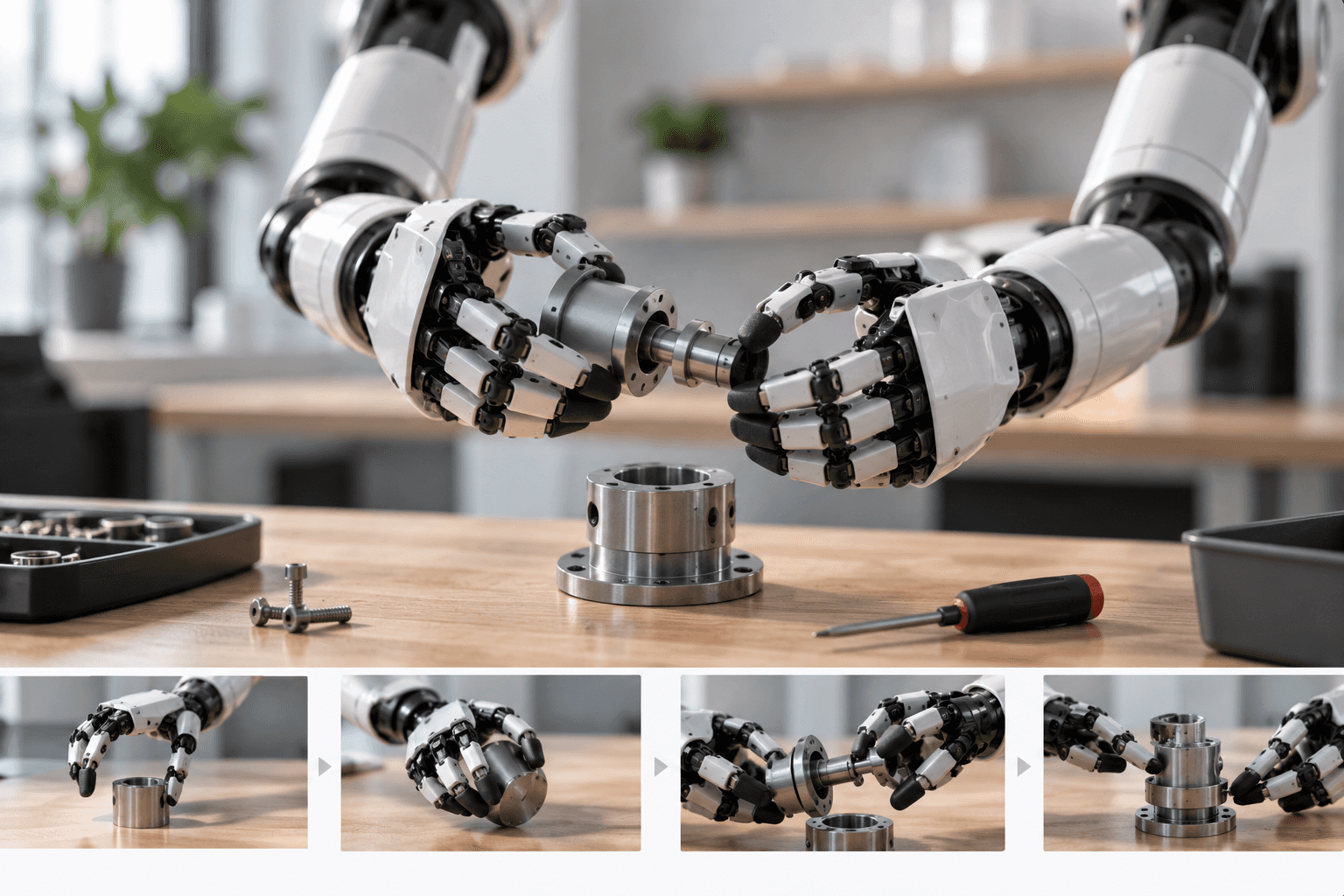
Teaching robots to manipulate the physical world requires more than showing them where an object is. Models need to understand how objects are approached, grasped, adjusted, used, transferred, and released as a task unfolds.

IndiVillage helps robotics and Physical AI teams build structured data for dexterous manipulation through human demonstrations, hand-object interaction capture, fine-motor task data, annotation, and human-in-the-loop quality review.

From everyday object handling to complex multi-step actions, we help turn physical interaction into data that is easier to train, evaluate, and scale.

Data for Dexterous Manipulation and Robot Learning
Dexterity Begins With the Details Between Perception and Action

Dexterity Begins With the Details Between Perception and Action

Picking up an object is only the beginning of manipulation.

A robot may need to rotate a component before inserting it, change its grip when an object begins to slip, coordinate both hands while folding a material, or use one object as a tool to act on another.

These tasks depend on the relationship between hands, objects, actions, and changing object states over time.

For model-development teams, the challenge is capturing those relationships with enough diversity and structure to support learning beyond a single clean demonstration.

IndiVillage builds data workflows around the task itself, preserving how interactions unfold rather than treating manipulation as a collection of disconnected frames.

Human Demonstration Data for Dexterous Manipulation

Human Demonstration Data for Dexterous Manipulation

Human demonstrations provide a rich source of information about how physical tasks are actually performed.

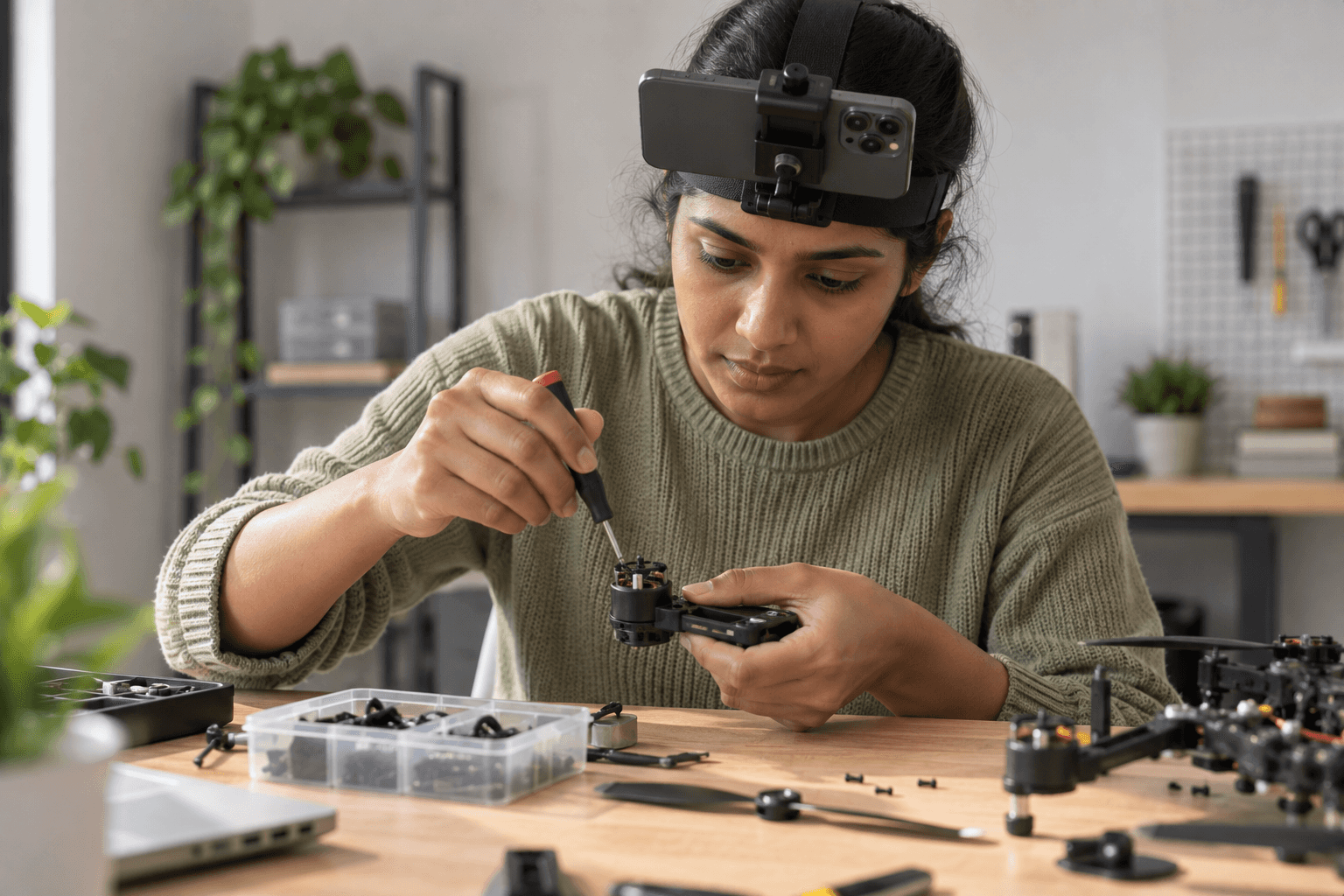
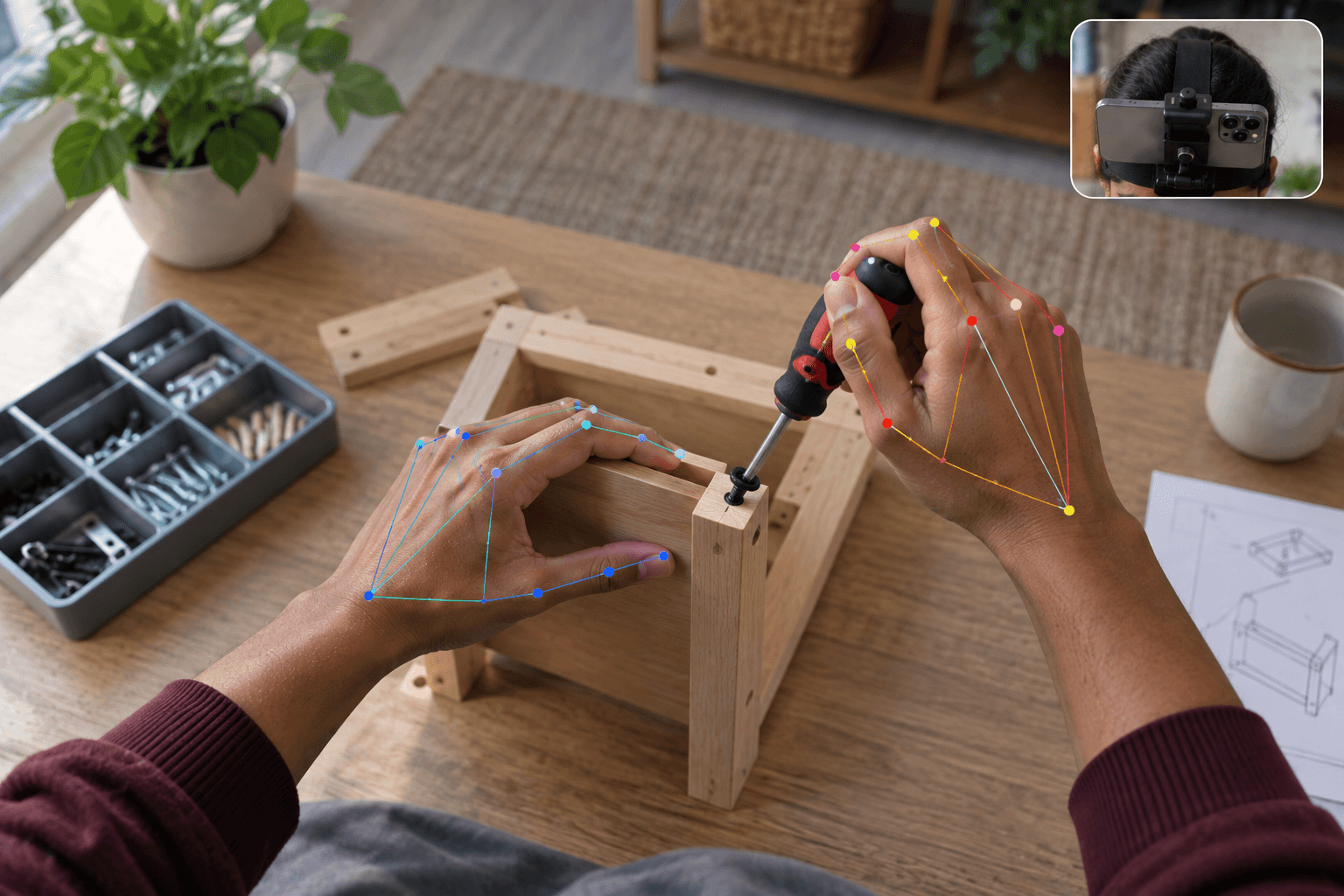
Through first-person and task-based video capture, manipulation data can preserve hand movement, object handling, task sequence, viewpoint changes, corrections, and environmental context as they occur.

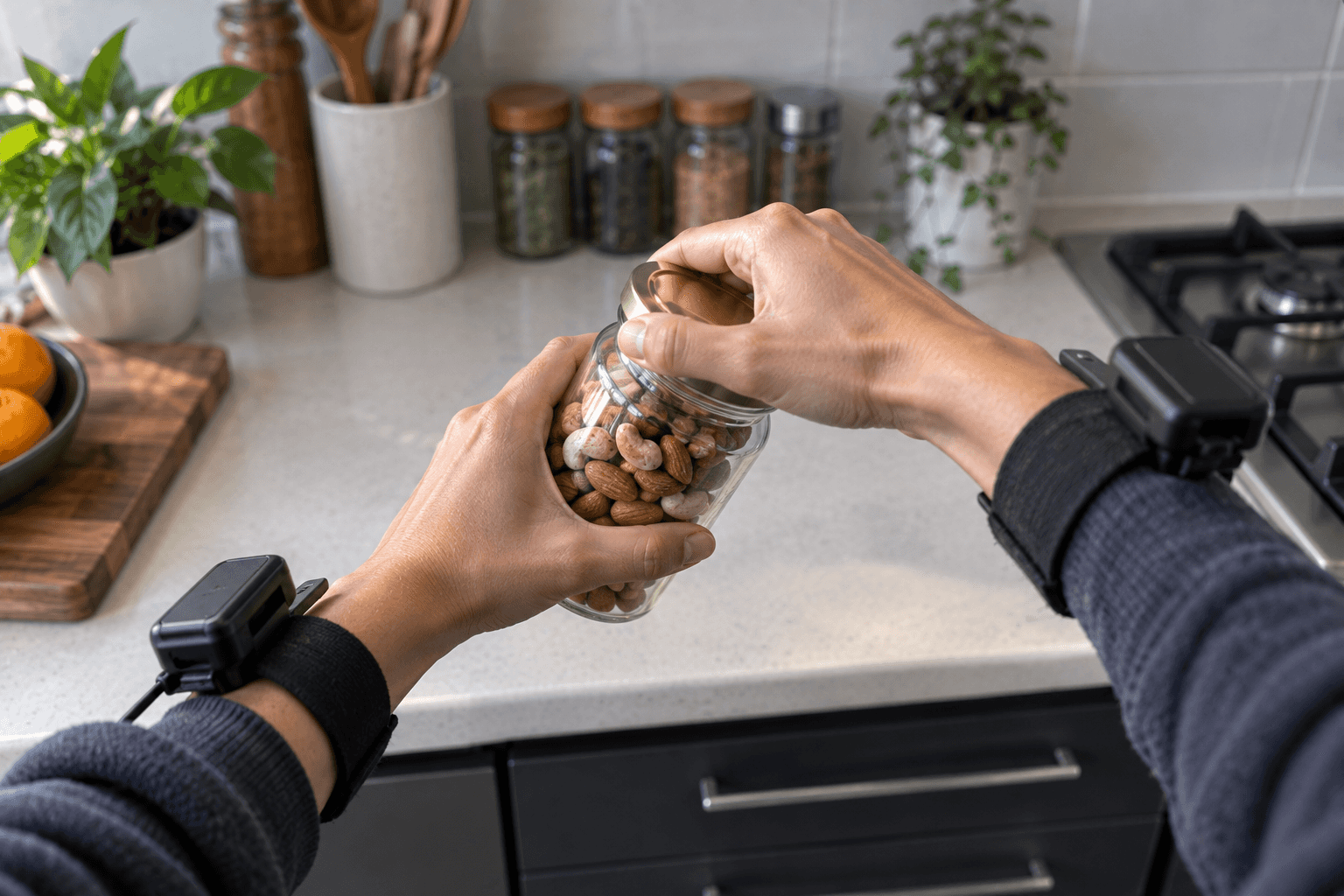
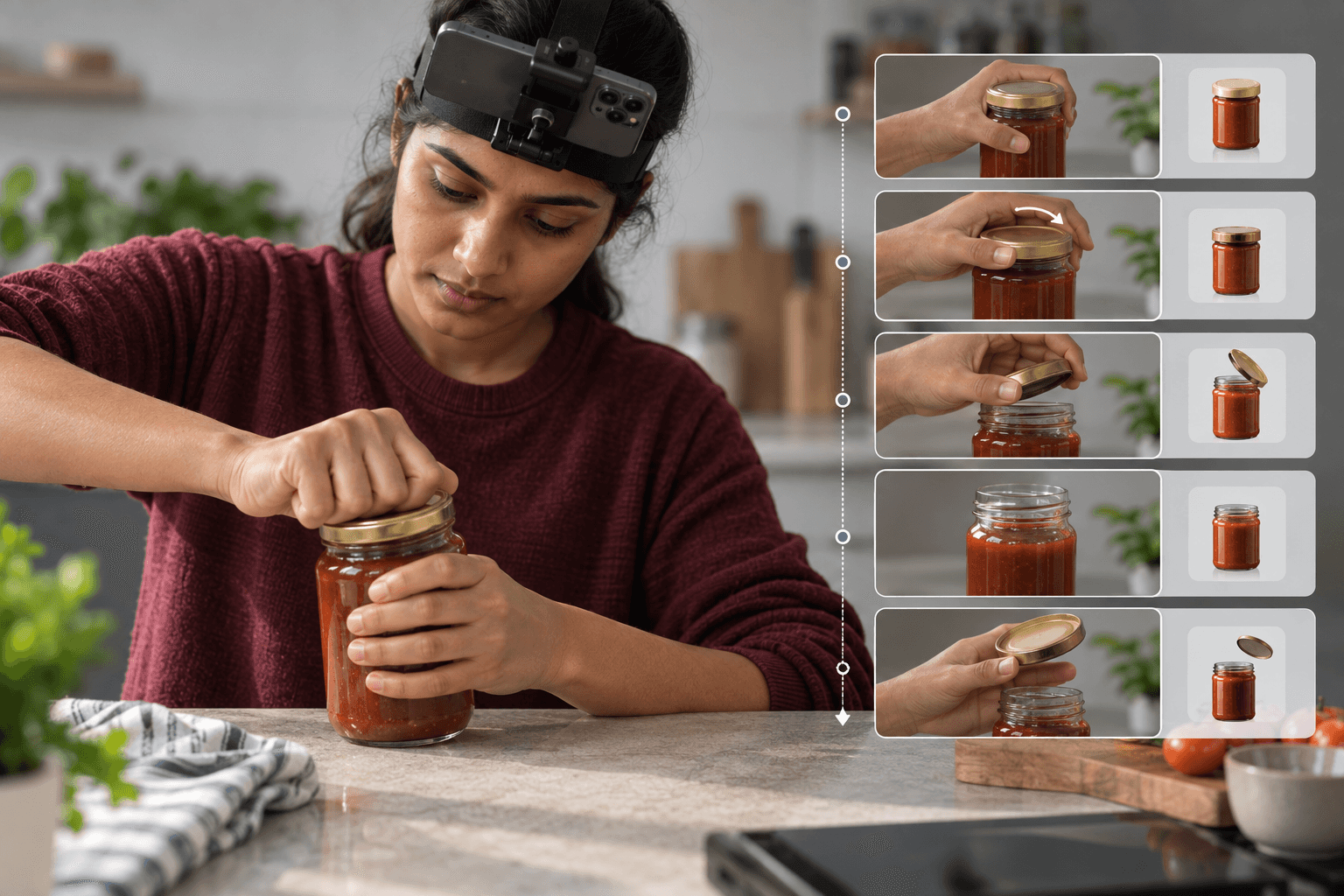
A demonstration of opening a container, for example, may show the initial grasp, hand repositioning, counter-force from the second hand, rotation, changes in object state, and completion of the task.

Those intermediate actions are often as important as the final outcome.

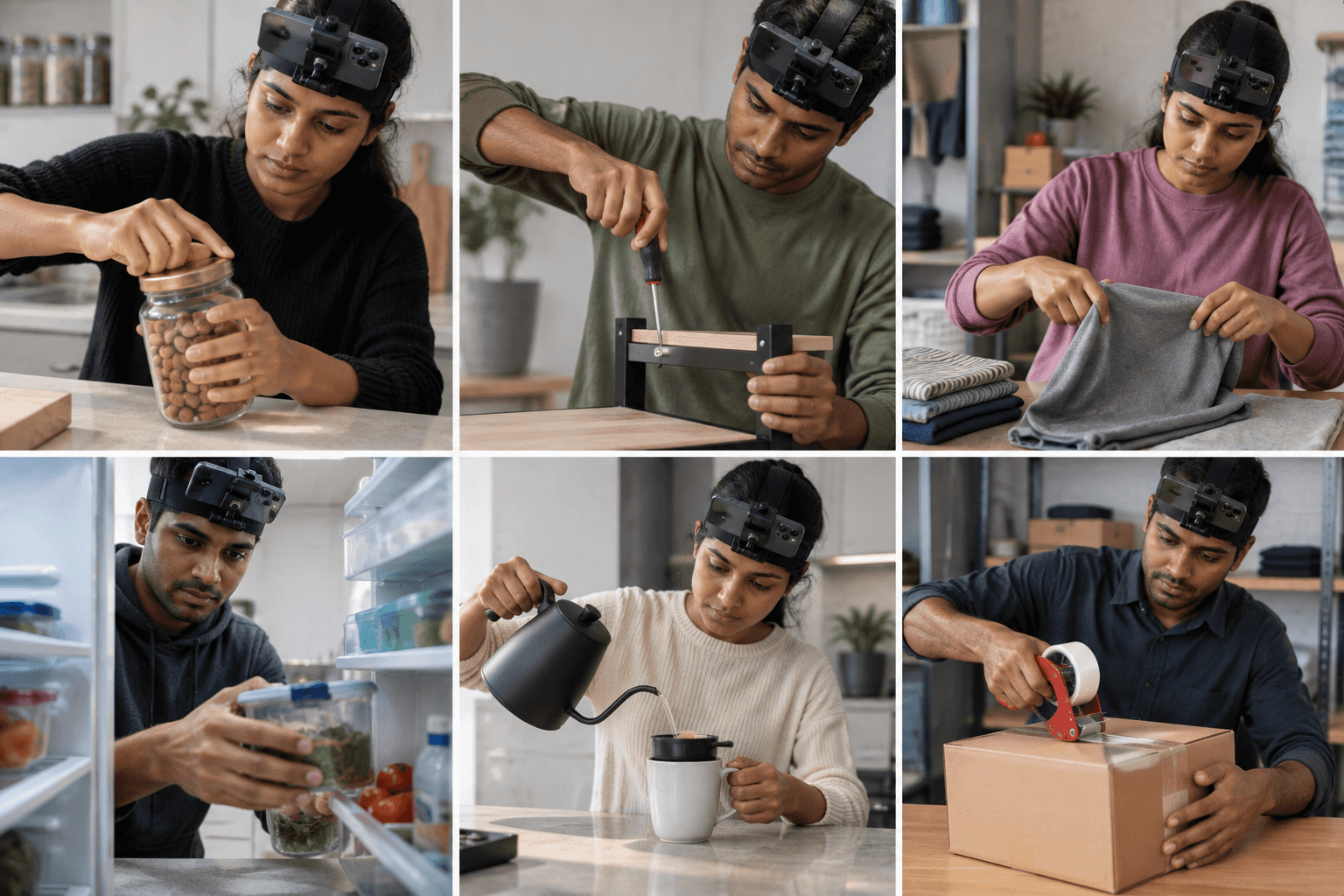
IndiVillage's existing egocentric video data collection workflows support human-object interaction, fine-motor activity, multi-step tasks, and first-person demonstrations for robotics and Physical AI.

Capture Fine-Motor Actions, Not Just Task Completion

Capture Fine-Motor Actions, Not Just Task Completion

Dexterous behavior often happens through small adjustments.

Finger placement changes. Grip orientation shifts. One hand stabilizes while the other acts. Objects are repositioned before the intended action can continue.

A dataset designed only around "task started" and "task completed" loses much of this information.

We structure capture programs around the behaviors a model needs to observe, with recording protocols designed to preserve visibility of the hands, relevant objects, task progression, and interaction context.

This makes the data more useful for teams developing imitation learning, manipulation understanding, action recognition, and Vision-Language-Action systems.

Manipulation Tasks Across Real-World Complexity

Manipulation Tasks Across Real-World Complexity

Useful dexterous manipulation data needs variation within the task, not only more repetitions of the same ideal example.

A grasp can change with object size, weight, material, orientation, placement, and accessibility. Flexible or articulated objects behave differently from rigid ones. Clutter introduces occlusion. Two-handed tasks create dependencies between actions. Small variations in the environment can change the sequence required to complete the same objective.

For this reason, data collection can be designed across different objects, participants, task configurations, environments, and execution styles while preserving a consistent task definition.

The goal is not variability for its own sake. It is to expose models to the range of interactions they may need to interpret or reproduce outside controlled demonstrations.

Bimanual and Coordinated Hand-Object Interaction

Bimanual and Coordinated Hand-Object Interaction

Many real-world tasks cannot be reduced to one hand performing one action.

Opening packaging, assembling components, folding material, preparing food, handling tools, and transferring objects often require both hands to play different roles at the same time.

One hand may stabilize while the other manipulates. Both may move together. Their roles may reverse as the task progresses.

Bimanual data should therefore preserve the relationship between the two hands and the objects they interact with, rather than labeling each movement independently.

For robotics teams, this can provide richer supervision for models that need to reason about coordinated manipulation and multi-step physical tasks.

From Raw Demonstrations to Structured Robot Learning Data

From Raw Demonstrations to Structured Robot Learning Data

Video alone does not always provide the structure required by downstream robotics models.

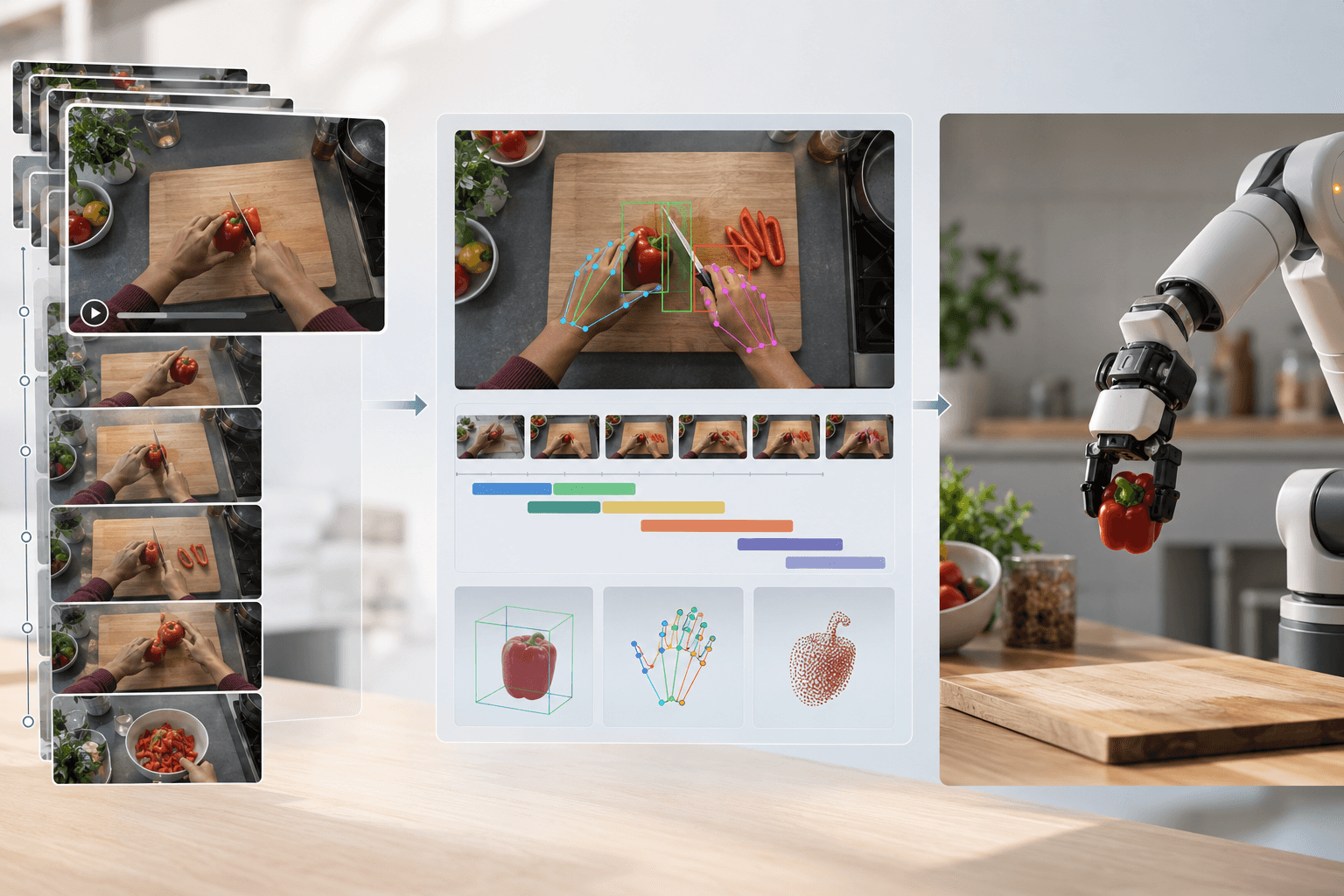
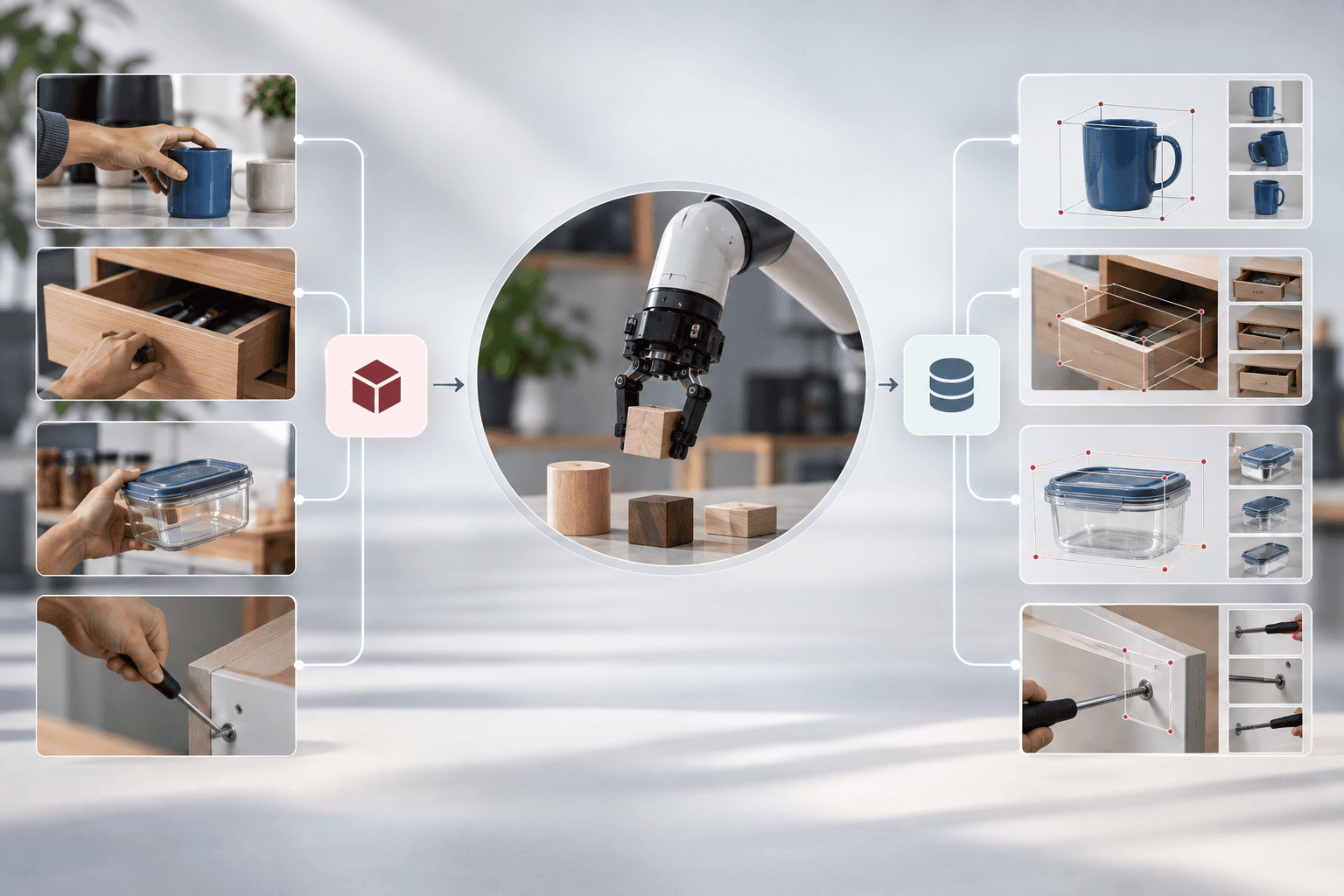
IndiVillage can add an annotation and metadata layer that makes manipulation episodes easier to search, train on, compare, and evaluate.

A multi-step task can be segmented into meaningful actions such as reach, grasp, lift, rotate, place, insert, open, close, hand over, or release. Object states can be linked to those actions, and important moments such as failed attempts, corrections, or task completion can be marked consistently.

Depending on the model requirement, workflows can also incorporate hand and object localization, keypoints, temporal boundaries, interaction labels, task-stage labels, and outcome metadata.

This creates a clearer connection between what happened in the demonstration and the learning signal the model needs.

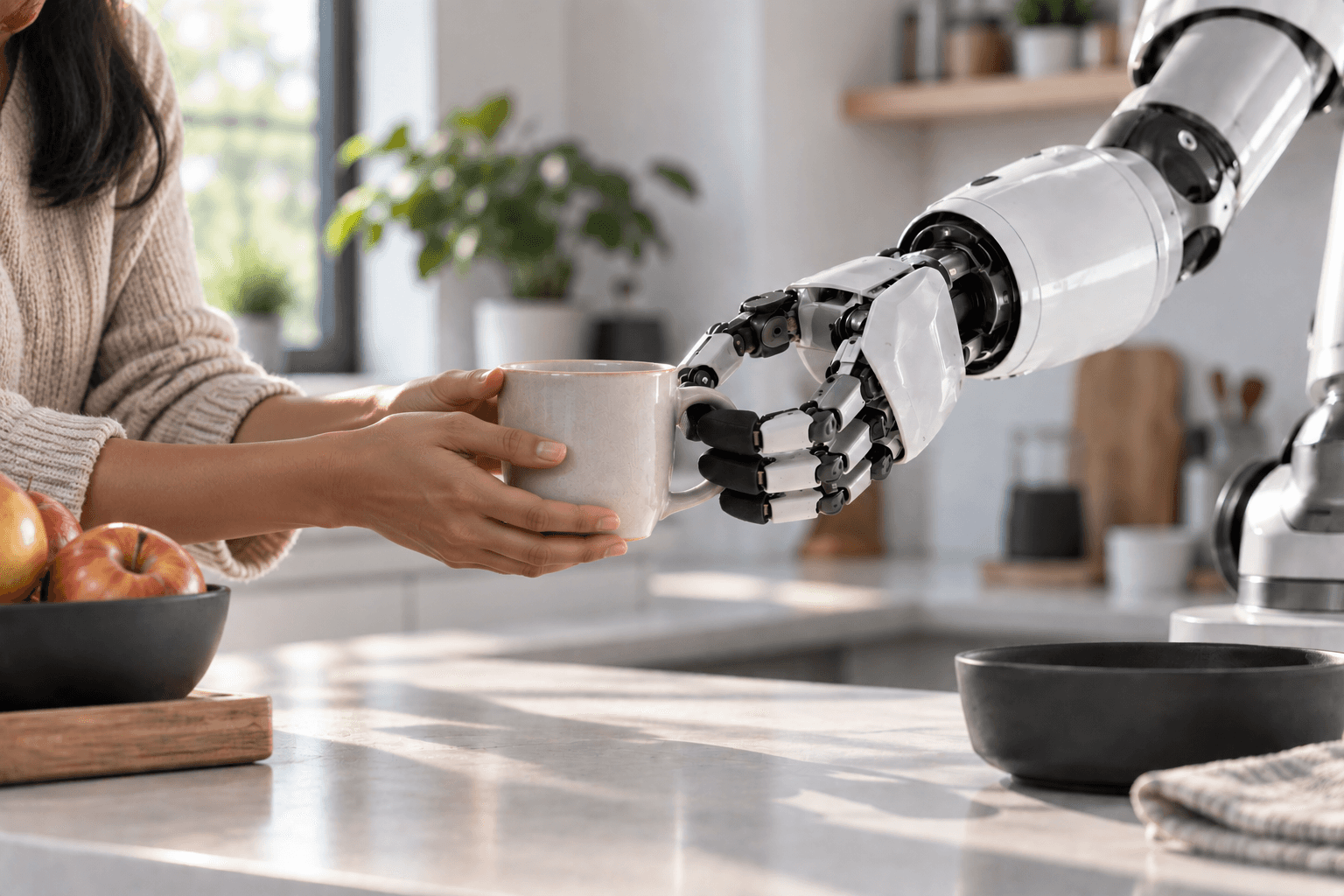
Object State Matters as Much as Object Identity

Object State Matters as Much as Object Identity

A robot does not only need to recognize an object. It often needs to understand what has happened to it.

A lid can be closed, partially loosened, or removed. A cloth can be folded, unfolded, stretched, or crumpled. A switch can move from off to on. A tool may be unused, engaged, or released.

Tracking these changes can make manipulation datasets more informative because actions can be connected to their physical consequences.

For long-horizon tasks, object-state annotation also helps reveal whether an action actually moved the task closer to completion.

Successful Demonstrations Are Not the Only Useful Data

Successful Demonstrations Are Not the Only Useful Data

Failure is part of physical interaction.

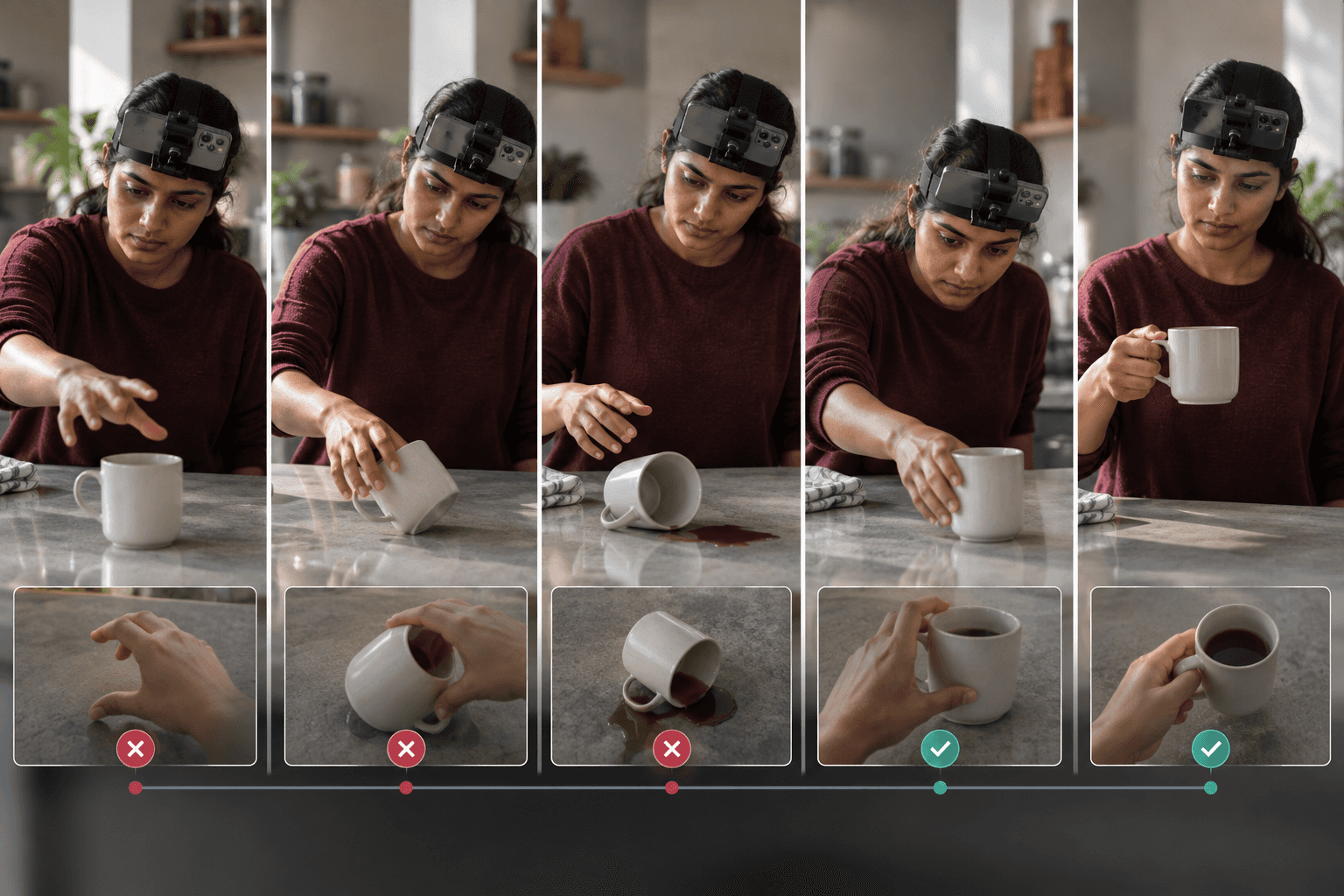
A person may miss a grasp, select an unstable hold, drop an object, approach from the wrong angle, or correct an action halfway through.

For robot learning and evaluation, these moments can contain valuable information about the boundary between successful and unsuccessful execution.

Instead of automatically excluding every imperfect demonstration, projects can define which failures, retries, and recovery behaviors should be retained and how they should be labeled.

A structured dataset can distinguish successful episodes from partial completions, failed attempts, recoveries, and protocol deviations, giving model teams more context for training and error analysis.

Quality Review for Manipulation Data

Quality Review for Manipulation Data

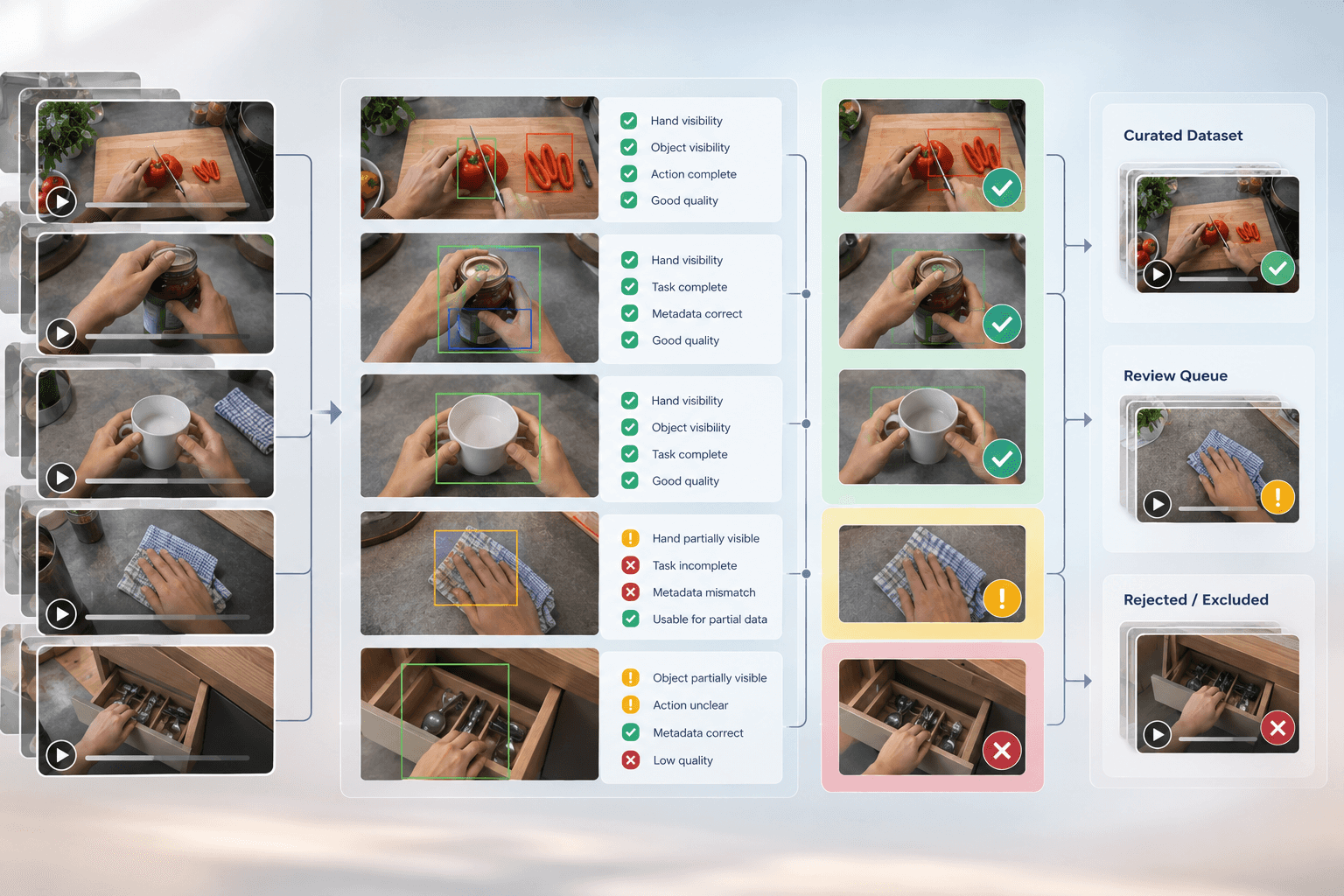
A large manipulation dataset has limited value if the action is difficult to see, the task is incomplete, or metadata does not match what actually occurred.

Our quality workflows review demonstrations against the agreed capture and task specification. This can include checking hand-object visibility, task completion, recording continuity, protocol adherence, metadata accuracy, and the usability of the episode for downstream work.

When ambiguous situations recur, they are documented rather than resolved differently by each reviewer.

That feedback loop becomes particularly important when collection scales across more participants, environments, and task variants.

Working With Teleoperation and Robot-Generated Episodes

Working With Teleoperation and Robot-Generated Episodes

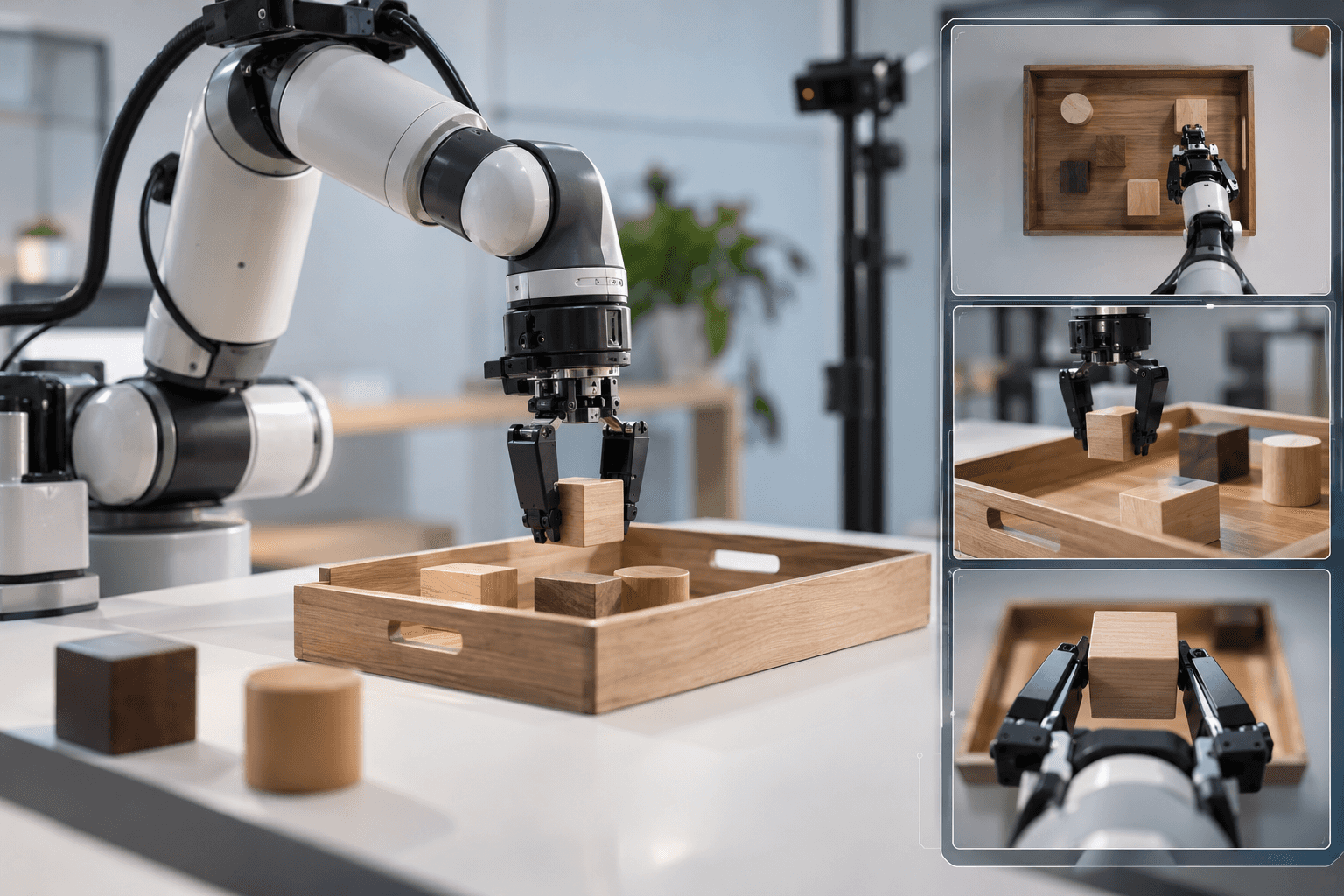
Many robotics teams already collect demonstrations directly through teleoperated robot arms, grippers, or dexterous hands.

Where those datasets are supplied by the client, IndiVillage can support the human data operations around them through episode review, task and outcome labeling, temporal annotation, failure classification, quality checks, and structured metadata workflows.

This allows the client to retain control of its robot hardware, sensors, and teleoperation stack while IndiVillage helps manage the labor-intensive review and data-quality layer around the resulting demonstrations.

Where synchronized camera or sensor data is part of the supplied dataset, the review framework can be aligned to the available modalities and project requirements.

Data for Vision-Language-Action Models

Data for Vision-Language-Action Models

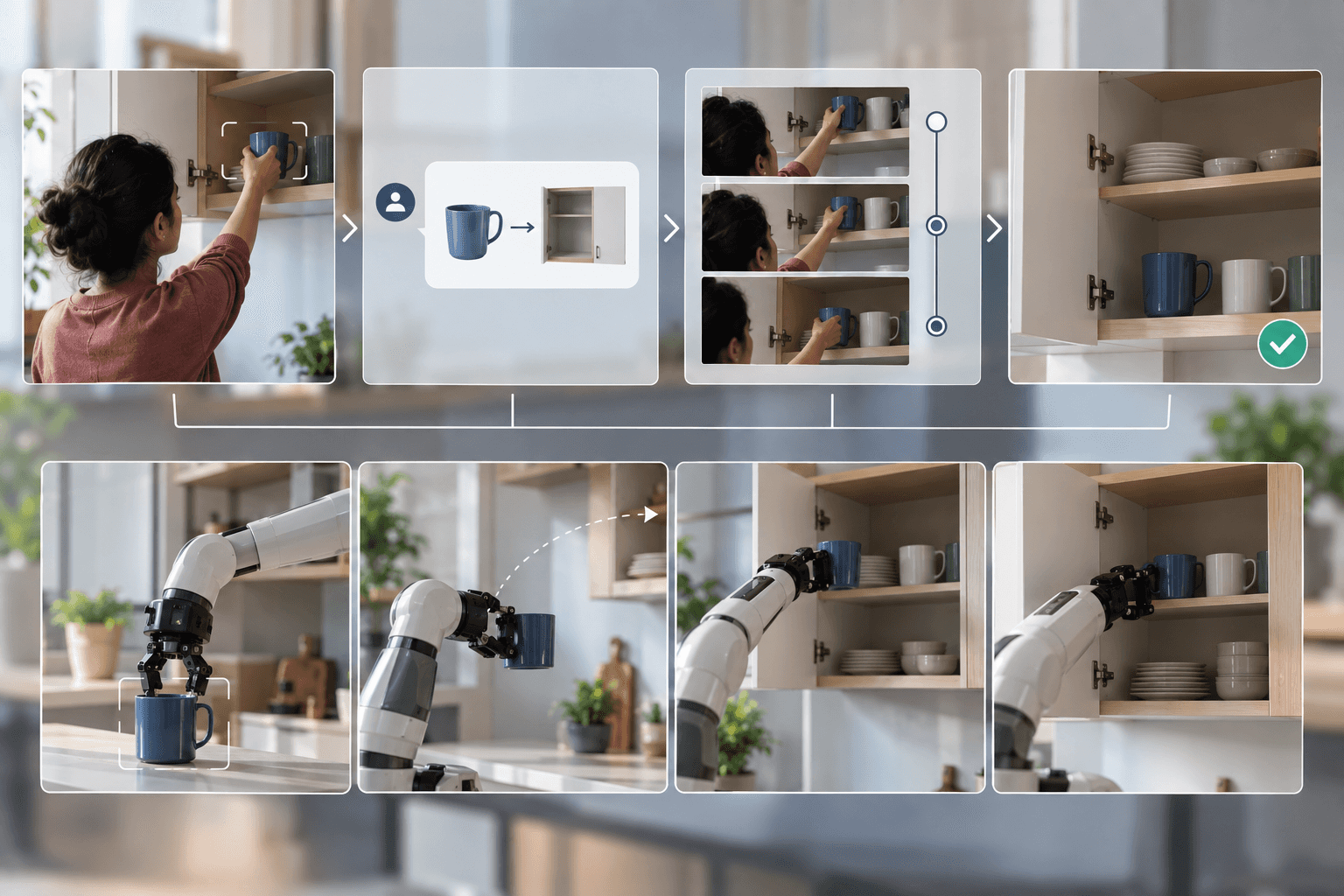
Vision-Language-Action (VLA) models connect what a system sees, what it is asked to do, and the actions it takes in response.

For manipulation tasks, this creates a need for datasets where physical actions remain connected to task intent.

A recording of a person "placing the blue cup inside the upper cabinet" becomes more useful when the instruction, visual context, action sequence, relevant objects, and completion state can be understood together.

Human demonstrations can therefore support more than motion learning. They can help build the connection between language, perception, and action required by emerging general-purpose robotic systems.

Designed Around Your Robot Learning Objective

Designed Around Your Robot Learning Objective

There is no single dexterous manipulation dataset that fits every robotics program.

A model learning grasp selection may need short, object-focused interactions. An imitation learning program may need complete task demonstrations. A VLA model may require task instructions aligned with actions. A manipulation benchmark may need success labels and carefully controlled variations.

We begin with the intended model behavior and work backward into the data specification.

That determines what should be captured, what variation matters, what metadata is required, how an episode should be annotated, and what makes the data acceptable for delivery.

A Structured Workflow From Task Design to Delivery

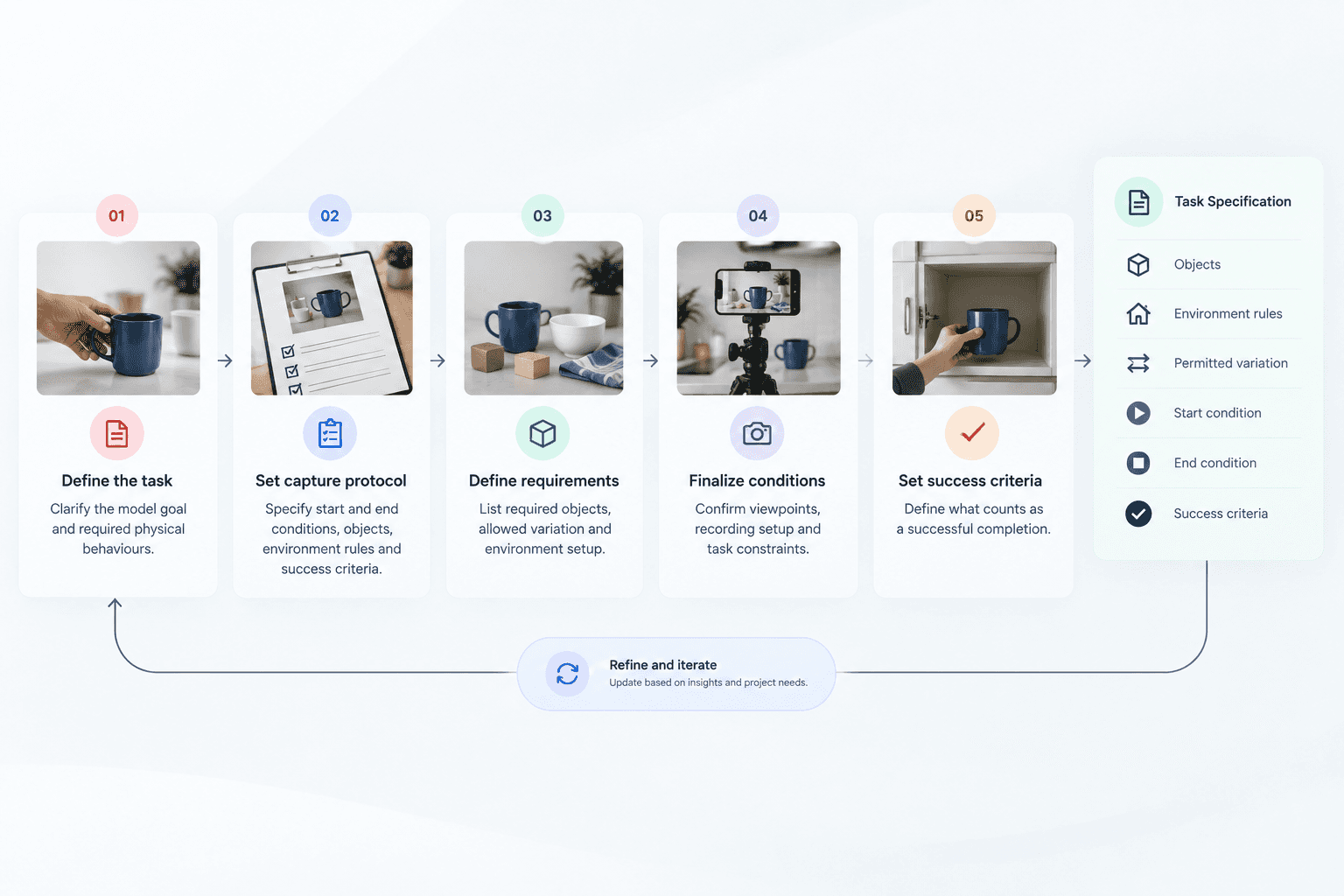
Define the Manipulation Task

01

Define the Manipulation Task

The first step is clarifying what the model needs to learn and which physical behaviors the dataset should represent. Tasks are translated into capture protocols with clear start and end conditions, object requirements, environment rules, permitted variation, and success criteria.

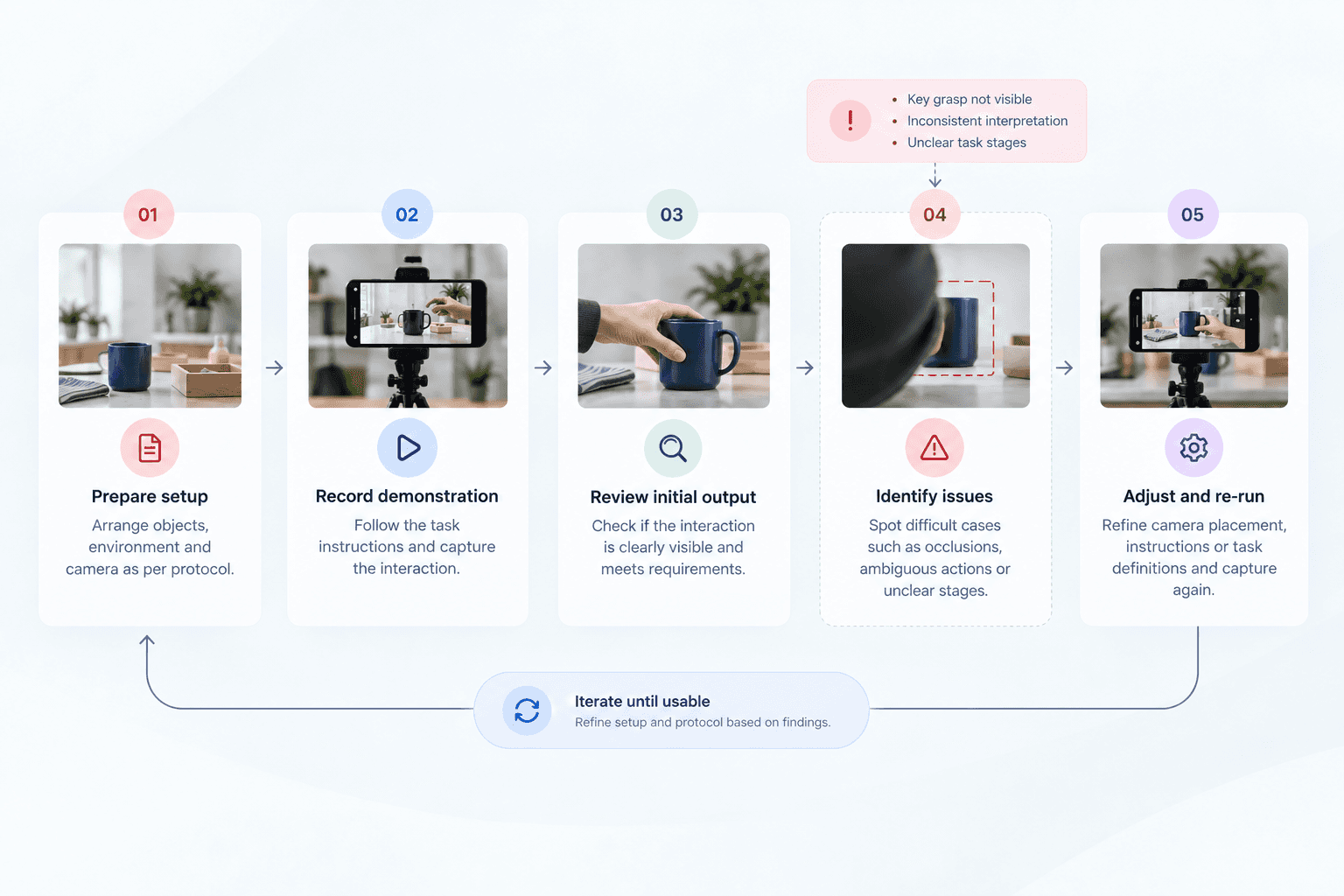
Run Representative Demonstrations

02

Run Representative Demonstrations

Initial sessions are used to test whether the required interaction is visible and whether the protocol produces usable data. Difficult cases often become apparent here. Camera placement may hide a key grasp, an instruction may produce inconsistent interpretations, or task stages may need clearer definitions before collection scales.

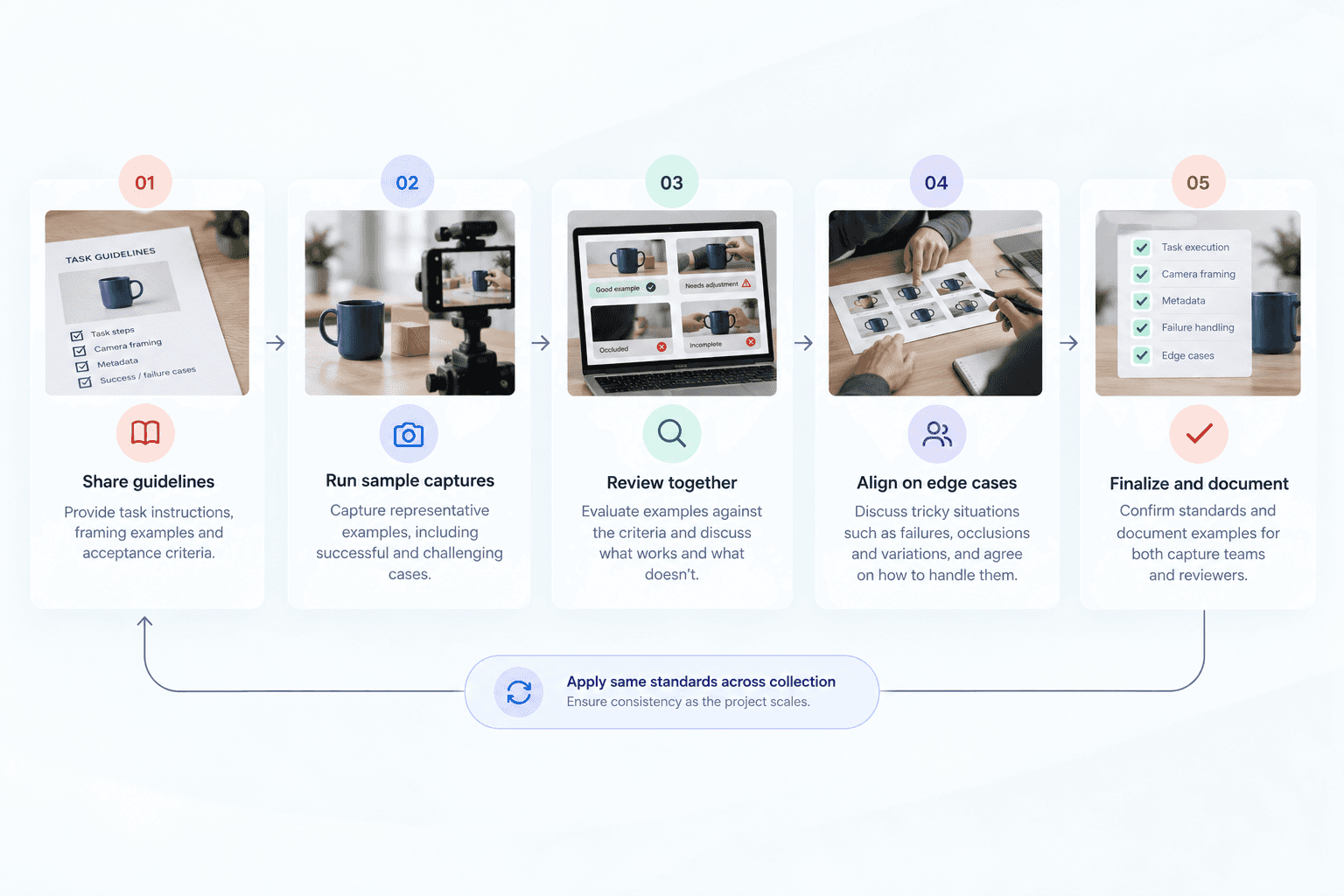
Calibrate Capture and Review Teams

03

Calibrate Capture and Review Teams

Representative examples establish what an acceptable demonstration looks like. Capture teams and reviewers are aligned on task execution, framing, metadata, failure handling, and edge cases so the same standards can be applied across later sessions.

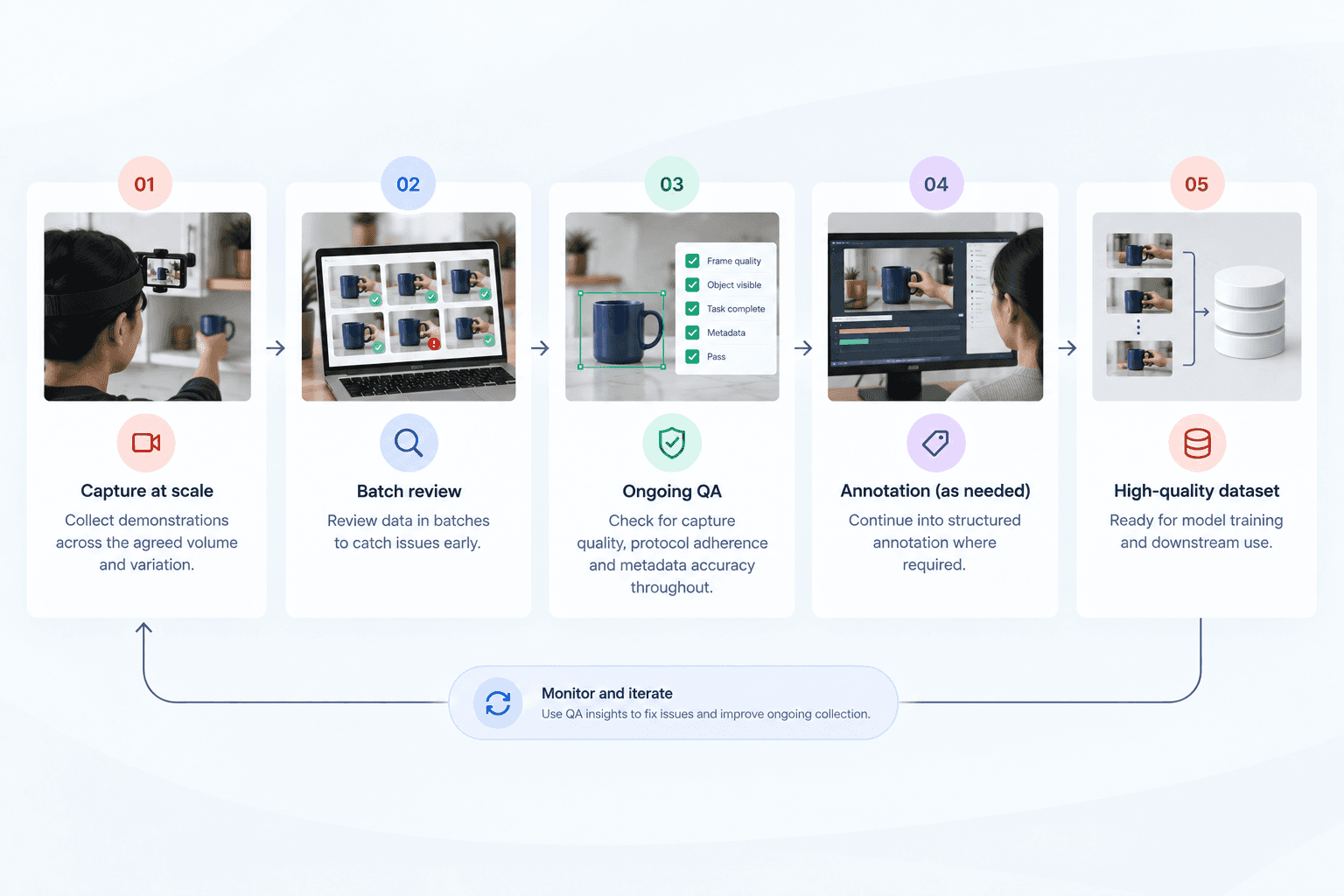
Scale Collection With Ongoing QA

04

Scale Collection With Ongoing QA

Production can then expand across the agreed volume and variation. Data is reviewed in batches so capture problems can be identified early rather than discovered after an entire collection is complete. The same process can continue into downstream annotation where structured labels are required.

Real-World Manipulation Data Across Task Environments

Real-World Manipulation Data Across Task Environments

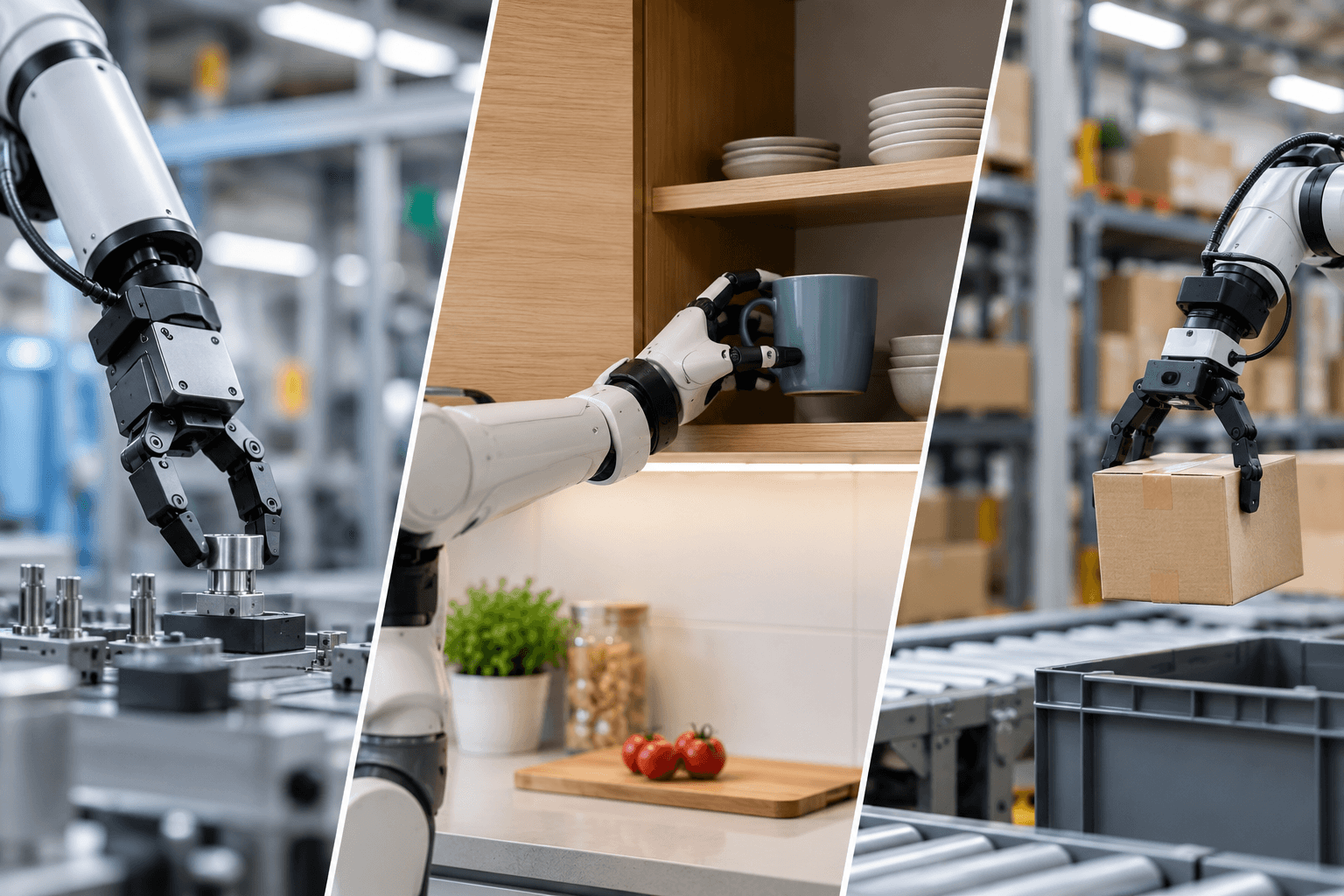
Dexterous manipulation is relevant wherever robots need to physically interact with everyday objects rather than operate only within fixed automation.

In industrial environments, tasks may involve assembly, sorting, component handling, insertion, or tool interaction.

Home and service robotics may need to understand opening, folding, cleaning, food preparation, storage, and other multi-stage activities.

Warehousing and retail introduce picking, packing, repositioning, handling varied packaging, and interactions in cluttered environments.

The underlying data problem remains similar: the model needs examples that preserve how the object is manipulated, how its state changes, and what successful completion looks like.

Why Robotics Teams Work With IndiVillage

Data designed around the physical task

We translate manipulation goals into structured capture, annotation, and review workflows instead of treating robotics data as generic video.

Human-object interaction expertise

Our first-person data programs already support fine-motor actions, task demonstrations, object handling, and manipulation-focused AI use cases.

Human-in-the-loop quality control

Capture and annotation are reviewed against defined protocols, with recurring edge cases converted into clearer guidance.

Flexible delivery around your stack

We can support client-defined tools, taxonomies, metadata structures, and supplied robot datasets where operationally feasible.

Scale through managed teams

Structured onboarding, calibration, batch review, and dedicated QA help programs expand without allowing collection standards to drift.

Secure AI data operations

IndiVillage supports production AI programs through controlled, in-house delivery environments and established enterprise data practices.

Build Manipulation Data Around the Skills Your Robot Needs to Learn

Build Manipulation Data Around the Skills Your Robot Needs to Learn

Whether you are developing dexterous hands, robotic arms, humanoids, imitation learning systems, or Vision-Language-Action models, the right dataset begins with the physical behavior you need the model to understand.

Share your target task, embodiment, sample data, or current data bottleneck. We can help map the capture, annotation, and quality workflow required for a pilot.

Frequently Asked Questions

Quick answers to help you make smarter, faster decisions with confidence

What is dexterous manipulation in robotics?+

Dexterous manipulation refers to a robot's ability to interact with objects through coordinated, precise actions such as grasping, reorienting, inserting, rotating, opening, tool use, or bimanual handling. The task typically requires more detailed physical interaction than simple pick-and-place behavior.

What data is used to train dexterous manipulation models?+

Training data can include human task demonstrations, first-person video, robot teleoperation episodes, hand-object interaction data, action sequences, object states, success and failure labels, and other synchronized observations available within the client's robotics stack. The appropriate data depends on the policy, robot embodiment, and task being learned.

Why are human demonstrations useful for robot manipulation?+

Human demonstrations show how physical tasks unfold in real environments. They can capture grasp choices, hand repositioning, task sequence, object-state changes, corrections, and other interaction patterns that are difficult to represent through static visual datasets alone.

What is the role of egocentric video in dexterous manipulation?+

Egocentric video records a task from the actor's perspective, keeping hands, relevant objects, viewpoint changes, and interaction context close to the action. This can make it useful for imitation learning, manipulation understanding, human-object interaction modeling, and VLA training.

Can IndiVillage collect fine-motor and bimanual demonstration data?+

IndiVillage's existing egocentric data workflows support fine-motor, multi-step, and human-object interaction capture. Project-specific requirements such as bimanual tasks, object variation, recording setup, and metadata can be defined during scoping.

Can you work with teleoperation data we already collect?+

Yes. Where teleoperated robot episodes are provided by the client, IndiVillage can scope review and annotation workflows around the supplied data, including task segmentation, outcome labeling, failure classification, metadata checks, and human QA.

Can manipulation data include failed attempts?+

Yes. Depending on the training or evaluation objective, failed attempts, retries, partial completion, and recovery behavior can be retained and labeled separately from successful demonstrations. The inclusion criteria should be defined before production.

How is manipulation data annotated?+

Annotation depends on the model requirement. It can include temporal action segments, task stages, object states, hand-object interactions, success labels, keypoints, object localization, and other project-specific metadata. Not every project requires every annotation layer.

How do you maintain quality across a large data collection program?+

The workflow begins with defined task protocols and representative pilot sessions. Capture and review teams are then calibrated against accepted examples. Batch-level QA, metadata checks, protocol review, and documented edge-case decisions help maintain consistency as collection scales.

Can the data support Vision-Language-Action models?+

Yes. Human demonstration datasets can be structured to preserve task instructions, visual context, object interactions, action sequences, and completion states, providing useful inputs for VLA and other robotics models that connect language, perception, and physical action.

Talk to us

Tell us about your AI data requirements and our team will help map the right workflow.

Loading form...