



IndiVillage Logo

Case Study

Keypoint Annotation for AI-Powered Laser Weeding

A leading agri-tech company is building AI-powered laser-weeding systems that can identify weeds in crop fields and target them with plant-level precision.

Keypoint Annotation for AI-Powered Laser Weeding

AGRI-TECH COMPANY

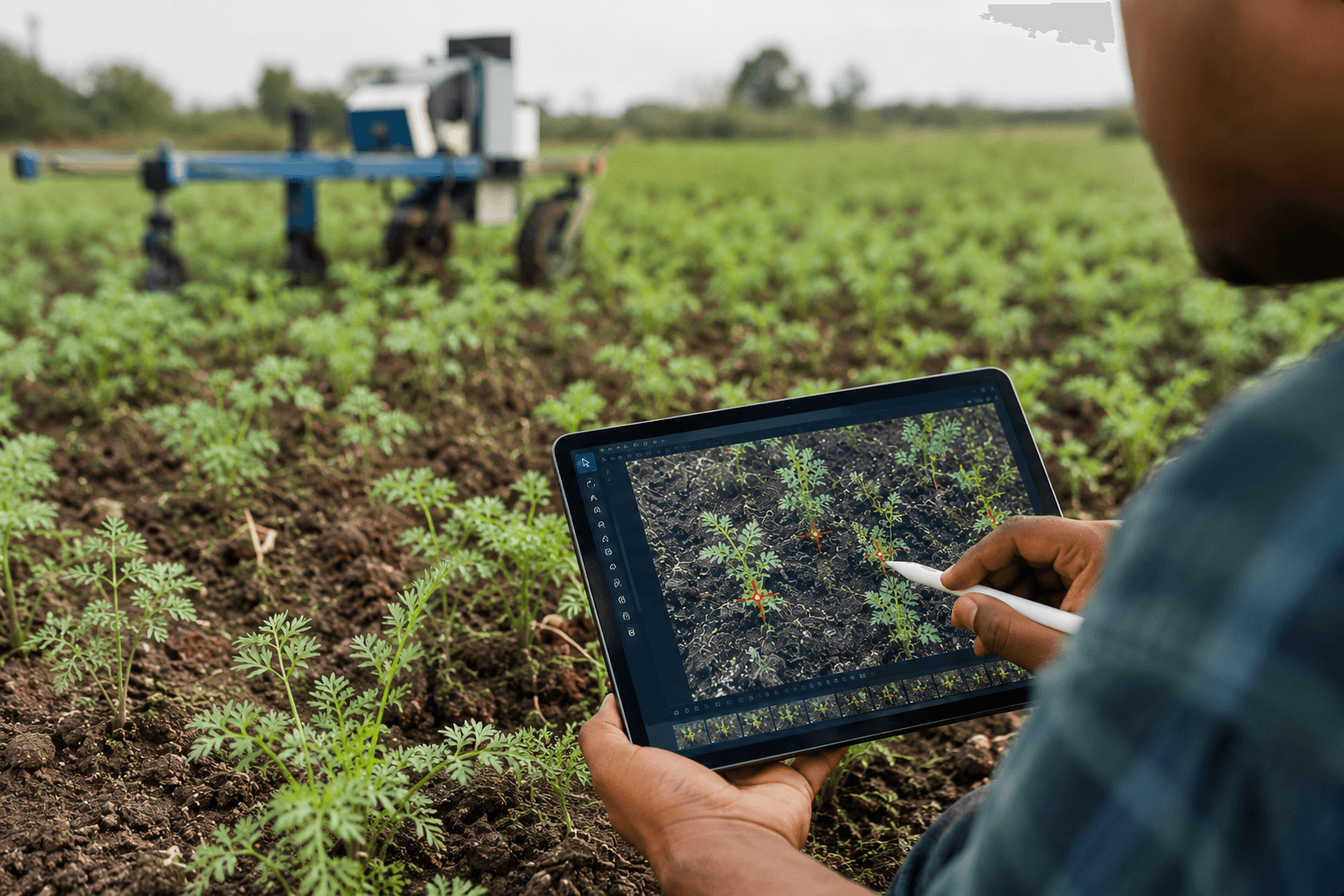
Our client develops AI-powered laser-weeding systems for precise, herbicide-free weed control. Its technology uses high-performance cameras to scan agricultural fields, while AI differentiates crops from weeds and identifies exact treatment points. A controlled laser then targets the weed's growth center while keeping the crop's meristem untouched.

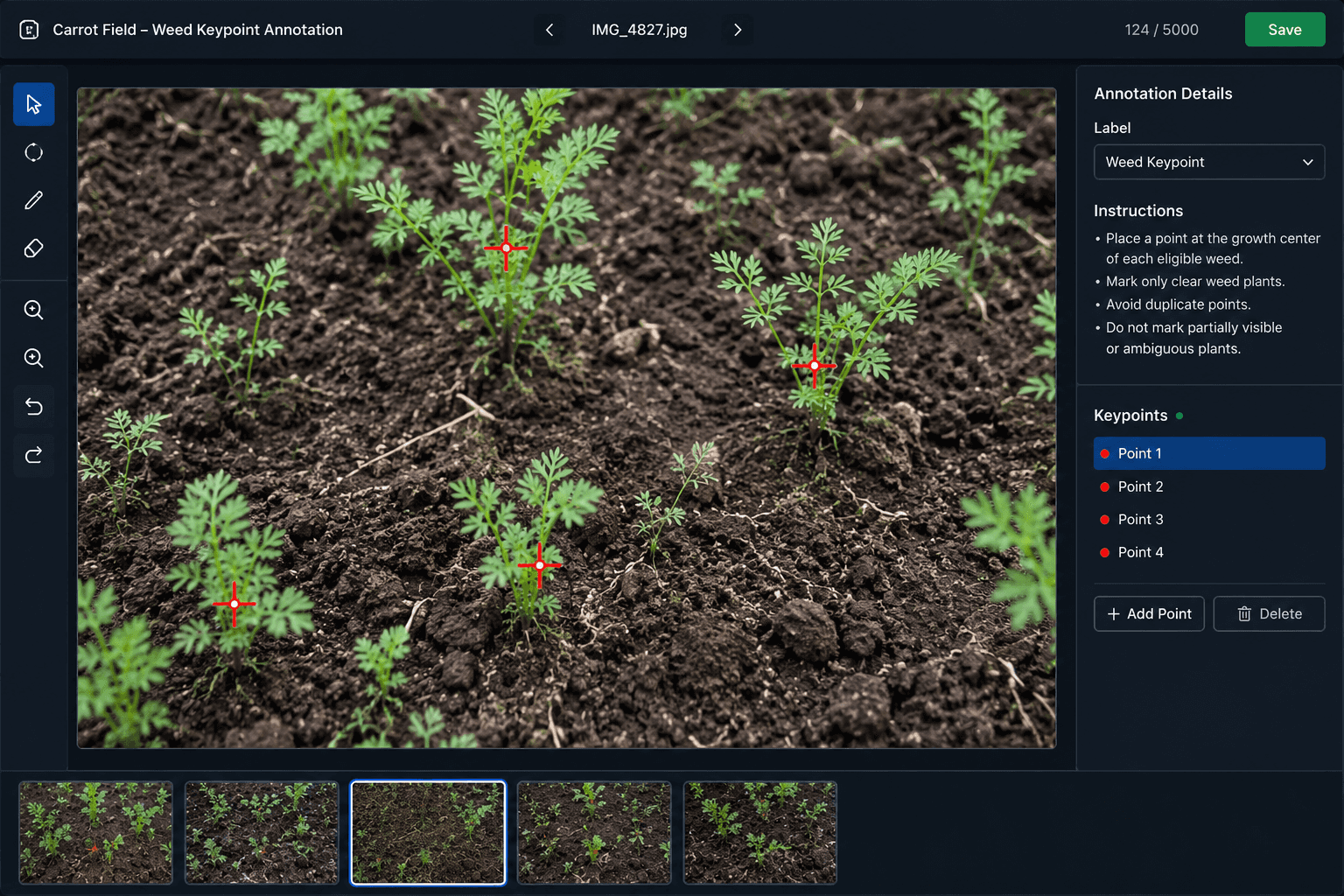
To support model development for carrot farming, the company needed consistent, point-level annotations that could identify the designated growth point of every eligible weed visible in field imagery. IndiVillage built a dedicated annotation workflow to support this requirement, helping convert complex agricultural images into structured training data for plant-level localization.

AGRI-TECH COMPANY

800+

images delivered per week

One Point Needed Precise Biological Judgment

Challenge

One Point Needed Precise Biological Judgment

Keypoint annotation may look simple because the final output is only a coordinate. In agricultural imagery, however, deciding where that coordinate belongs requires careful visual judgment. Weeds change shape across growth stages, leaves overlap, and field conditions such as soil texture, shadows, blur, motion, and camera angle can affect visibility.

For the client's model, each eligible weed needed to be marked at its defined growth center. This meant the annotation team had to interpret plant structure consistently across crowded carrot-field images, while avoiding missed weeds, duplicate points, and small placement errors that could introduce label noise into the training dataset.

The work required more than speed. It needed a shared understanding of the biological target, clear handling of edge cases, disciplined guideline application, and a dependable review process for uncertain images. Without this consistency, the model would have weaker spatial supervision for learning where the laser should act.
Consistent Keypoints for Plant-Level Model Training

Solution

Consistent Keypoints for Plant-Level Model Training

IndiVillage assembled a dedicated annotation team to support the client's computer vision model development. The team produced keypoint annotations for carrot-farming imagery by identifying and marking the designated growth point of every eligible weed visible in each field image. These point-level labels created the ground-truth coordinates needed to train and evaluate the model's ability to localize the correct laser target.

The workflow began with guideline alignment. Annotators studied the client's definition of the target keypoint, accepted examples, and exclusion rules before entering production. During annotation, the team examined each image and placed keypoints according to the approved convention, ensuring that similar plant structures were handled consistently across the dataset.

Ambiguous cases were flagged and reviewed against the guidelines. These included overlapping weeds, partial visibility, mature weeds with hidden growth centers, early growth stages, soil clutter, and unclear plant centers. Completed annotations were then checked for correct placement, completeness, consistency, and compliance before delivery.

As the dataset evolved, recurring edge cases were converted into clearer examples and decisions. This helped refine the workflow over time and improved consistency across new batches of carrot-field imagery.

Scaled Delivery for Precision Weeding Data

Results

Scaled Delivery for Precision Weeding Data

IndiVillage helped the client scale delivery to approximately 800 images per week, supported by a dedicated team and structured delivery oversight.

The team provided consistent keypoint annotations across complex agricultural imagery, helping build the human-labeled data foundation required for model learning and plant-level localization. Each approved keypoint represented the connection between what trained annotators could identify in field imagery and what the computer vision model needed to learn for precise weed targeting.

The engagement also strengthened operational continuity through guideline alignment, quality validation, feedback loops, and account-level coordination. As the client continues to develop its carrot-farming model, IndiVillage's annotation support provides a reliable data workflow for turning field images into quality-checked keypoint data.