
IndiVillage Logo

Generative image & video AI

Human Feedback for Better Image and Video Generation

Generative visual models can produce impressive results and still fail in ways automated metrics do not fully capture. A scene may look convincing but miss the prompt. A person may change appearance across frames. Motion can feel unnatural even when individual images appear correct.

IndiVillage provides human-in-the-loop data operations for teams building and evaluating image and video generation models. We help turn model outputs into structured feedback through human evaluation, preference ranking, multimodal quality review, error analysis, and safety validation.

Human Feedback for Better Image and Video Generation
Visual Quality Is More Than a Good-Looking Output

Visual Quality Is More Than a Good-Looking Output

As part of IndiVillage's broader Generative AI data services, we support teams building visual models with structured human evaluation for generated images and video.

Evaluating generated content is not simply a question of whether an image or video looks realistic. A model may generate the correct subject but miss an attribute. Objects may appear in the wrong spatial relationship. Text may be unreadable. Human anatomy can break down under complex poses. In video, these problems extend over time as identities shift, objects disappear, lighting changes unexpectedly, or motion loses physical coherence.

Effective generative AI evaluation therefore needs to distinguish what went wrong, where it happened, and whether the failure matters for the intended model experience.

IndiVillage helps teams translate those questions into structured human evaluation criteria that can be applied consistently across model outputs and iterations.

Human Evaluation Across Image and Video Generation

Prompt Adherence

Prompt Adherence

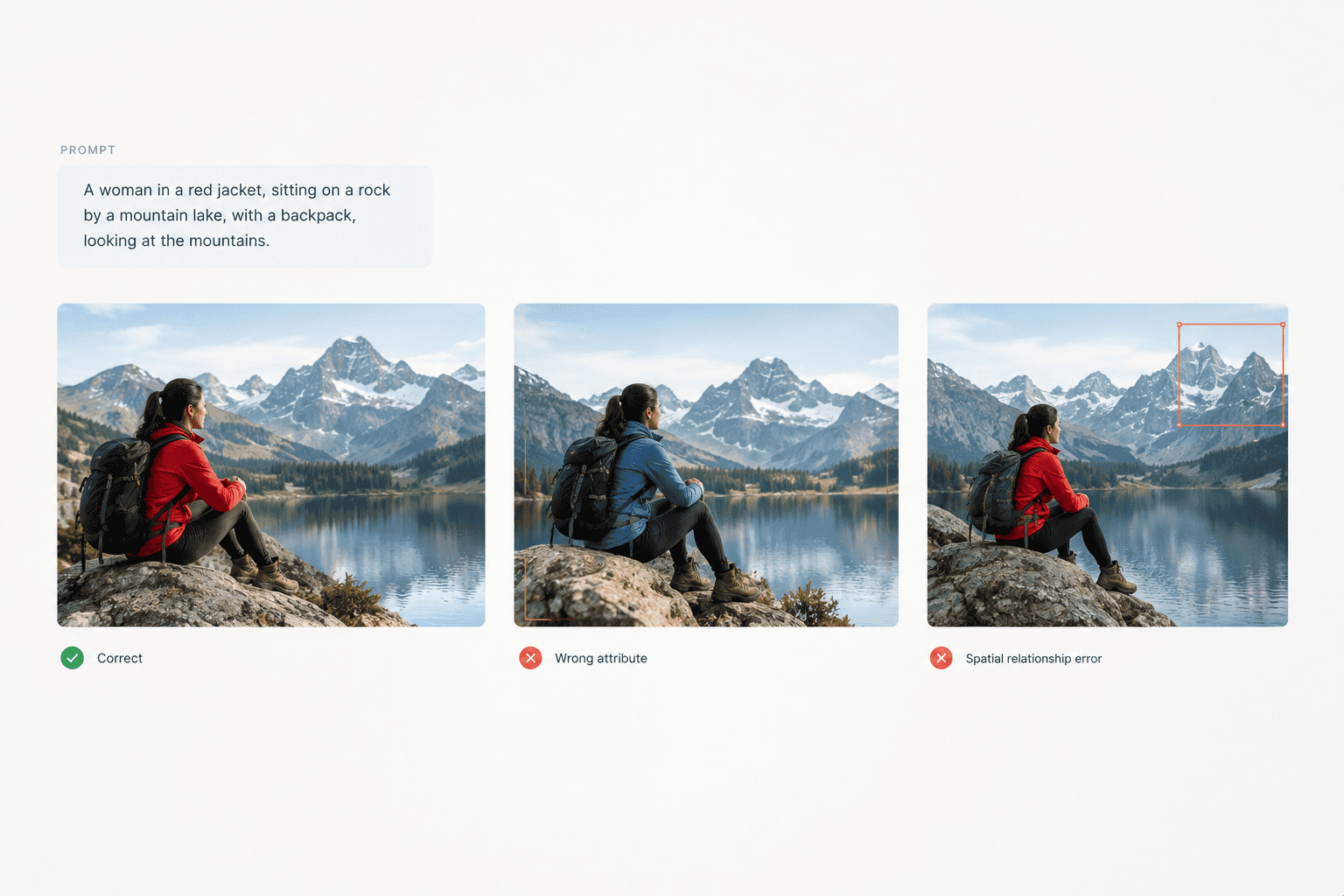
A visually appealing generation can still be a poor response to the prompt.

Evaluators assess whether the output captures the requested subject, attributes, actions, environment, composition, spatial relationships, and creative direction. More complex prompts can also be reviewed for failures such as missing instructions, incorrect object counts, attribute confusion, or relationships being applied to the wrong subject.

This creates a clearer picture of whether a model is simply producing attractive content or actually following user intent.


Visual Coherence and Generation Quality

Visual Coherence and Generation Quality

Generative models often fail through details that are individually small but collectively reduce output quality.

Reviewers can identify distorted objects, inconsistent lighting, malformed anatomy, implausible geometry, repeated visual elements, broken reflections, background artifacts, and other generation errors.

Rather than reducing all of these issues to one subjective quality score, they can be categorized into a structured error taxonomy. This allows model teams to see which failure types are recurring and whether they improve between model versions.

Human Preference Evaluation

Human Preference Evaluation

Two generations may both satisfy the prompt while differing substantially in composition, visual quality, realism, style, or overall appeal.

Pairwise and multi-output evaluation allows trained reviewers to determine which result better meets a defined objective. Preference decisions can be captured alongside the reason for the choice, creating richer feedback than a simple winner-or-loser label.

This kind of preference data can support model comparison, post-training workflows, benchmark development, and iterative evaluation of new model releases.

Spatial and Object Accuracy

Spatial and Object Accuracy

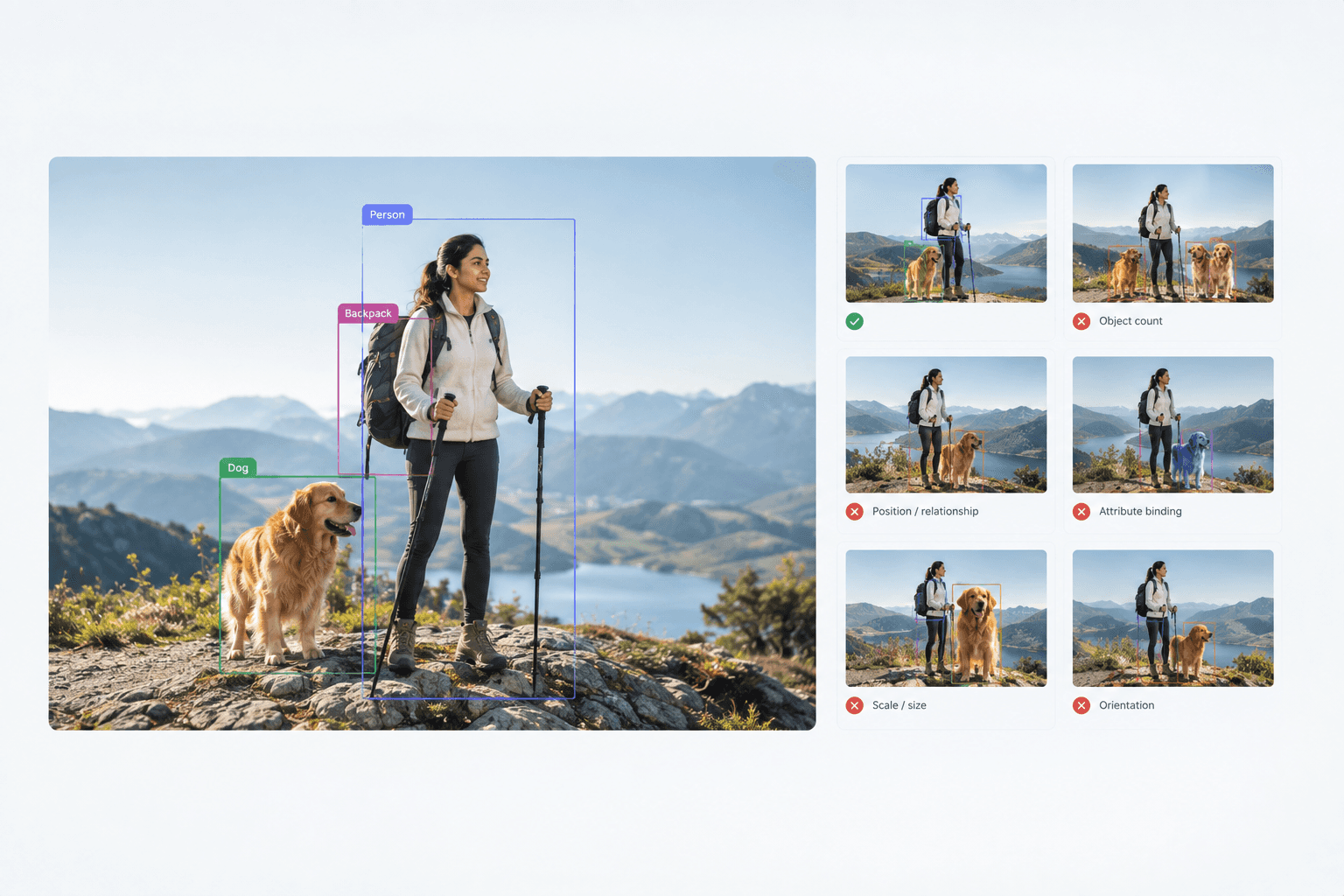
Generative models frequently understand the objects requested in a prompt without representing their relationships correctly.

A model may generate three objects instead of two, place one subject behind another when the prompt asks for the opposite, or apply the correct color to the wrong object.

Human evaluation can examine object count, position, scale, orientation, attribute binding, and spatial relationships as separate quality dimensions. These distinctions are particularly useful when teams are investigating compositional reasoning rather than overall aesthetics.

Human Anatomy and Interaction

Human Anatomy and Interaction

People remain one of the most demanding subjects for generative visual models.

Hands, fingers, facial features, body proportions, expressions, poses, and interactions with objects can introduce errors that are obvious to a human reviewer but difficult to capture through a general quality metric.

Evaluation guidelines can define what constitutes an acceptable representation for the use case and separate minor visual imperfections from failures that materially affect the output.

Image Generation and Video Generation Fail Differently

Image evaluation primarily asks whether a single generated frame represents the prompt accurately and coherently.

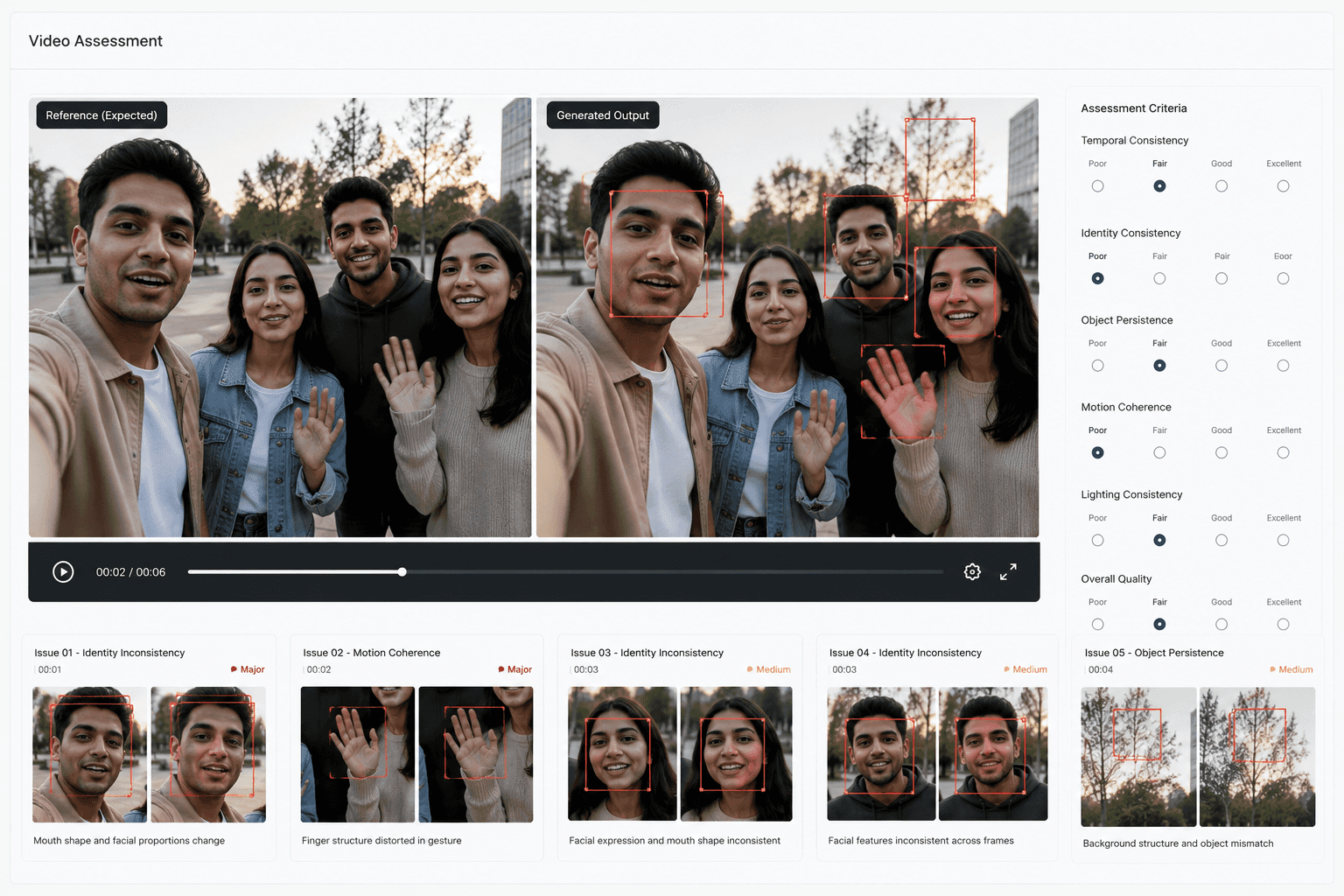
Video evaluation introduces another requirement: the generation must remain coherent over time.

A person who appears correctly in the first frame may gradually change face, clothing, or proportions. An object can disappear and return. Background elements may shift between frames. Motion can accelerate unnaturally or produce interactions that do not follow basic physical expectations.

For this reason, video generation model evaluation needs to consider both frame-level quality and sequence-level consistency.

Image GenerationVideo Generation
Prompt adherencePrompt and action adherence
Object and spatial accuracyObject persistence
CompositionScene continuity
Anatomy and facesAnatomy during movement
Visual artifactsFrame-to-frame instability
Style alignmentStyle consistency over time
Text renderingMotion and transition quality
Image coherenceTemporal coherence

A video can contain several strong individual frames and still fail as a sequence. Human evaluation helps capture that distinction.

Evaluating Motion and Temporal Consistency

Evaluating Motion and Temporal Consistency

Generated video should not only contain the right elements; those elements must behave consistently from one frame to the next.

Reviewers can examine whether subjects retain their identity, whether objects remain present when they should, whether actions progress naturally, and whether movement follows the prompt.

Camera behavior, transitions, flicker, scene continuity, and physical interactions can also be evaluated where they are relevant to the model.

The evaluation framework should reflect the product experience. A short cinematic generation, an avatar video, and an image-to-video model may require very different definitions of acceptable motion.

From Model Output to Structured Human Feedback

Define What the Model Needs to Get Right

01

Define What the Model Needs to Get Right

The evaluation process begins with the intended model behavior rather than a generic visual-quality checklist. Known failure modes, product requirements, safety constraints, and user expectations are translated into clear evaluation dimensions. This establishes what reviewers should measure and what should be escalated when an output falls outside the existing rubric.

Calibrate Human Evaluators

02

Calibrate Human Evaluators

Terms such as realistic, coherent, natural, or aesthetically strong can mean different things to different people. Calibration gives evaluators representative examples before production begins. Differences in judgment are reviewed, unclear criteria are refined, and edge cases are documented. The objective is not to eliminate human judgment. It is to make that judgment more consistent and measurable.

Evaluate at Production Scale

03

Evaluate at Production Scale

Once criteria are established, reviewers can score, compare, rank, or annotate model outputs using the approved evaluation framework. The workflow can be structured around individual generations, prompt-output pairs, model comparisons, or repeated benchmark sets depending on the development stage. IndiVillage can work within client-defined platforms, rubrics, taxonomies, and evaluation environments where operationally feasible.

Turn Disagreements Into Better Guidelines

04

Turn Disagreements Into Better Guidelines

Visual evaluation inevitably produces ambiguous examples. Instead of allowing individual reviewers to make independent assumptions, difficult outputs can move through review and adjudication. Once resolved, the decision becomes part of the shared evaluation guidance. This is particularly important as evaluation volumes grow. A recurring ambiguity that remains undocumented can quickly turn into inconsistent preference or quality data.

Structured Error Analysis for Generative Models

Structured Error Analysis for Generative Models

A single score can tell a team that an output is weak. It rarely explains why.

Error tagging creates a more useful layer of evaluation by separating failures such as incorrect attributes, missing objects, anatomical distortion, prompt omissions, spatial mistakes, text-rendering problems, temporal instability, or unsafe content.

Over multiple evaluation runs, this makes it possible to compare not only whether one model version performs better, but which types of failures are becoming less frequent and which remain persistent.

That distinction can make human evaluation significantly more actionable for model-development teams.

Preference Data for Model Comparison

Preference Data for Model Comparison

Preference evaluation becomes especially useful when teams need to compare several plausible outputs rather than classify one generation as simply correct or incorrect.

Reviewers can compare generations against an agreed objective such as prompt adherence, visual quality, realism, style, motion quality, or overall user preference.

A structured preference workflow can also record why one output was selected. This helps separate cases where the winning generation was more visually attractive from those where it followed the prompt more accurately.

For teams comparing model versions, this creates a more interpretable signal than an overall preference percentage alone.

Benchmark Visual Models Across Iterations

Benchmark Visual Models Across Iterations

Visual generative models change quickly. Evaluation therefore needs to remain stable enough to reveal whether those changes represent genuine improvement.

The same prompt sets, quality criteria, and review methodology can be applied across successive model versions to identify improvements, regressions, and category-specific weaknesses.

A model may improve significantly on simple object generation while continuing to struggle with multi-object composition. A video model may produce smoother motion while losing identity consistency. Breaking evaluation results down by failure category makes those trade-offs easier to identify.

Safety Review for Generated Images and Video

Safety Review for Generated Images and Video

Visual generation also introduces risks that cannot always be resolved through automated filtering alone.

Human reviewers can apply client-defined policies to the generated content and assess whether outputs require rejection, escalation, or further review. Context matters particularly when content sits close to a policy boundary or when a model combines otherwise acceptable elements in an unsafe way.

IndiVillage's broader content moderation experience can support structured review workflows where quality evaluation and safety assessment need to operate alongside one another.

Explore Content Moderation->
Visual AI Data Across Different Model Experiences

Visual AI Data Across Different Model Experiences

Generative visual models are increasingly used across product design, ecommerce, advertising, entertainment, avatars, creative tools, and multimodal assistants.

The evaluation criteria should change with the experience.

A product-generation model may need strict control over shape, color, branding, and packaging. A creative model may place greater emphasis on composition, style, and aesthetic preference. Human-centric generation may require closer review of anatomy, expressions, identity, and interaction. Video products add motion, continuity, camera behavior, and temporal stability.

IndiVillage structures evaluation around these model requirements rather than applying one universal scoring system to every visual generation task.

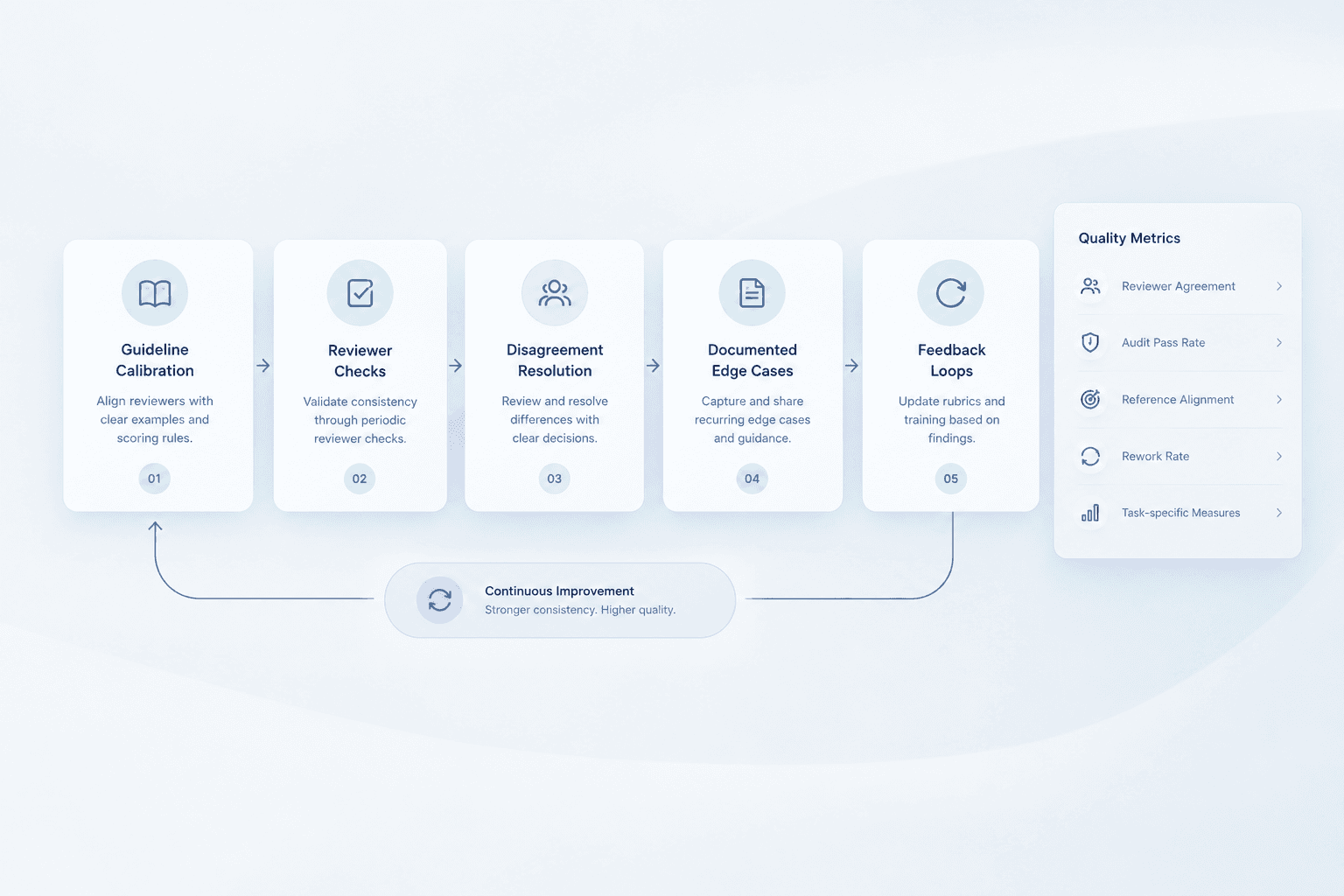
Quality Assurance for Human Evaluation

Quality Assurance for Human Evaluation

Human evaluation itself needs quality control.

Review criteria must remain consistent across evaluators and production batches, particularly where judgments involve subjective concepts.

IndiVillage uses guideline calibration, reviewer checks, disagreement resolution, documented edge cases, and feedback loops to strengthen evaluation consistency. Depending on the workflow, quality can be monitored through reviewer agreement, audit pass rates, reference-example alignment, rework, and other task-specific measures.

When recurring disagreements appear, the evaluation rubric should be refined rather than allowing reviewers to repeatedly interpret the same problem differently.

Secure Data Operations for Generative AI Development

Secure Data Operations for Generative AI Development

Visual AI development can involve unreleased models, proprietary prompts, confidential training data, and generated outputs that should not leave controlled environments.

IndiVillage operates managed data teams with controlled project access, structured permissions, and documented workflows for enterprise AI programs.

Security requirements can be aligned to the sensitivity of the project and the client's existing data environment, with relevant controls applied across access, review, storage, and delivery.

Scale Human Evaluation Without Changing the Standard

Scale Human Evaluation Without Changing the Standard

Increasing the number of evaluators should not change what an acceptable output means.

Production programs need stable rubrics, calibrated teams, sufficient reviewer capacity, documented edge cases, and consistent quality checks as volume increases.

IndiVillage's managed delivery model allows evaluation teams to ramp in stages while maintaining the same interpretation of prompt adherence, quality, preference, and other approved criteria.

This matters particularly for visual AI programs where model output volumes can increase rapidly between development, benchmarking, and production testing.

Why Generative AI Teams Work With IndiVillage

Human judgment designed around the model

Evaluation frameworks begin with the model objective and its known failure modes rather than a predefined rating template.

Structured evaluation and quality control

Calibration, review, adjudication, and feedback help convert subjective visual judgments into more consistent data.

Image and video expertise

Our experience across computer vision, visual annotation, video data, robotics, ecommerce, agriculture, healthcare, and autonomous systems provides a strong foundation for complex visual evaluation.

Tool-agnostic delivery

Teams can work within client-defined evaluation environments, taxonomies, and review processes where operationally feasible.

Managed and secure operations

Structured teams and controlled environments support ongoing visual AI programs that require reliability, confidentiality, and scale.

Impact sourcing at scale

Our delivery model also creates skilled digital careers in communities outside traditional technology hubs, extending the impact of AI development beyond the model itself.

Build Human Evaluation Around What Your Model Needs to Improve

Build Human Evaluation Around What Your Model Needs to Improve

Share a sample prompt set, generated images or videos, an existing evaluation rubric, or the failure modes your team is currently investigating.

We can help translate those requirements into a structured human evaluation workflow and define a scoped pilot before production scales.

Frequently Asked Questions

Quick answers to help you make smarter, faster decisions with confidence

What services support generative AI image and video models?+

IndiVillage can support visual generative AI programs through human evaluation, preference ranking, multimodal quality review, error tagging, model comparison, and safety validation. The appropriate workflow depends on the model stage, product experience, and the behaviors the development team needs to measure or improve.

How is image generation model evaluation different from traditional image annotation?+

Traditional image annotation generally adds labels such as bounding boxes, segmentation masks, classes, or keypoints to existing visual data. Generative image evaluation examines the output produced by a model and determines how well that output satisfies criteria such as prompt adherence, visual coherence, spatial accuracy, anatomy, style, and human preference.

Can you evaluate text-to-image models?+

Yes. Text-to-image evaluation can compare the generated image with the original prompt and assess whether subjects, attributes, spatial relationships, style, composition, and other requirements have been represented correctly.

How do you evaluate AI-generated video?+

Video generation evaluation examines both individual frames and the sequence as a whole. Reviewers can assess prompt adherence, motion, identity preservation, object persistence, scene continuity, frame-to-frame stability, physical plausibility, and other model-specific quality requirements.

What is preference data for generative AI?+

Preference data records which output a human evaluator considers better when two or more generations are compared against a defined objective. The comparison may focus on overall quality or a specific dimension such as prompt adherence, realism, style, motion, or safety.

How do you reduce subjectivity in visual AI evaluation?+

Subjective criteria are translated into structured rubrics supported by representative examples. Evaluators are calibrated before production, disagreements are reviewed, difficult cases are adjudicated, and recurring decisions are incorporated into the evaluation guidance.

Can you evaluate different model versions against each other?+

Yes. Controlled prompt sets and consistent review criteria can be used across model versions to identify changes in human preference, failure patterns, prompt adherence, visual quality, or video consistency.

Can generated content be reviewed for safety?+

Yes. Human reviewers can assess generated images and videos against client-defined moderation and safety policies. Ambiguous cases can be escalated through an agreed review process rather than resolved through individual assumptions.

Can IndiVillage work within our existing evaluation platform?+

IndiVillage follows a tool-agnostic delivery approach and can work within client-defined platforms, rubrics, taxonomies, and evaluation workflows where operationally feasible.

Can human evaluation scale with model output volume?+

Yes. Evaluation programs can expand through staged team ramp-up, evaluator calibration, reviewer capacity, stable guidelines, documented edge cases, and ongoing quality monitoring. The focus is on increasing throughput without allowing the evaluation standard to drift.

Talk to us

Tell us about your AI data requirements and our team will help map the right workflow.

Loading form...