Computer Vision Data Annotation: Types, Process, Quality and Use Cases
Oct 13, 2026 | 20 min read
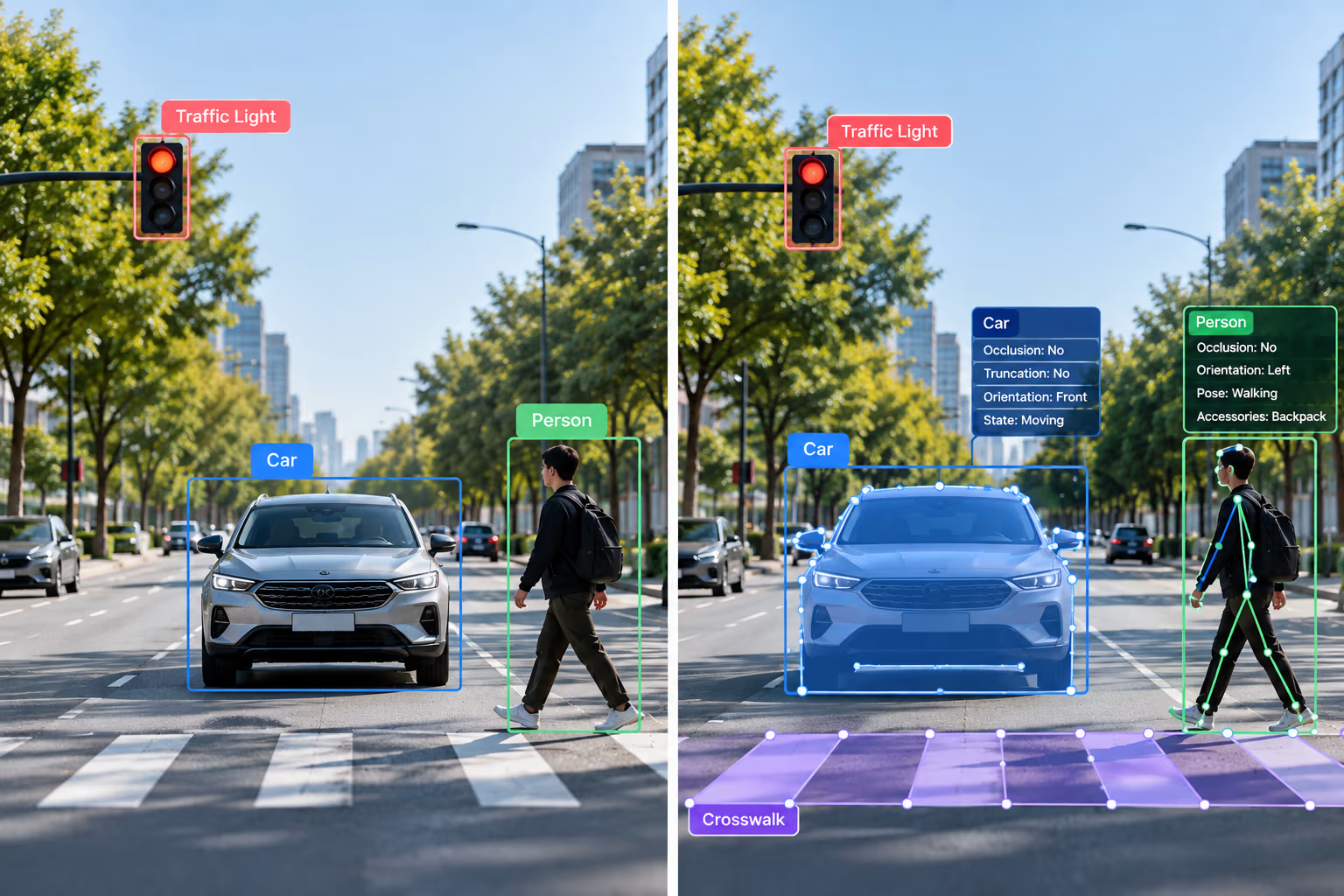
Computer vision data annotation is the process of adding structured labels to images, video, and other visual or spatial data so computer vision models can learn what to identify, locate, segment, track, or interpret. The annotation becomes ground truth, providing a reference against which a model can learn during training or be evaluated later.
Depending on the task, data annotation may identify an entire image, locate individual objects, trace exact boundaries, mark keypoints, or maintain object identities across video frames. Well-designed vision data annotation therefore connects the raw visual input directly to the prediction a computer vision system is expected to make.
What Is Computer Vision Data Annotation?
Computer vision data annotation adds structured labels or metadata to visual data such as images, video frames, and three-dimensional spatial inputs. These labels can identify classes, object locations, boundaries, landmarks, identities, attributes, or relationships depending on what the model must predict.
The resulting labels are generally treated as ground truth during supervised model training or evaluation. Ground truth is not simply a file of annotations. It is the agreed reference created according to a defined annotation specification, ontology, and review process.
Is Data Annotation the Same as Data Labeling?
Data annotation and data labeling are often used interchangeably in computer vision.
In practice, labeling may refer to assigning a relatively simple category, such as identifying an image as containing a car or a pedestrian. Annotation can also describe richer structured information, including bounding boxes, polygons, segmentation masks, keypoints, object attributes, and temporal identifiers.
There is no universal industry rule requiring the two terms to describe different processes. What matters is whether the labels contain the information required by the intended computer vision task.
Why Is Data Annotation Important for Computer Vision?
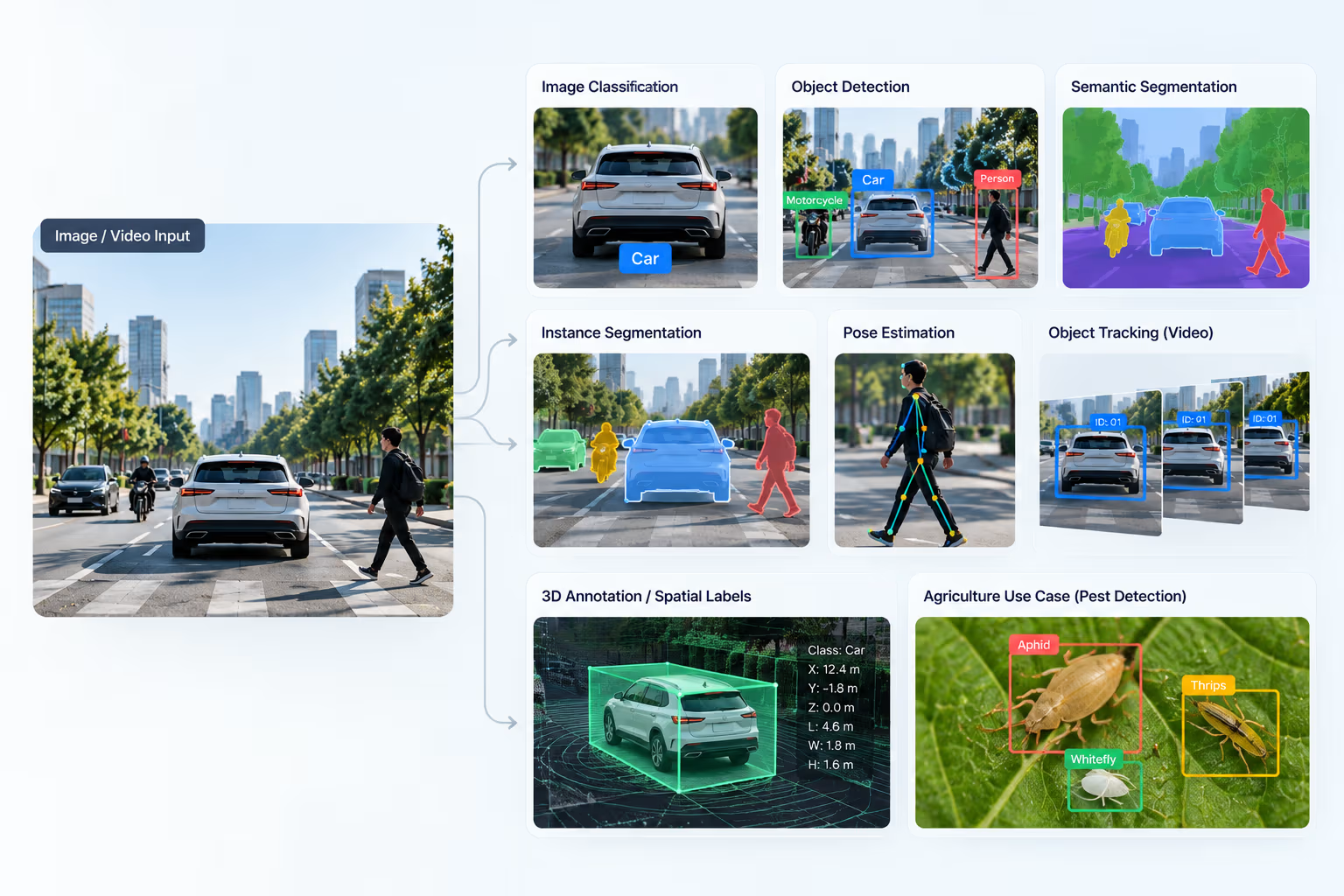
A supervised computer vision model needs examples of both the visual input and the expected output. Annotation defines that expected output.
The required ground truth therefore changes according to the model objective.
Image classification requires a category or set of categories for an image.
Object detection requires an object class together with its location.
Semantic or instance segmentation requires pixel-level boundaries.
Pose estimation requires defined keypoints or landmarks.
Object tracking requires an object to retain the same identity over time.
Three-dimensional perception requires spatial labels such as cuboids, depth information, or point-cloud classes.
This relationship is important because an annotation can be technically correct while still being unsuitable for the intended model. For example, labeling an image as containing a vehicle may be sufficient for classification, but it provides no information about where the vehicle is located. An object-detection model would need a location annotation, such as a bounding box, in addition to the class label.
In one IndiVillage agriculture engagement, annotators applied bounding boxes to pest imagery and followed an expert-defined taxonomy so computer vision models could distinguish relevant insect species. The annotation structure was determined by the model task rather than by the availability of a particular labeling tool.
What Are the Main Types of Computer Vision Data Annotation?
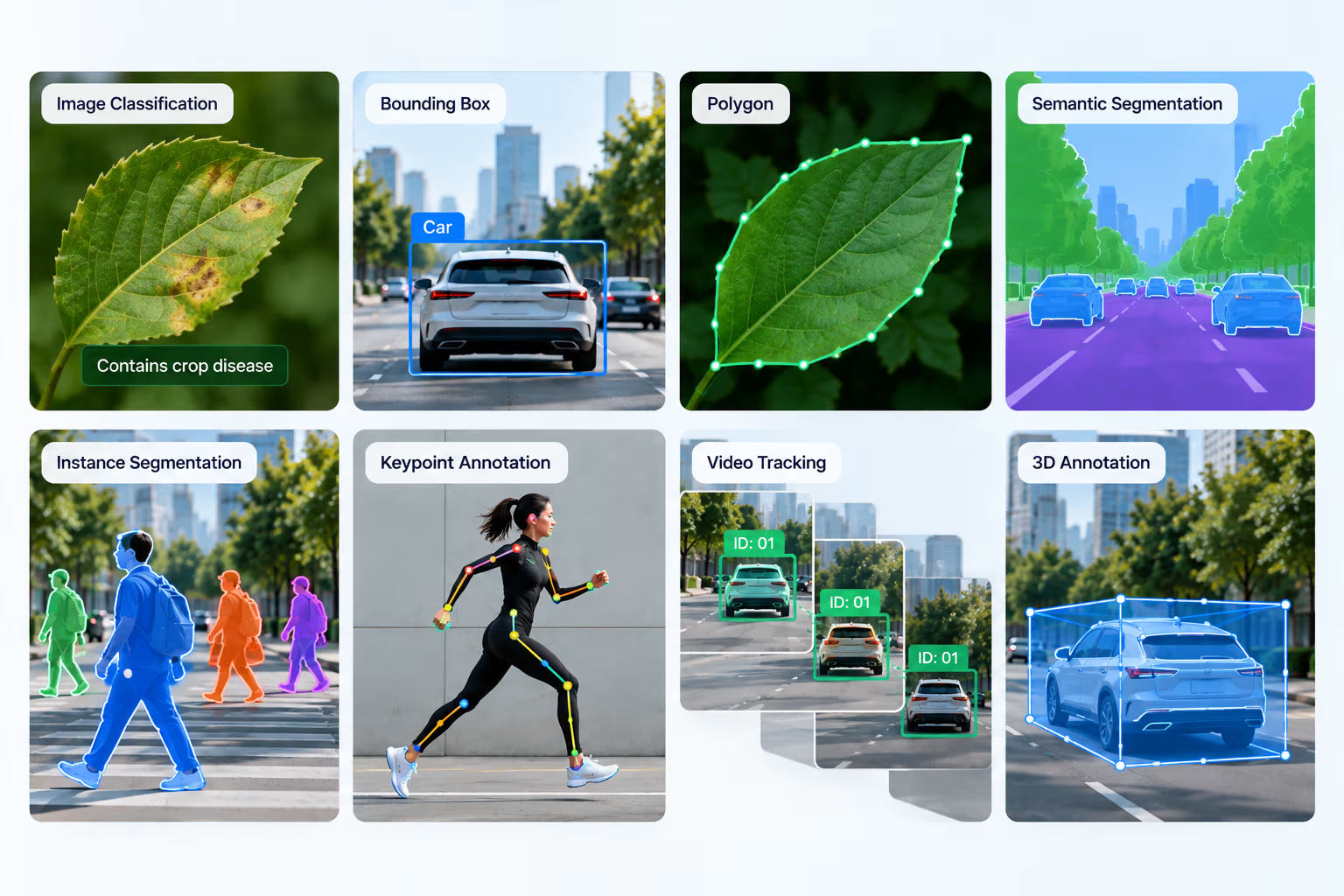
Computer vision annotation types are best understood according to what information the model needs to predict.
Annotation type
What is labeled
Typical computer vision task
Example output
Image classification
Entire image
Image classification
“Contains crop disease”
Bounding box
Approximate object location
Object detection
Rectangle around a vehicle
Polygon
Detailed object outline
Precise object localization
Outline around an irregular object
Semantic segmentation
Pixels belonging to a class
Scene understanding
Every road pixel labeled “road”
Instance segmentation
Pixels belonging to individual objects
Object detection and segmentation
Each pedestrian separated individually
Keypoint annotation
Defined locations on an object
Pose or landmark estimation
Human joints or plant growth points
Video tracking
Object identity across frames
Object tracking and behavior analysis
Same vehicle identifier across a sequence
Three-dimensional annotation
Position, orientation, depth, or point-cloud regions
Spatial perception
Three-dimensional cuboid around a vehicle
Image Classification
Image classification assigns one or more labels to an entire image without identifying the location of an object within it.
A single-label classification task might classify an image as healthy crop, diseased crop, or unknown. Multi-label classification may assign several categories to the same image when multiple conditions or characteristics can be present simultaneously.
Classification is appropriate when the model only needs to determine what an image represents, rather than where a particular object appears.
Bounding Box and Polygon Annotation
Bounding boxes define the location of an object using a rectangle. They are widely used for object-detection tasks because they provide both the class and an approximate spatial location while remaining relatively efficient to annotate.
Polygon annotation follows an object's outline more closely. This can be useful when the object has an irregular shape or when excess background within a rectangular box would reduce the usefulness of the spatial label.
The choice is not simply a question of precision. Polygons generally require more annotation effort than bounding boxes. If approximate localization is sufficient for the downstream task, the additional boundary detail may not justify the added cost and time. If the model must distinguish closely overlapping or irregularly shaped objects, the additional spatial information may be necessary.
Semantic and Instance Segmentation
Segmentation assigns labels at the pixel level and is used when a model needs more precise information about object or region boundaries.
Semantic segmentation assigns every relevant pixel to a class. All pixels representing road, for example, receive the same class regardless of whether they belong to different sections of the road.
Instance segmentation separates individual objects belonging to the same category. If five people appear in an image, semantic segmentation can identify all pixels belonging to the class “person,” while instance segmentation distinguishes each person as a separate object.
Panoptic segmentation combines aspects of semantic and instance segmentation by assigning semantic categories across a scene while also distinguishing countable object instances.
Keypoint and Landmark Annotation
Keypoint annotation marks specific, predefined locations on an object rather than its entire boundary.
Examples include human joints for pose estimation, facial landmarks for face analysis, anatomical locations in medical imagery, or defined structural points on a plant.
The value of a keypoint depends on the annotation specification. Annotators must understand exactly which location represents the intended landmark and apply that interpretation consistently, particularly when the target is partially obscured or visually ambiguous.
Keypoint labels are commonly used for:
pose estimation
movement analysis
facial landmark detection
gesture understanding
structural analysis
object-part localization
Video Annotation and Object Tracking
Video annotation introduces a temporal dimension to visual labeling.
In addition to identifying what appears within individual frames, the annotation may need to represent how objects, actions, or events change over time. Depending on the model objective, labels can include persistent object identifiers, actions, frame-level classes, temporal boundaries, object states, or tracked locations.
Temporal consistency is particularly important. A vehicle assigned one identifier in one frame and a different identifier several frames later can introduce an incorrect training signal even when both individual bounding boxes are spatially accurate.
Video datasets for robotics and embodied Artificial Intelligence (AI) can also require labels for actions, hand-object interactions, task stages, timestamps, and object states. IndiVillage discusses these requirements in its guide toegocentric video data collection, where first-person video is structured for downstream computer vision and robotics workflows.
3D and LiDAR Annotation
Three-dimensional (3D) annotation adds spatial information such as depth, orientation, and position.
Light Detection and Ranging (LiDAR) systems generate point clouds representing objects and surfaces in three-dimensional space. These datasets can be annotated using three-dimensional cuboids, point-cloud segmentation, object classes, spatial attributes, and multi-frame object identities.
This form of annotation is commonly used for perception, localization, scene understanding, and spatial reasoning in autonomous systems. IndiVillage's autonomous vehicle data services include LiDAR point-cloud labeling, three-dimensional cuboids, segmentation, and multi-frame continuity workflows.
How Do You Choose the Right Annotation Type?
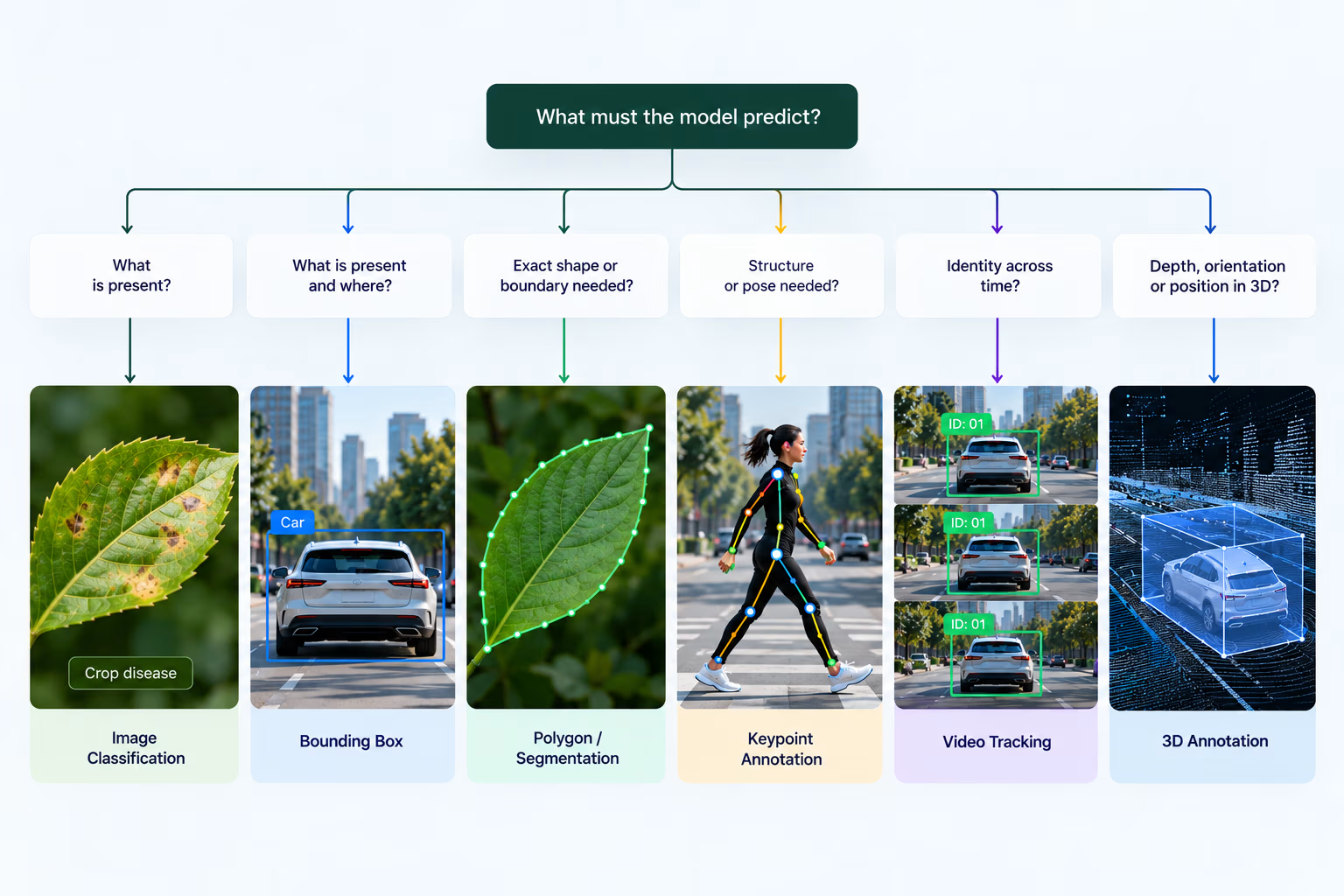
The correct annotation type should be derived from the model output, not from the capabilities of an annotation platform.
A useful starting point is to ask what the model must predict.
If the model needs to answer what is present, image classification may be sufficient.
If it needs to answer what is present and where, bounding boxes may provide the minimum useful ground truth.
If exact shape or boundary information matters, segmentation or detailed polygons may be required.
If the model must identify structure or pose, keypoints are more appropriate.
If identity must persist over time, the dataset needs tracking annotations.
If the model must understand depth, orientation, and position in three-dimensional space, LiDAR or other spatial annotations may be necessary.
The decision should then account for characteristics of the dataset and the acceptable error profile. Important considerations include:
object size
object density
overlapping instances
occlusion
truncation
visual ambiguity
required boundary precision
annotation effort
downstream evaluation method
Consider a roadside perception model that only needs to detect whether a pedestrian is present within a general region. A bounding box may provide sufficient spatial supervision. A separate model intended to identify precise pedestrian contours could require instance segmentation instead.
Annotation design is therefore part of the model specification. Choosing a more detailed annotation format without a model requirement for that additional information can increase production effort without creating equivalent downstream value.
How Does the Computer Vision Data Annotation Process Work?
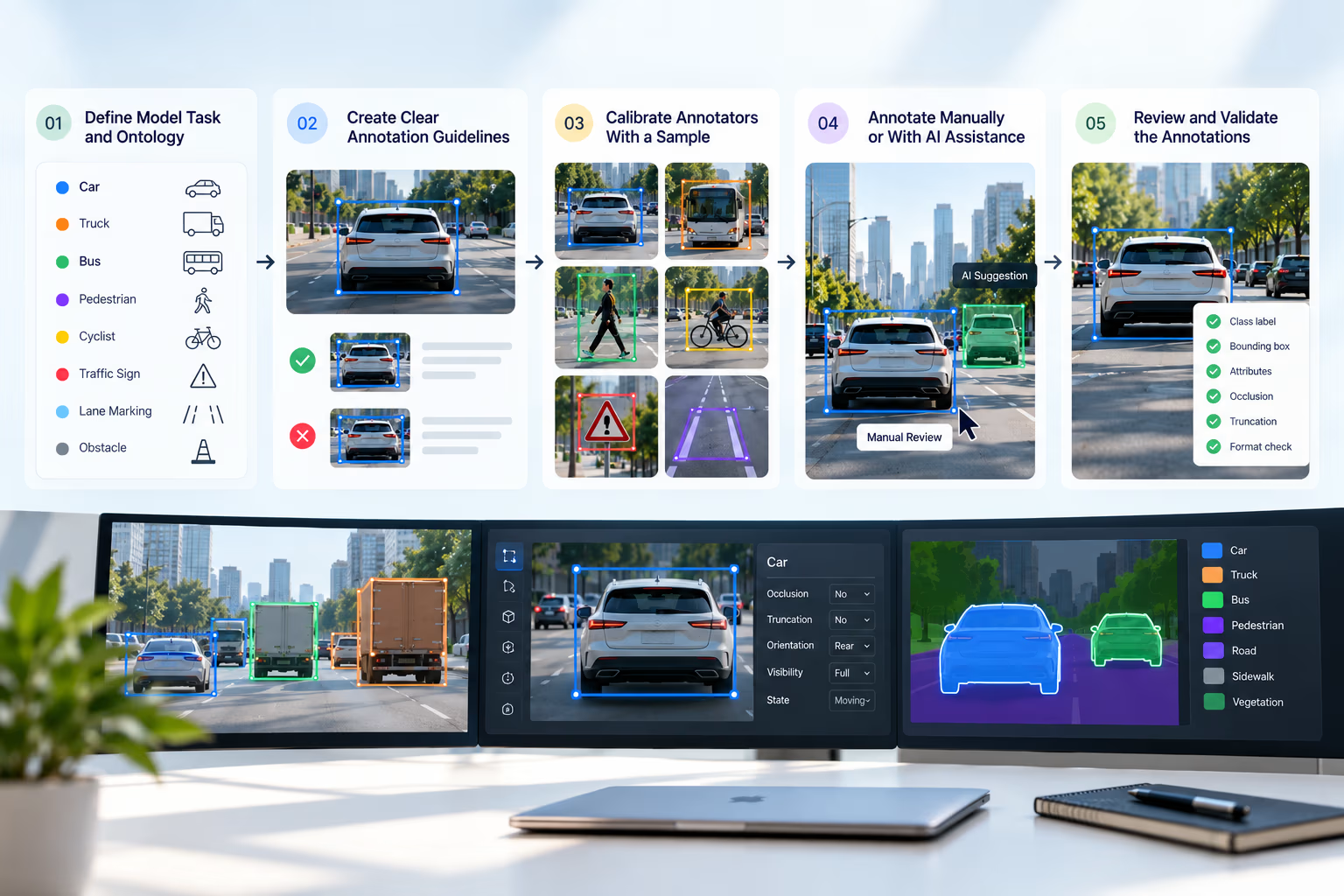
A production-quality annotation workflow begins before the first image is labeled. The model objective, ontology, guidelines, calibration process, review methodology, and output specification should be aligned before annotation reaches scale.
1. Define the Model Task and Annotation Ontology
The first step is to establish what the computer vision model needs to predict.
From that objective, the project team can define the annotation ontology: the set of objects, classes, attributes, relationships, and rules that determine how concepts are represented.
For an autonomous-driving dataset, for example, an ontology may distinguish cars, trucks, buses, pedestrians, cyclists, traffic signs, lane markings, and obstacles. It may also define attributes such as visibility, direction, motion state, or occlusion.
The ontology is different from an individual annotation. The ontology defines what concepts exist and how they relate; the annotation applies those definitions to a specific image, frame, or point cloud.
Ambiguous classes should be resolved before full production. If annotators cannot consistently distinguish two categories based on the available imagery and specification, scaling the same uncertainty across a larger dataset will not solve the problem.
2. Create Clear Annotation Guidelines
Guidelines translate an annotation specification into repeatable decisions.
They should define:
object boundaries
class definitions
inclusion and exclusion rules
treatment of occlusion
treatment of truncation
overlapping objects
minimum visibility requirements
ambiguous cases
class naming
relevant attributes
correct examples
incorrect examples
escalation procedures
The objective is to reduce unnecessary individual interpretation.
Guidance from Ultralytics similarly emphasizes objective labeling instructions, examples, consistent application, annotator training, and consistency checks when developing computer vision datasets.
Guidelines should also evolve when recurring edge cases expose gaps in the original specification. That does not mean allowing standards to shift informally during production. Changes should be documented, communicated, and versioned so the dataset remains internally consistent.
3. Calibrate Annotators With a Representative Sample
Before production scales, annotators and reviewers should work on a representative sample of the dataset.
The sample should include both routine cases and relevant edge conditions. The purpose is not simply to assess individual speed. It is to determine whether different annotators interpret the specification in the same way.
Disagreements during calibration can reveal:
unclear class definitions
missing boundary rules
inconsistent treatment of partial objects
overlooked edge cases
ontology gaps
conflicting examples
The team can then refine the guidelines, clarify the specification, and repeat calibration where necessary.
There is no universal pilot size suitable for every computer vision project. A useful calibration set is one that adequately represents the decisions annotators will encounter in production.
4. Annotate Manually or With AI Assistance
Computer vision data annotation may be manual, AI-assisted, or use a combination of both.
Manual annotation relies on human interpretation to assign labels. This remains important where imagery is ambiguous, contextual judgment matters, or the model has not yet reached sufficient performance to generate useful preliminary labels.
Artificial Intelligence-assisted annotation can reduce repetitive work by generating initial predictions, propagating labels between frames, interpolating tracked objects, or suggesting masks and object boundaries.
These approaches are complementary rather than mutually exclusive. Roboflow, for example, describes manual, semi-automatic, and automated approaches as different ways of creating computer vision annotations depending on the workflow and available model assistance.
Model-generated annotations should not automatically be treated as ground truth. Validation requirements should reflect the task, the reliability of the pre-labeling model, class difficulty, edge-case frequency, and the consequences of an incorrect label.
IndiVillage has used similar human-plus-model workflows in production. In its FMC agriculture engagement, manual bounding-box annotation was combined with AI-assisted review to support pest-identification model development.
5. Review and Validate the Annotations
Before annotations are accepted as ground truth, Quality Assurance (QA) should evaluate whether they are correct, complete, and consistent with the specification.
Validation can include:
automated schema and format checks
human review
audit sampling
expert agreement
disagreement resolution
completeness checks
geometric validation
escalation of uncertain examples
Different projects require different review structures. A straightforward classification dataset may be reviewed differently from medical imagery requiring specialist interpretation or a video-tracking dataset where spatial and temporal consistency must both be assessed.
For example, in IndiVillage's work with Audere on Rapid Diagnostic Test (RDT) imagery, unclear cases were reviewed again and escalated to medical professionals when required. More than 185,000 image annotations were processed using standardized tagging as part of the broader workflow.
Once annotations have been approved, the dataset should be versioned and exported in the required format. Annotation specifications, ontology versions, guideline changes, and dataset releases should remain traceable, particularly when models are trained across multiple dataset generations.
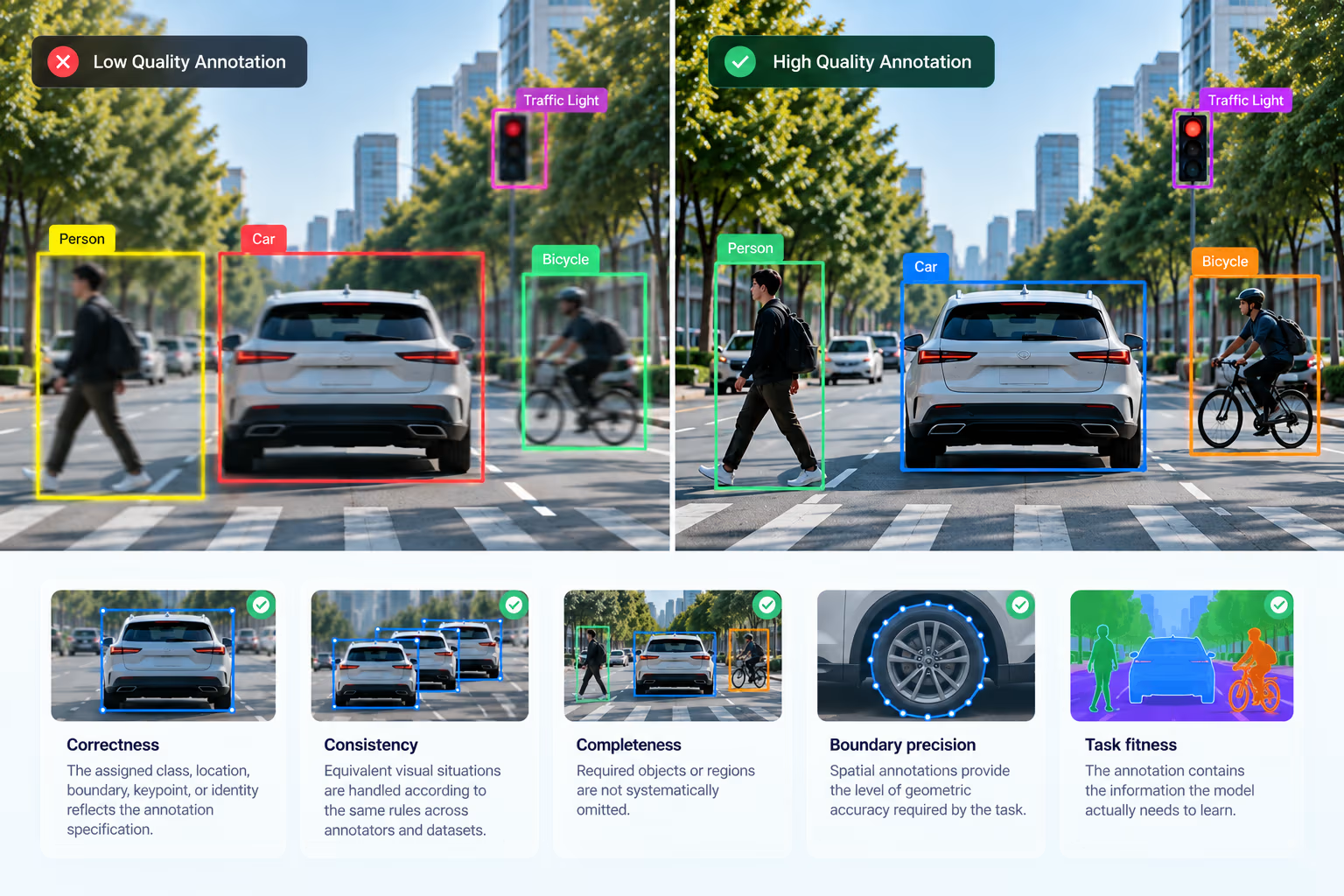
What Makes Computer Vision Data Annotation High Quality?
High-quality annotation is not defined by a universal accuracy percentage. It is defined by whether the ground truth is sufficiently reliable for the intended model task.
Important quality dimensions include:
Correctness The assigned class, location, boundary, keypoint, or identity reflects the annotation specification.
Consistency Equivalent visual situations are handled according to the same rules across annotators, batches, and dataset versions.
Completeness Required objects or regions are not systematically omitted.
Boundary precision Spatial annotations provide the level of geometric accuracy required by the task.
Task fitness The annotation contains the information the model actually needs to learn.
The last point is particularly important. A loose bounding box may technically satisfy the required file format, yet still be unsuitable for a task where precise object localization is essential.
Quality expectations should therefore be defined before production begins. A generic percentage introduced after annotation is complete cannot compensate for unclear ground-truth criteria.
How Should Annotation Quality Be Measured?
Quality metrics should correspond to the annotation type.
For classification and other semantic labels, teams may measure inter-annotator agreement or agreement with an expert reference.
For bounding boxes and segmentation masks, Intersection over Union (IoU) can measure how closely two spatial annotations overlap.
Other relevant measures may include:
missing-object rate
class-error rate
completeness rate
boundary deviation
keypoint distance
identity-switch rate for tracking
rework rate
reviewer disagreement rate
The metric should reflect the error that matters for the task.
Annotation-quality metrics should also be distinguished from downstream model-performance metrics. A model may achieve a particular precision, recall, or accuracy score, but that score alone does not establish that its reference labels are correct. Poor ground truth can distort both training and evaluation.
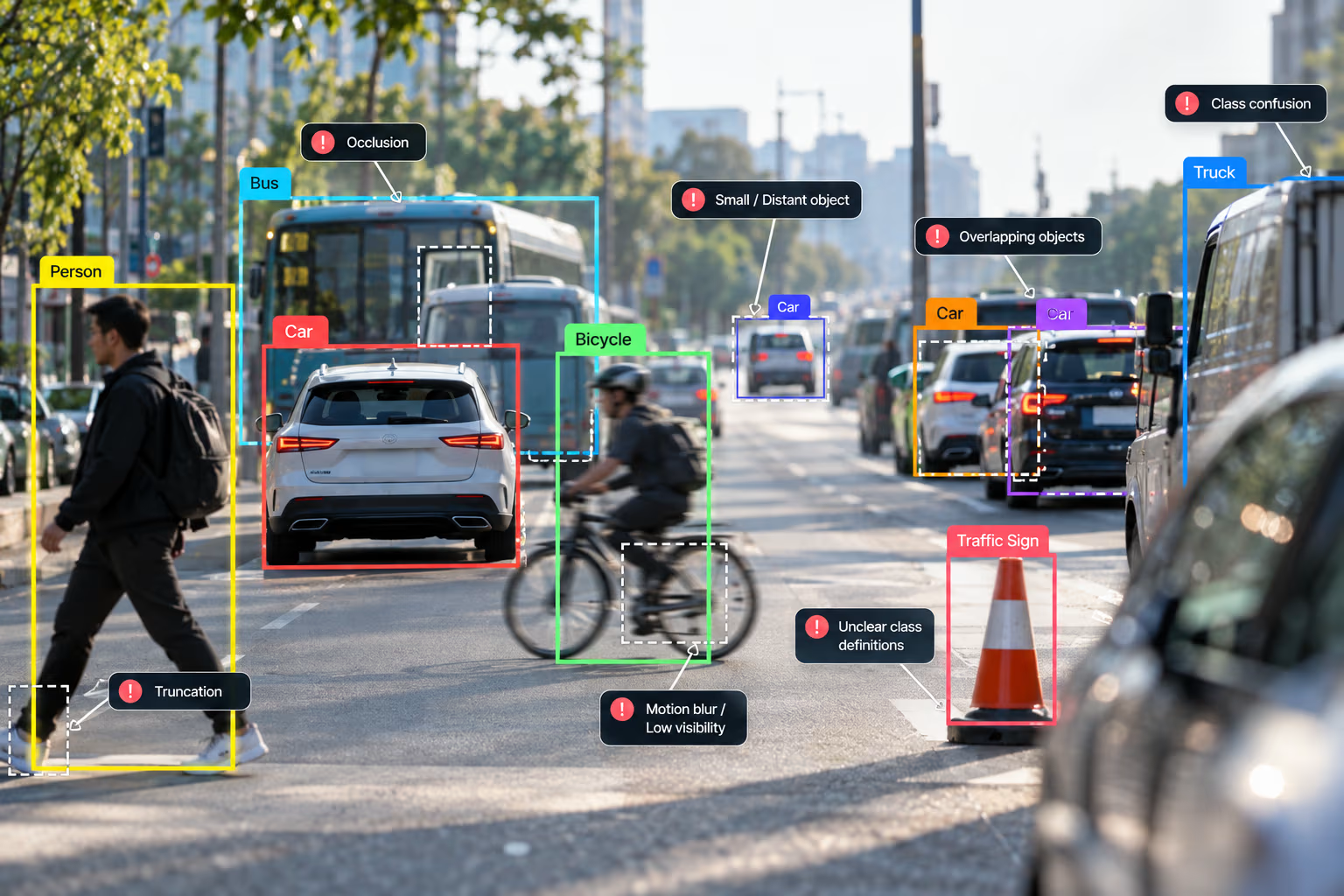
What Are the Most Common Computer Vision Annotation Challenges?
Visual data contains ambiguity that becomes more difficult to manage as datasets grow.
Scale makes these challenges more significant because small inconsistencies can be repeated across thousands or millions of annotations.
The objective of quality control is not to eliminate all uncertainty from visual data. It is to define how uncertainty should be handled so different annotators do not resolve the same situation in conflicting ways.
How Do Occlusion and Ambiguous Objects Affect Annotation?
Occlusion occurs when part of an object is hidden by another object or environmental feature. Ambiguity may also arise from poor lighting, blur, distance, overlapping instances, unusual viewpoints, or incomplete visibility.
Without predefined rules, one annotator may label the partially visible object, another may ignore it, and a third may estimate its full boundary. Each decision may appear reasonable independently, but together they create inconsistent ground truth.
Guidelines should specify when an uncertain object should be:
labeled normally
labeled with an occlusion attribute
partially outlined
ignored
assigned an uncertainty state
escalated for review
The correct rule depends on the model objective. What matters is that the decision is deliberate and reproducible.
How Can Annotation Bias Affect Computer Vision Models?
Annotation bias can enter a dataset through both the underlying visual data and the labeling specification.
Examples include:
particular environments being underrepresented
certain object appearances being systematically missed
subjective classes being interpreted differently
difficult edge cases being excluded disproportionately
the same visual feature being classified differently across groups
annotators relying on assumptions not defined in the guidelines
These patterns can change what the model learns.
Reducing annotation-related bias therefore requires representative data, clear class definitions, consistent decision rules, dataset review, and deliberate coverage of relevant operating conditions. Ultralytics also emphasizes diverse data, balanced representation, and consistent labeling practices when developing computer vision datasets.
Frequently Asked Questions
1. What is an example of computer vision data annotation?+
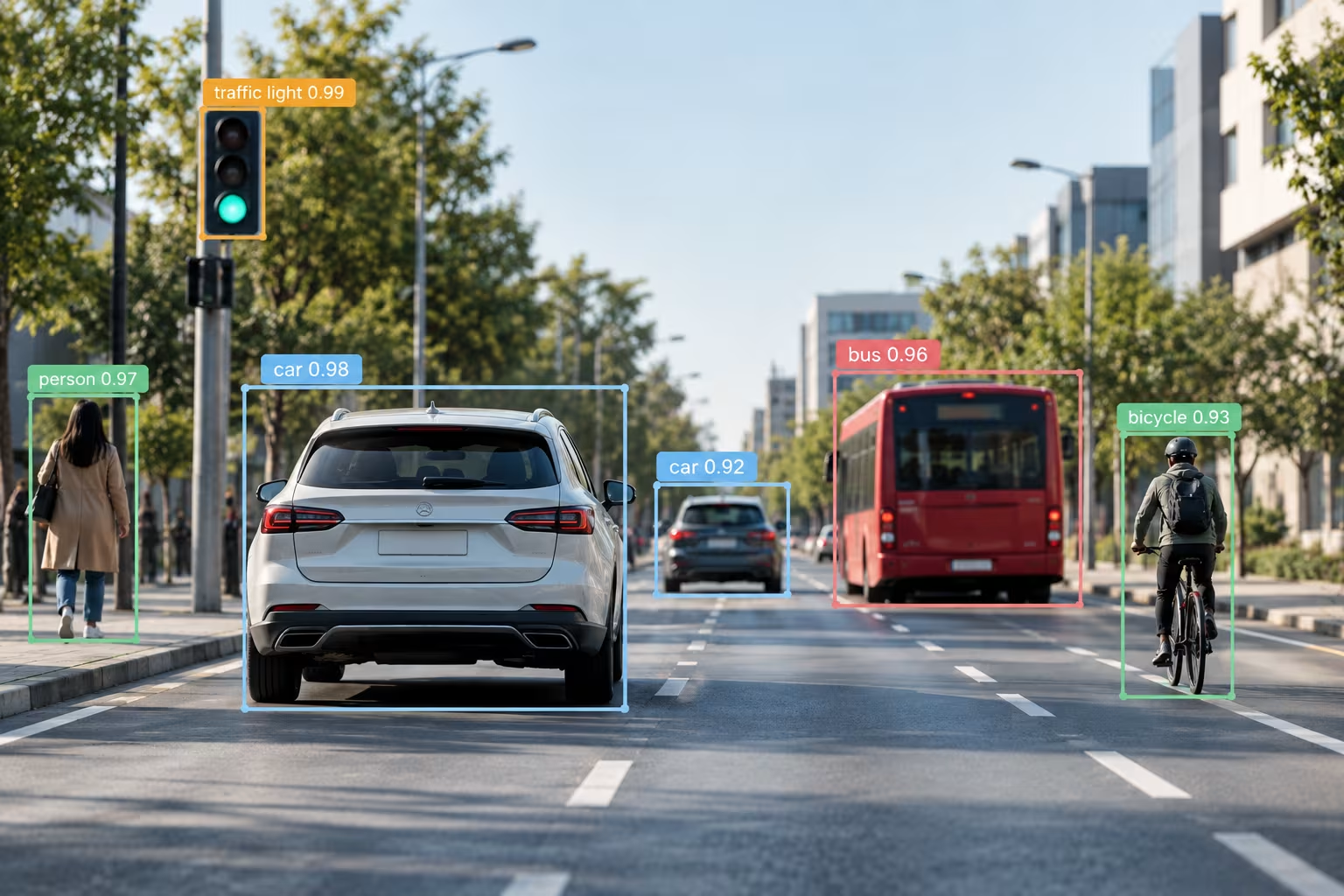
Consider an object-detection model designed to identify vehicles in road images.
The raw input is an image containing several objects. An annotator draws a bounding box around each relevant vehicle and assigns the correct class, such as car, bus, or truck. These labeled locations become ground truth.
The relationship is:
Raw road image → vehicle bounding boxes and class labels → ground truth → object-detection model
During supervised training, the model learns to predict both the class and location of vehicles by comparing its predictions with these reference annotations.
2. What is ground truth in computer vision?+
Ground truth is the reference annotation used to train or evaluate a computer vision model.
It may consist of class labels, bounding boxes, segmentation masks, keypoints, object identities, three-dimensional cuboids, or other task-specific labels.
The term does not mean that annotations are inherently free from error. Ground truth is only as reliable as the specification, human interpretation, validation process, and quality controls used to create it. Poorly defined annotation rules can produce inconsistent reference data even when the annotation format itself is valid.
3. What is the difference between image annotation and computer vision data annotation?+
Image annotation is a subset of computer vision data annotation.
Image annotation specifically refers to adding structured labels to still images. Computer vision data annotation is broader and can include still images, video sequences, first-person or egocentric video, three-dimensional data, LiDAR point clouds, and other visual or spatial sensor inputs.
The broader term is therefore more appropriate when a computer vision system learns from several forms of visual or spatial data rather than from individual images alone.
4. What is the difference between bounding boxes and segmentation?+
Bounding boxes provide approximate object localization by drawing a rectangle around an object.
Segmentation represents the object or region at the pixel level.
The appropriate choice depends on what the model must predict. If the objective is to determine that a pedestrian exists at a particular location, a bounding box may be sufficient. If the system needs the pedestrian’s exact silhouette or must distinguish the person from closely surrounding pixels, segmentation provides more precise ground truth.
Segmentation generally requires greater annotation effort, so the additional precision should correspond to a genuine model requirement.
5. Can computer vision data annotation be automated with AI?+
Parts of the annotation process can be automated or accelerated using Artificial Intelligence.
A model may generate preliminary bounding boxes, masks, classes, or tracked object locations that human annotators then verify and correct. Interpolation can also propagate annotations across video frames, reducing repetitive manual work.
The appropriate level of automation depends on the dataset and task. Common objects in clear imagery may be suitable for substantial model assistance, while ambiguous examples, rare classes, unusual environments, and complex edge cases may require greater human review.
AI-generated annotations therefore still need a validation strategy. Automation can reduce annotation effort, but it does not remove the need to define ground truth, measure quality, resolve uncertainty, and verify that the labels remain aligned with the intended computer vision objective.
6. What are the main types of computer vision data annotation?+
The main types of computer vision data annotation include image classification, bounding boxes, polygons, semantic segmentation, instance segmentation, keypoints, video tracking, and three-dimensional annotation.
Each type supports a different model objective. Classification identifies what an image represents. Bounding boxes and polygons locate objects. Segmentation defines pixel-level regions. Keypoints mark specific landmarks. Video tracking maintains object identity across frames. Three-dimensional annotation adds spatial information such as depth, position, and orientation.
7. How do you choose the right annotation type for a computer vision project?+
The right annotation type should be based on what the model needs to predict.
If the model needs to identify what is present, classification may be enough. If it needs to identify what is present and where, bounding boxes may be appropriate. If it needs exact boundaries, segmentation or polygons may be required. If it needs pose, structure, or movement references, keypoints may be more useful. If it needs to understand objects over time, video tracking may be required.
The decision should also consider object size, density, occlusion, truncation, visual ambiguity, required boundary precision, annotation effort, and the downstream evaluation method.
8. What does the computer vision data annotation process involve?+
A production-quality annotation process begins before labeling starts.
The workflow typically includes defining the model task, creating the annotation ontology, writing clear guidelines, calibrating annotators with a representative sample, annotating manually or with AI assistance, reviewing outputs, resolving disagreements, and exporting the validated dataset in the required format.
This process helps ensure that annotations are not only completed at scale, but also remain consistent with the intended model objective.
9. How is computer vision annotation quality measured?+
Annotation quality should be measured according to the annotation type and the error that matters for the model task.
For classification, quality may be measured through inter-annotator agreement or expert-reference agreement. For bounding boxes and segmentation, Intersection over Union can help measure spatial overlap. Other relevant measures include missing-object rate, class-error rate, completeness rate, boundary deviation, keypoint distance, identity-switch rate for tracking, rework rate, and reviewer disagreement rate.
Annotation-quality metrics should also be distinguished from model-performance metrics. A model’s precision, recall, or accuracy score does not automatically prove that the reference annotations were correct.
10. What are the most common challenges in computer vision data annotation?+
Common challenges include unclear class definitions, different annotator interpretations, occlusion, truncation, overlapping objects, small or distant objects, poor image quality, class imbalance, and large-scale production inconsistency.
These issues become more serious as datasets grow because small inconsistencies can be repeated across thousands or millions of annotations. The goal of quality control is not to remove every uncertainty from visual data, but to define how uncertainty should be handled so that similar cases are annotated in the same way.