Egocentric Video Data Collection Services for Robotics and Embodied AI
Oct 27, 2026 | 20 min read
A useful egocentric dataset is not defined by how many hours of video it contains.
It is defined by whether those hours contain the tasks, interactions, viewpoints, environments, variations, and edge cases the model needs to learn from.
IndiVillage provides egocentric video data collection for robotics, Physical AI, embodied AI, and Vision-Language-Action teams that need structured first-person human-task data.
Our collection programs are designed backward from the model objective. We translate the required model behavior into task specifications, capture protocols, environment and participant requirements, metadata, quality criteria, and delivery structures before production begins.
The result is more than first-person footage. It is a controlled dataset designed around a defined training or evaluation requirement.
What Is Egocentric Video Data Collection?
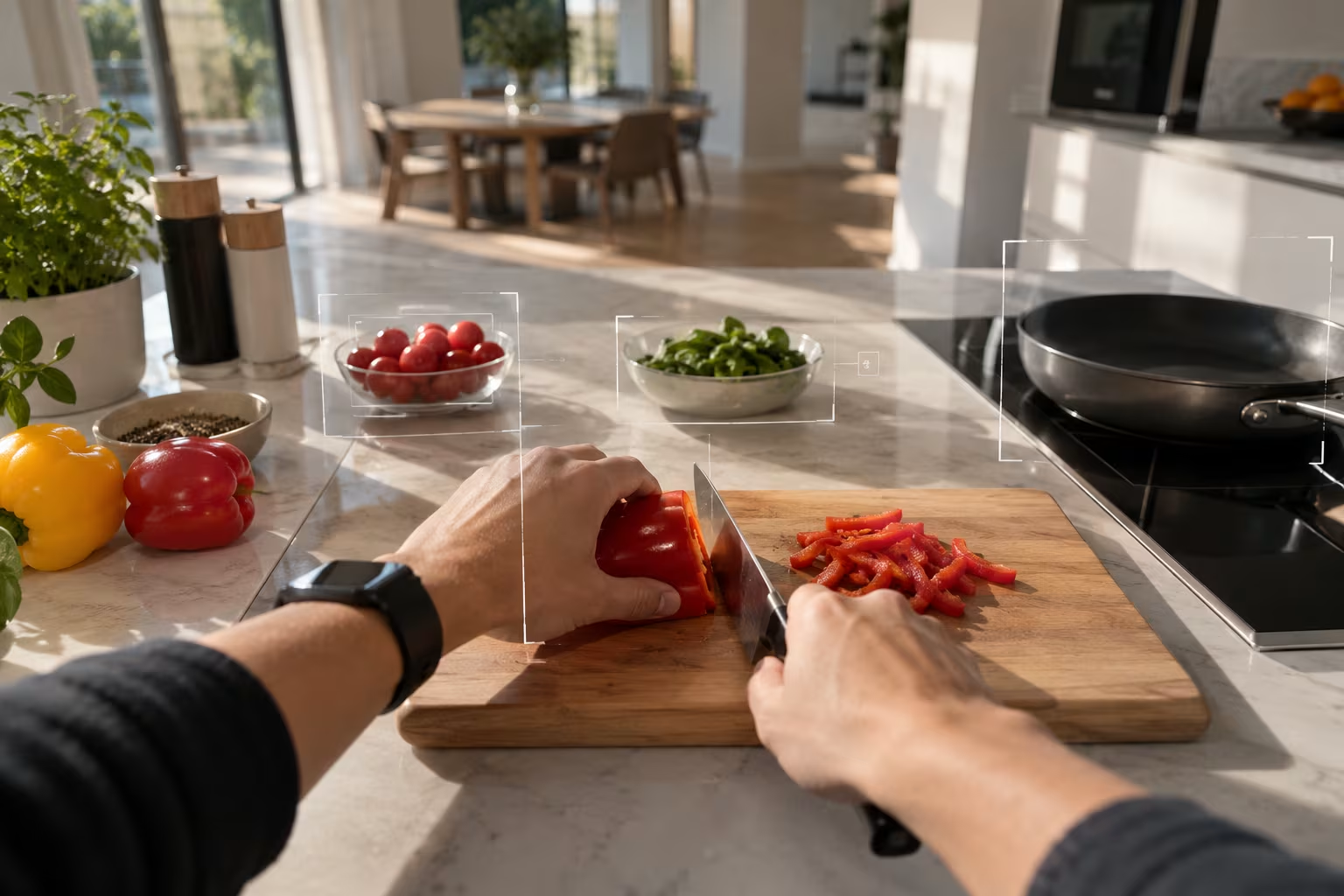
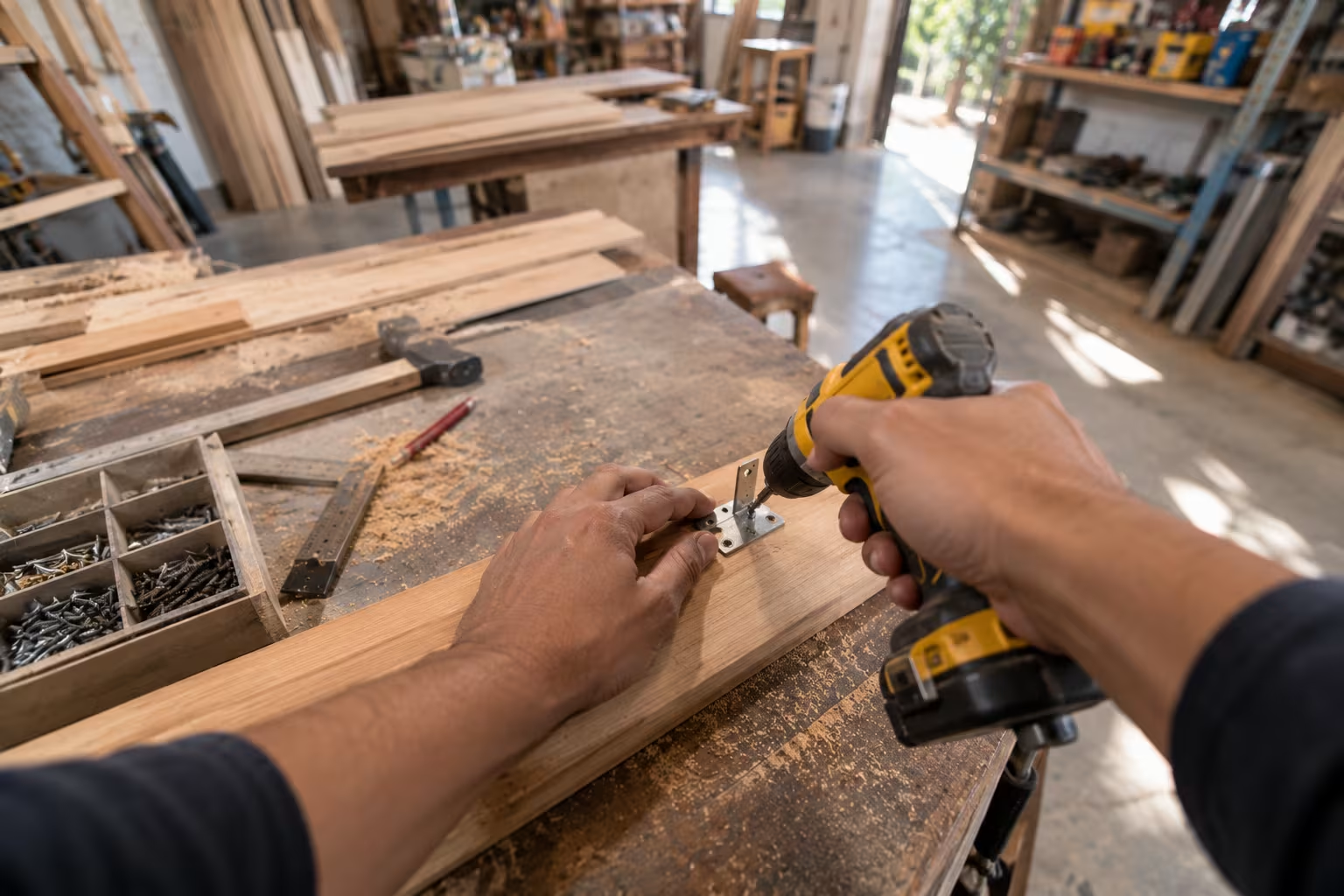
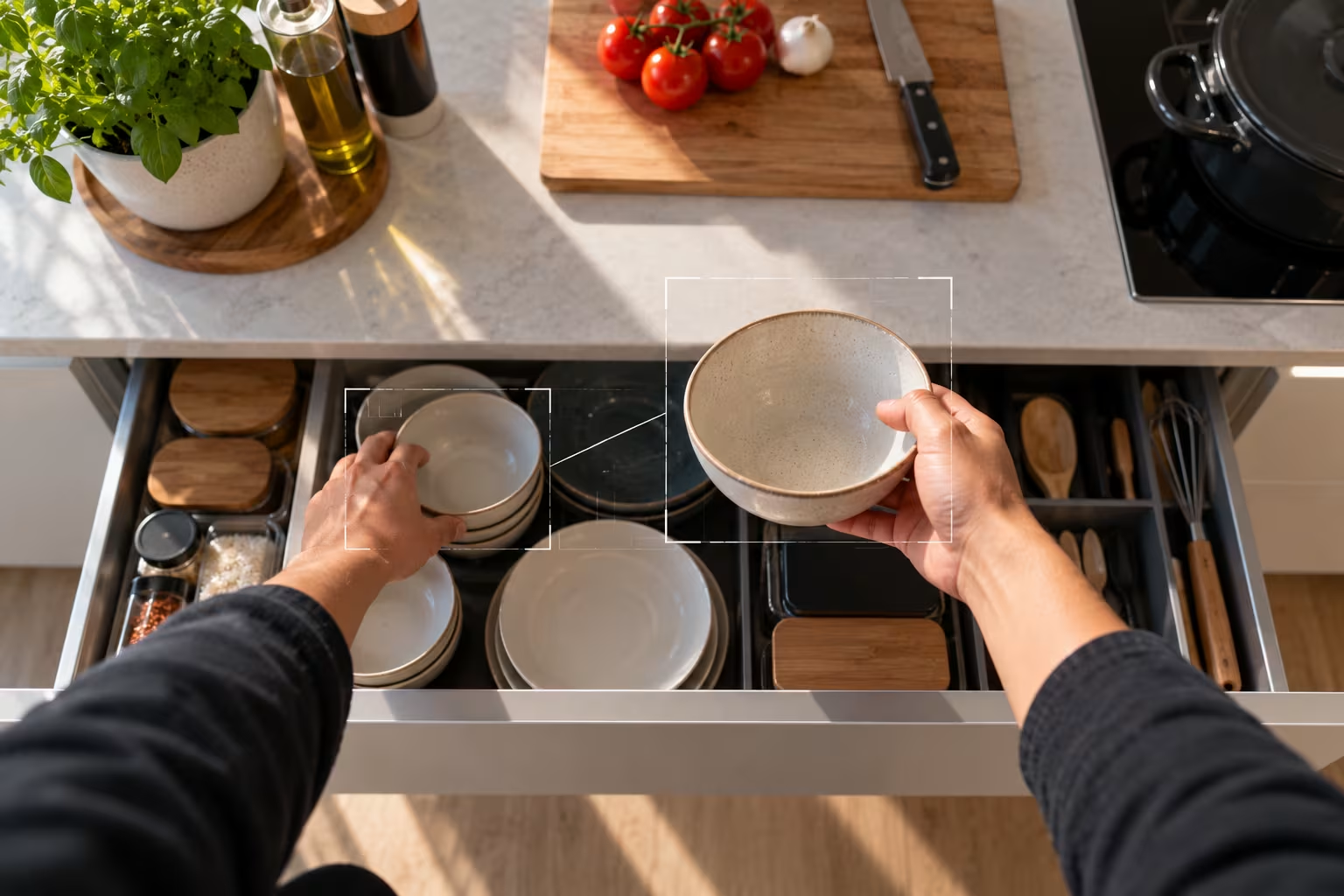
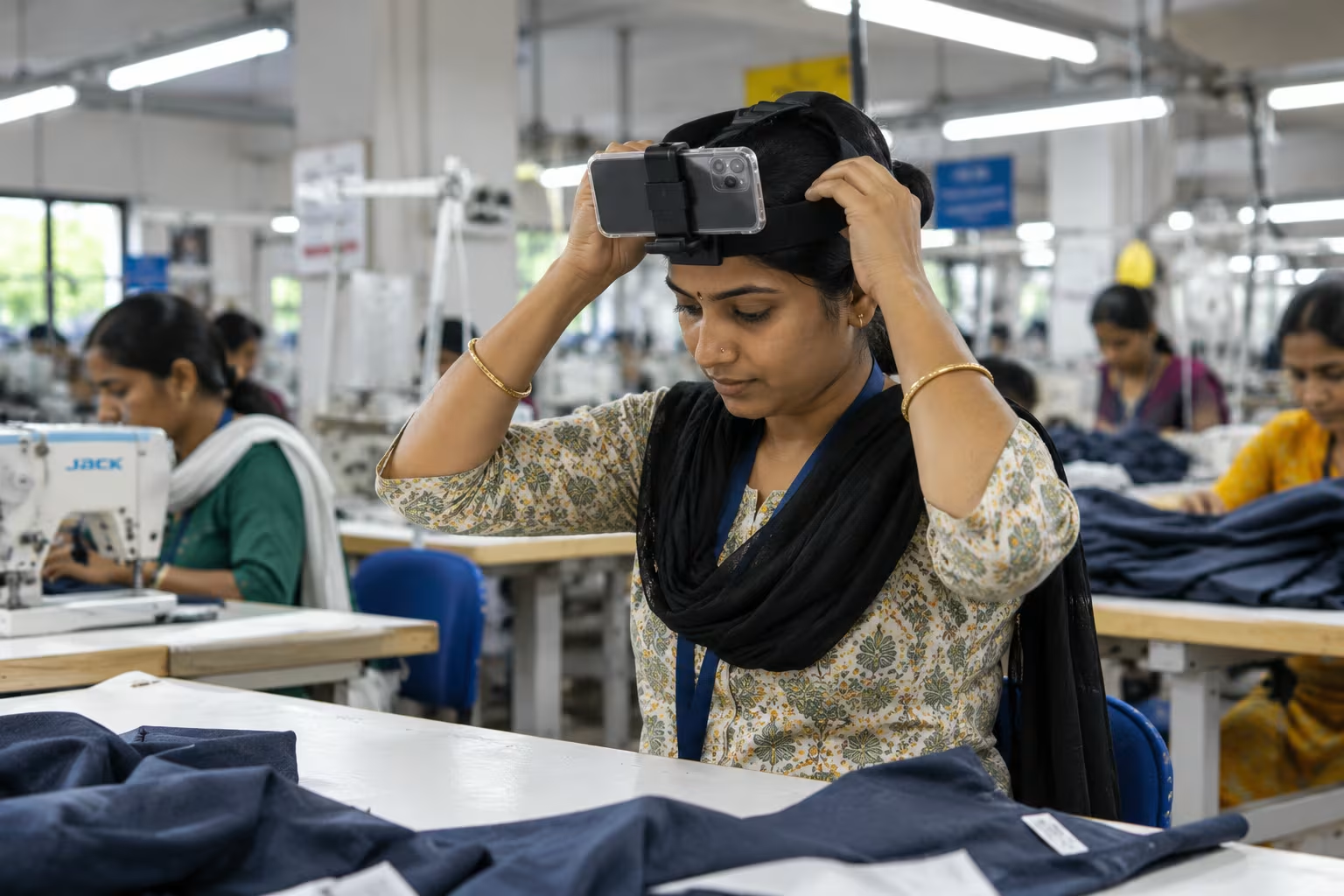
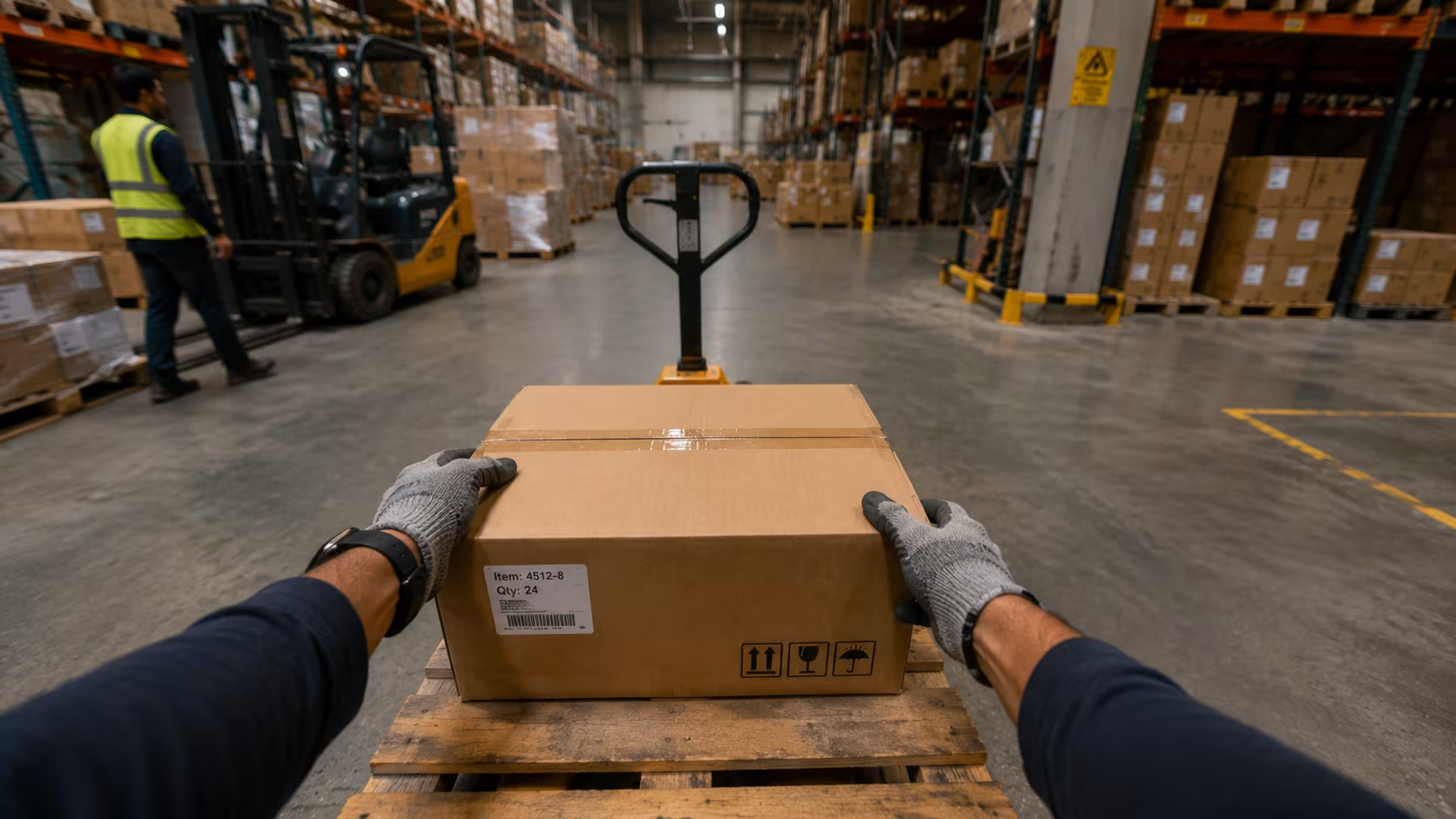
Egocentric video data collection captures real-world activities from the first-person perspective of the person performing them, typically through wearable, head-mounted, or other approved body-mounted camera configurations.
Because the camera moves with the participant, the footage can preserve actor-relative details such as hand movements, object manipulation, tool use, task progression, and changes in viewpoint during an activity.
The more important question for a custom project is not what egocentric video is, but what the dataset needs to contain.
Start With the Model Requirement, Not the Video-Hour Target
A request for “500 hours of egocentric video” defines volume.
It does not define a dataset.
Two collections can contain the same number of hours and provide very different coverage of the behavior a model needs.
Consider a model expected to understand object transfer between two hands. A large collection of general household footage may contain relatively few clean examples of that interaction. A smaller program intentionally designed around object transfers can control which objects are used, which hand initiates the action, whether orientation changes, whether the transfer succeeds, and whether the interaction remains visible throughout the sequence.
The useful specification therefore begins further upstream.
For every proposed capture program, this sequence helps answer a more important question than total duration:
What needs to happen inside the video for that video to be useful?
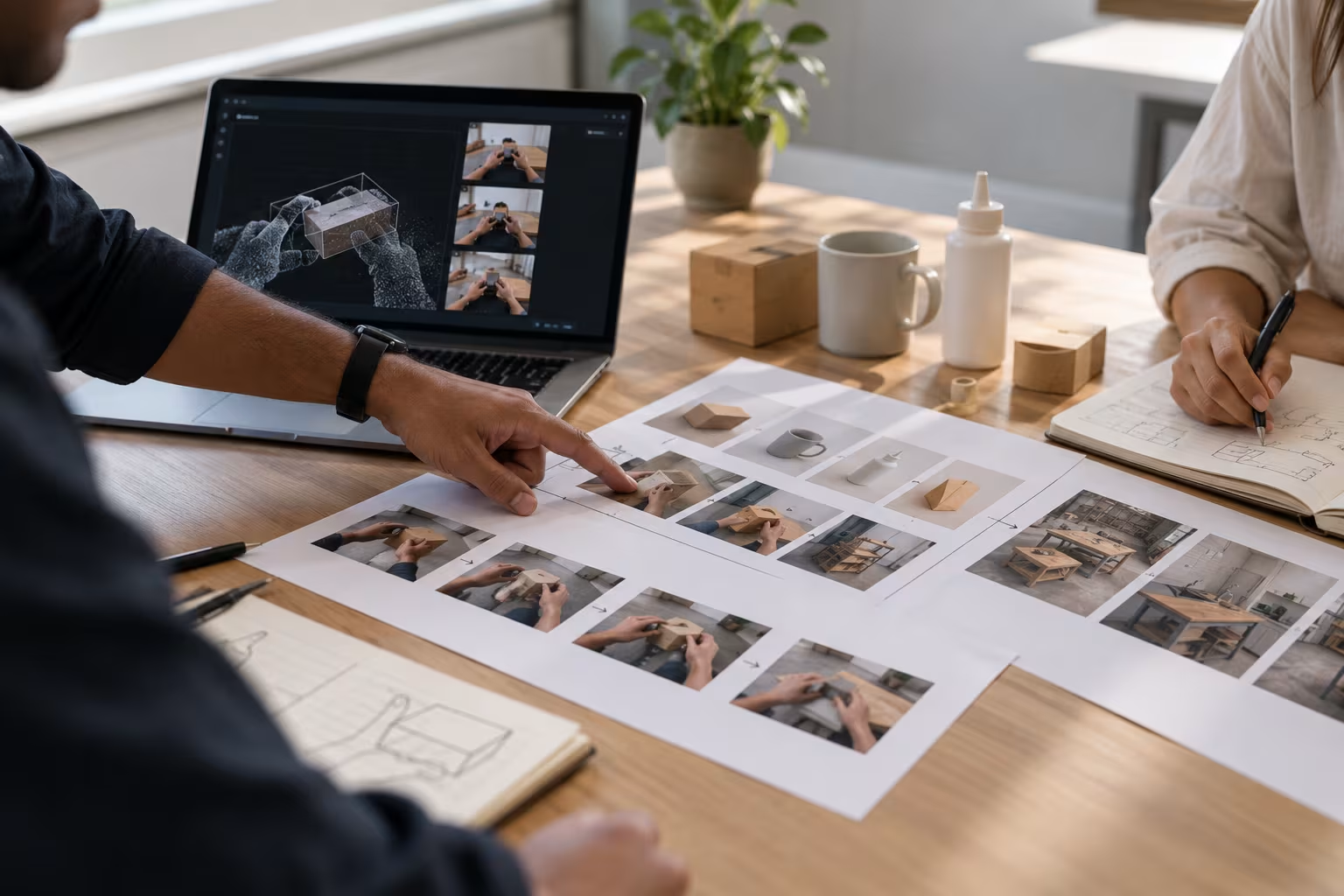
Turn the Model Objective Into a Coverage Plan
Once the target behavior is understood, the next step is deciding what the dataset must cover.
A manipulation model, for example, may not simply need examples of “picking up objects.” Its performance may depend on differences in object size, shape, placement, orientation, accessibility, task sequence, or environment.
The collection plan should identify which of those differences are meaningful to the intended model and which are unnecessary.
Model requirement
Collection decision
Question to resolve
Learn a physical action
Task definition
What exactly must the participant do?
Observe manipulation
Viewpoint
Which interaction must remain visible?
Handle task variation
Objects and conditions
Which variations may affect execution?
Generalize across relevant settings
Environment design
Which deployment conditions need representation?
Distinguish task outcomes
Completion criteria
What constitutes success, partial completion, or failure?
Filter and organize sessions
Metadata
What information must accompany each recording?
Maintain usable source data
QA specification
What causes a session to be accepted or rejected?
This is where custom collection differs most from simply sourcing more footage.
The objective is not maximum variety. It is relevant coverage.
A difference should be introduced because it matters to the model, evaluation plan, or expected deployment environment, not because diversity looks impressive in a dataset description.
Build the Task Specification Before Capture Begins
A broad scenario needs to be translated into observable actions before participants start recording.
“Kitchen activity,” for example, could include hundreds of possible behaviors. If the model needs manipulation data, the useful units may instead be actions such as retrieving an object, opening a container, transferring an ingredient, operating a utensil, repositioning an item, wiping a surface, or storing an object.
Likewise, “warehouse activity” is too broad to function as a reliable collection instruction.
Picking an item from a shelf, checking its orientation, placing it in packaging, sorting by category, scanning an object, repositioning inventory, and inspecting packaging all produce different interaction sequences.
Defining the task at this level improves both capture consistency and downstream usability.
It also helps teams identify what must remain visible, what variation is permitted, what counts as task completion, and which sessions should be rejected.
Design the Capture Protocol Around Repeatability
The collection protocol converts the dataset specification into instructions that participants and field teams can execute consistently.
A complete protocol can define the task, permitted environments, camera position, recording conditions, required objects, participant instructions, task boundaries, visibility requirements, relevant variation, metadata fields, and acceptance criteria.
The important distinction is between what should remain fixed and what should intentionally vary.
One project may require identical task instructions while varying object orientation.
Another may intentionally capture several valid ways to complete the same activity.
A third may require consistent object placement because the research question concerns the manipulation itself rather than environmental variation.
These decisions should be deliberate.
Without them, different participants can create visually plausible recordings that represent different underlying tasks.
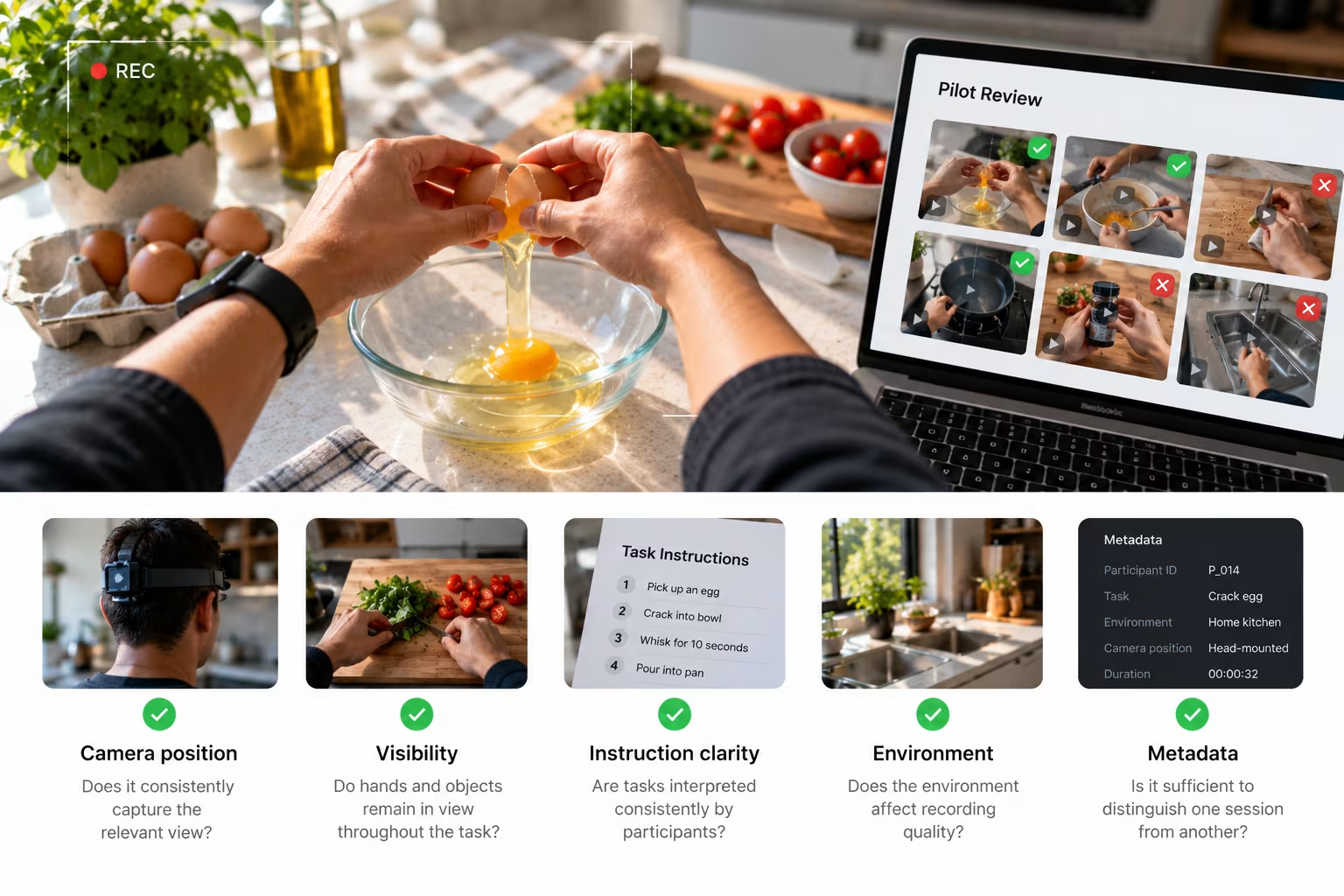
What Should a Pilot Validate?
The first meaningful output of an egocentric collection project should usually be a representative pilot rather than full-scale production.
A pilot tests the specification against reality.
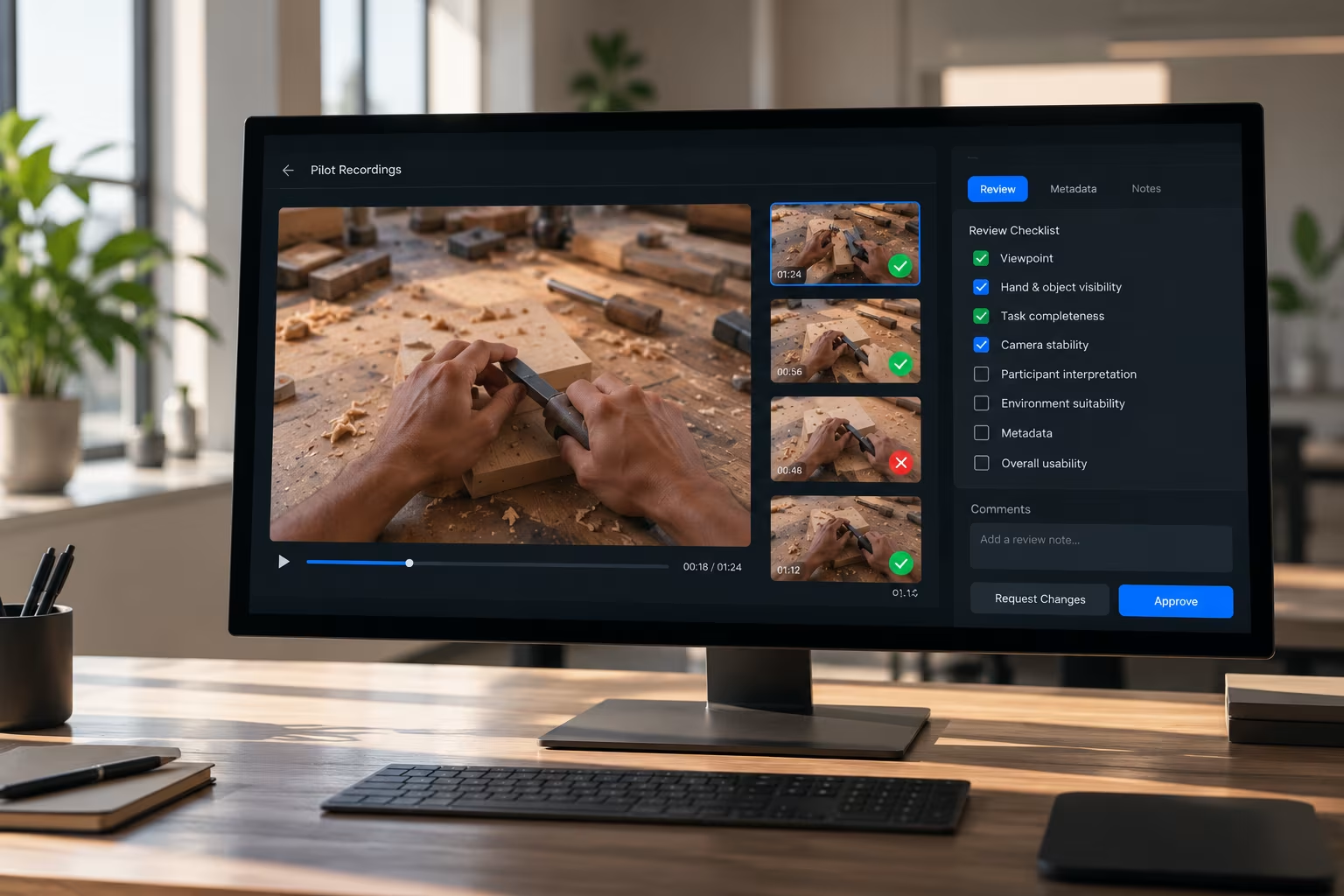
It can reveal whether the selected camera position consistently captures the manipulation area, whether hands or objects disappear from view, whether task instructions are interpreted consistently, whether the environment affects recording quality, and whether the metadata is sufficient to distinguish one session from another.
It can also reveal problems that are difficult to anticipate from written instructions alone.
A task may contain an intermediate step that regularly happens outside the camera's field of view.
Participants may begin recording after the model-relevant action has already started.
A supposedly simple instruction may produce several materially different behaviors.
An environment may introduce reflections, clutter, movement, or visibility issues that make otherwise correct recordings difficult to use.
These are inexpensive problems to discover during a pilot and expensive problems to discover after hundreds of hours have been collected.
IndiVillage supports pilot-scale collection so capture workflows and output quality can be reviewed before production expands.
What Types of Egocentric Video Can IndiVillage Collect?
Our collection programs can be configured around the task and model requirement rather than around one fixed recording template.
Capture type
What it preserves
Potential use
Wearable / POV capture
First-person task perspective
Action and task understanding
Head-mounted capture
Actor-relative view of hands, objects, and task area
Robot learning and manipulation
Human-object interaction
Grasping, moving, handling, placing, and using objects
Interaction understanding
Task demonstrations
Complete execution of defined activities
Human demonstration and imitation-learning workflows
Fine-motor activity
Smaller hand and object movements
Dexterous manipulation
Multi-step tasks
Ordered activity across several stages
Procedural and long-horizon task understanding
Indoor / outdoor capture
Activities in relevant approved environments
Environment-specific training or evaluation
Multi-environment programs
Task families recorded across defined settings
Deployment-relevant dataset coverage
The exact configuration should be chosen according to the project requirement.
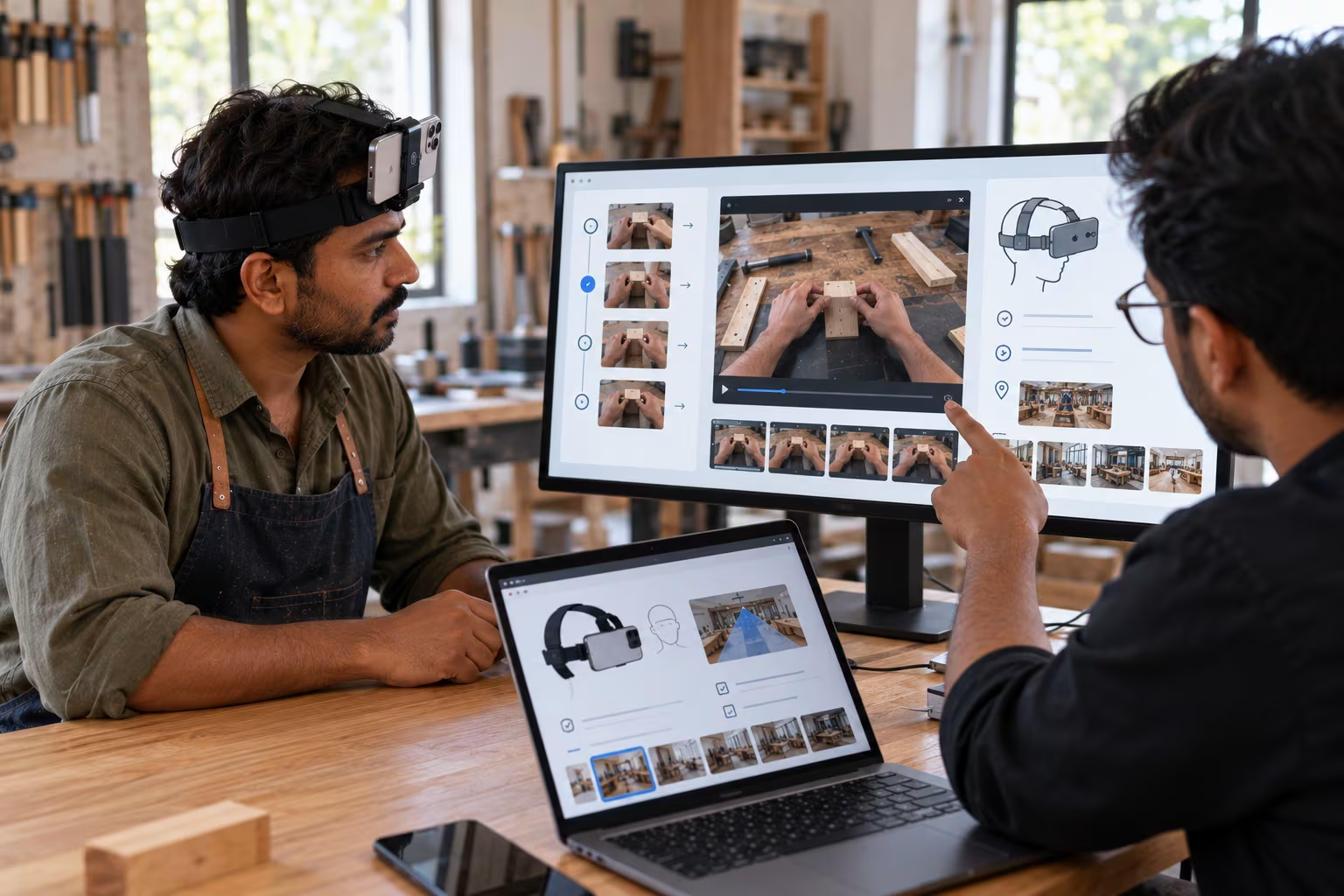
Wearable and Head-Mounted Capture
Camera placement affects what the dataset can preserve.
A suitable configuration should provide the required field of view while keeping the model-relevant interaction visible through the task.
A setup that works well for packing at a workbench may not suit a task involving greater participant movement or small, close-range manipulation.
Representative recordings should therefore be reviewed before production to confirm that the intended behavior is visible from the selected configuration.
Human-Object Interaction and Task Demonstrations
For many robotics use cases, the useful signal lies in the interaction between the person and the physical environment.
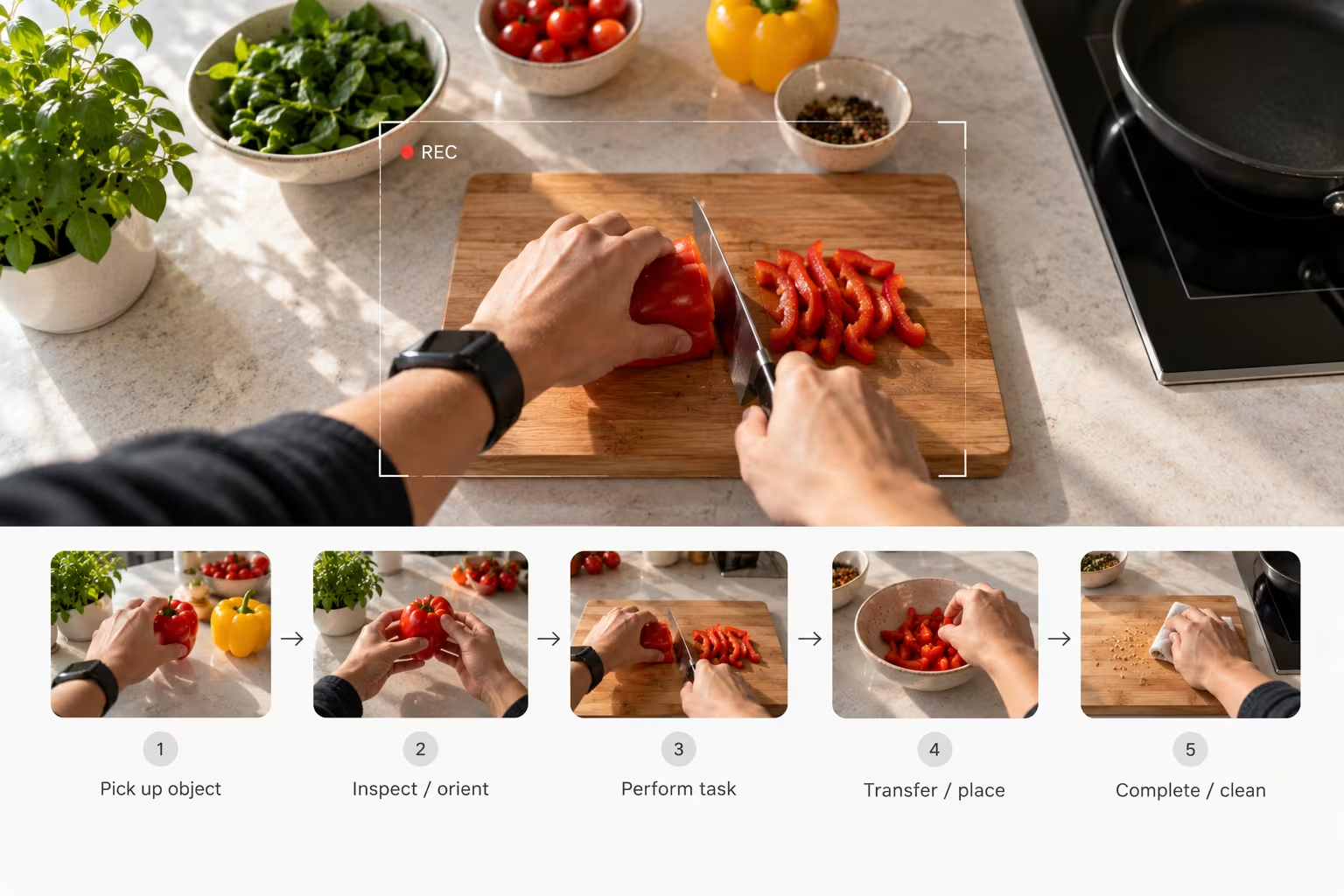
A participant may approach an object, change grip, reposition it, stabilize it with another hand, use a tool, complete the action, and inspect the outcome.
Capturing the complete sequence preserves more useful task context than collecting isolated visual moments.
Fine-motor activity creates a specific capture challenge because important information can occur through small changes in hand position, grip, orientation, or object state.
The recording specification should therefore establish which stages must remain visible and where the task begins and ends.
This is especially important for multi-step procedures. A recording that captures the beginning and final result but misses an important manipulation stage may be technically complete as a video file while still being unsuitable for the intended dataset.
What Metadata Should Travel With the Video?
At scale, a folder of video files is not enough.
Each recording needs enough context to make it traceable, filterable, and reviewable.
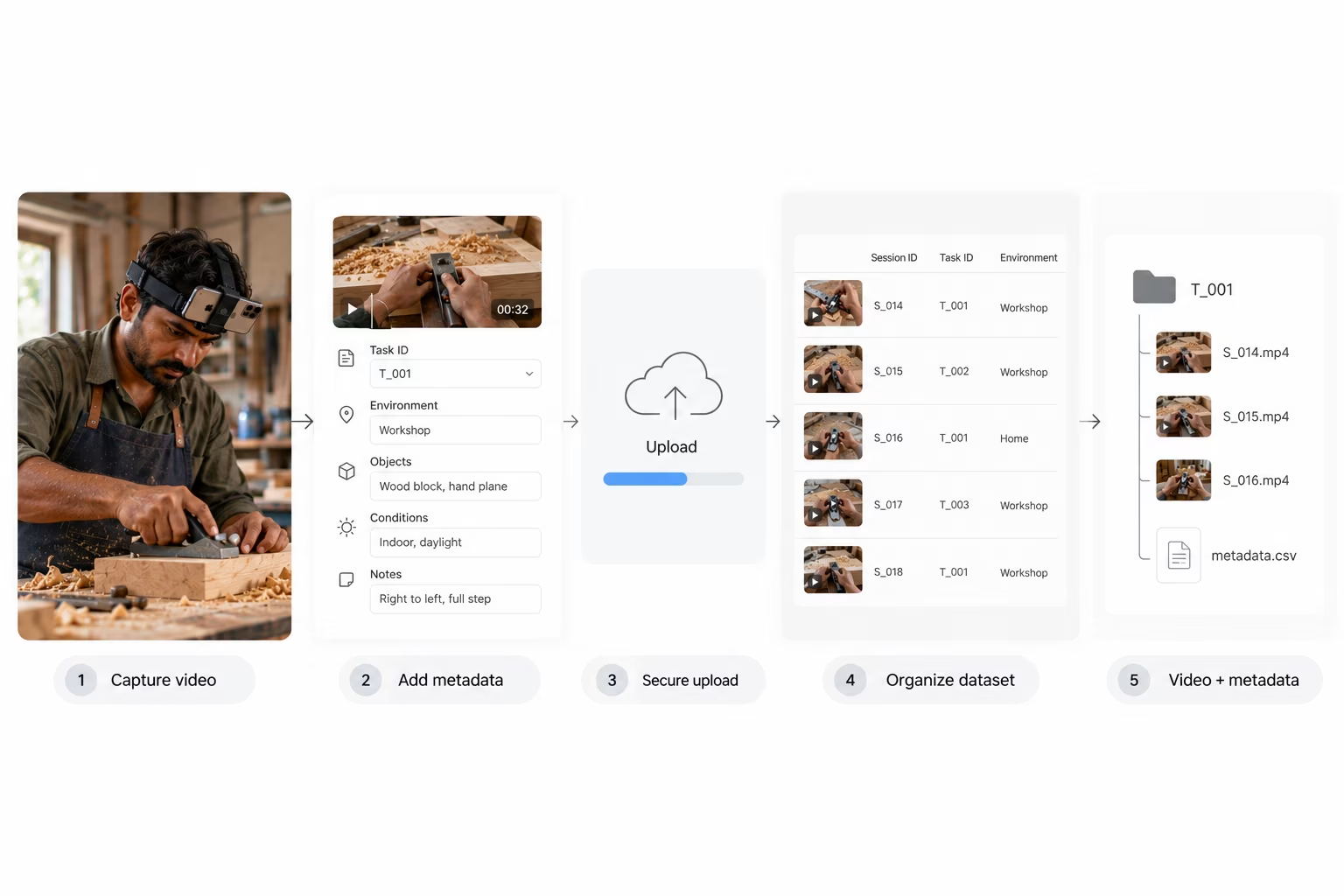
Depending on the project and permissions, IndiVillage can structure delivery around fields such as task ID, session ID, environment label, permitted participant/session identifiers, object lists, recording conditions, session notes, QA status, and file manifests.
The appropriate schema should be determined before production.
For example, if object configuration matters to the model but is not captured as metadata, separating those conditions later may require manual re-review of the footage.
Metadata is therefore not simply administrative information.
It helps preserve the experimental structure of the collection.
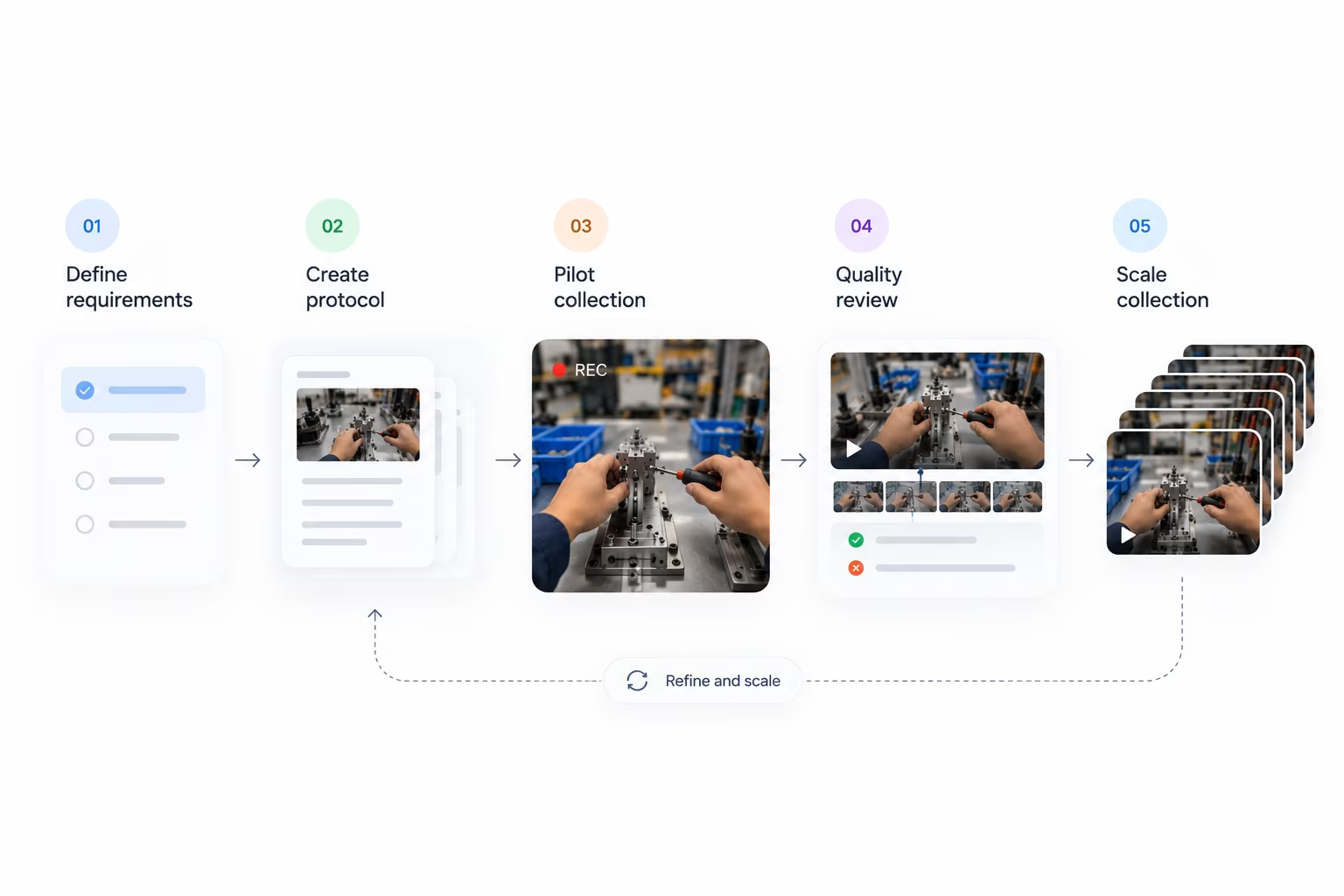
Our Egocentric Video Data Collection Process
The collection workflow moves from model requirements to repeatable production rather than from available cameras to video volume.
1. Define the Model and Dataset Requirements
The first stage identifies what the model needs to learn or evaluate and translates that objective into required actions, objects, environments, viewpoints, variation, approximate volume, metadata, and acceptance criteria.
Ambiguities are resolved before participants begin recording.
2. Build and Test the Capture Protocol
Those requirements are translated into field instructions covering camera positioning, task execution, recording boundaries, visibility, environment setup, permitted variation, and metadata.
Representative recordings are then reviewed before the specification is approved.
The protocol should be treated as a controlled project document. If a requirement changes, the change should be versioned and communicated rather than introduced informally during production.
3. Run a Representative Pilot
A pilot tests whether the planned workflow actually produces usable data.
The review can evaluate viewpoint, hand and object visibility, task completeness, camera stability, participant interpretation, environment suitability, metadata, and downstream usability.
Recurring failures should feed back into the capture protocol before volume increases.
4. Scale Production Without Changing the Dataset
Once the pilot is accepted, capture can expand across the agreed participants, sessions, environments, objects, and task conditions.
The challenge is preserving the same semantic definition of the task as production grows.
If later contributors interpret the task differently, different environments introduce unplanned conditions, or field teams gradually change instructions, the dataset may drift away from the specification even while the number of recorded hours increases.
Production management therefore needs to protect the dataset definition as well as the delivery schedule.
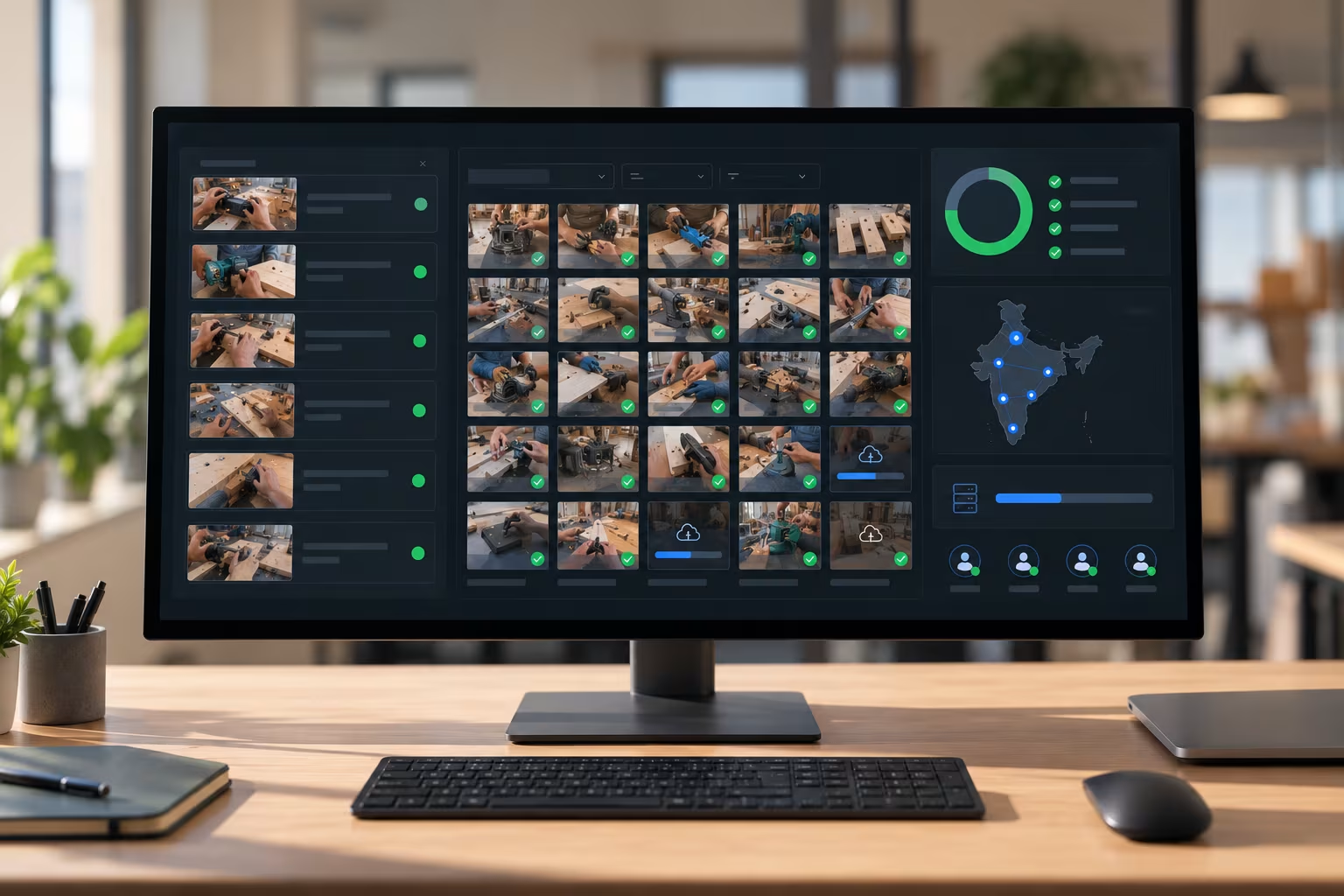
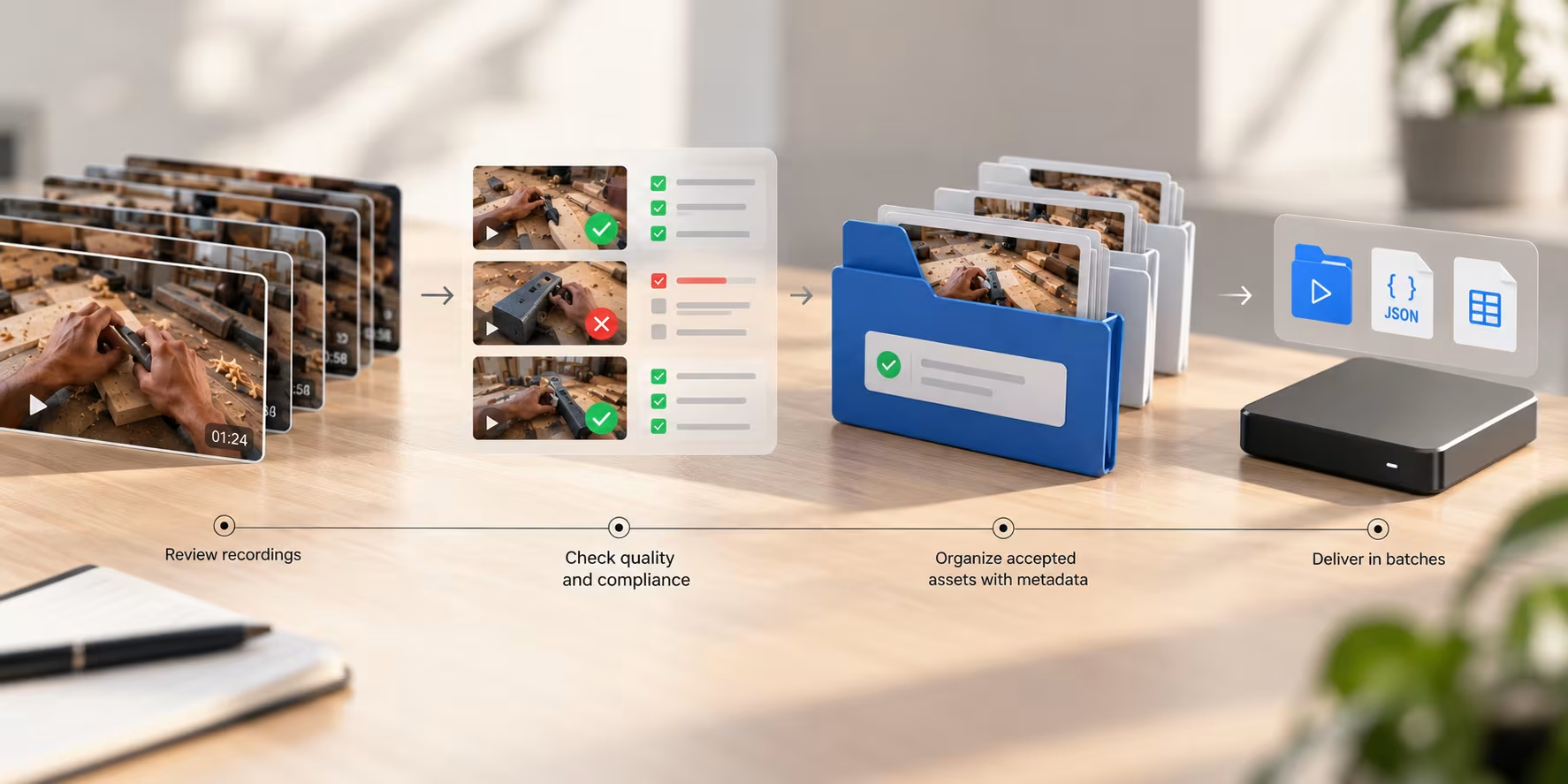
5. Validate and Deliver Data in Batches
Sessions are reviewed against the agreed collection specification before acceptance.
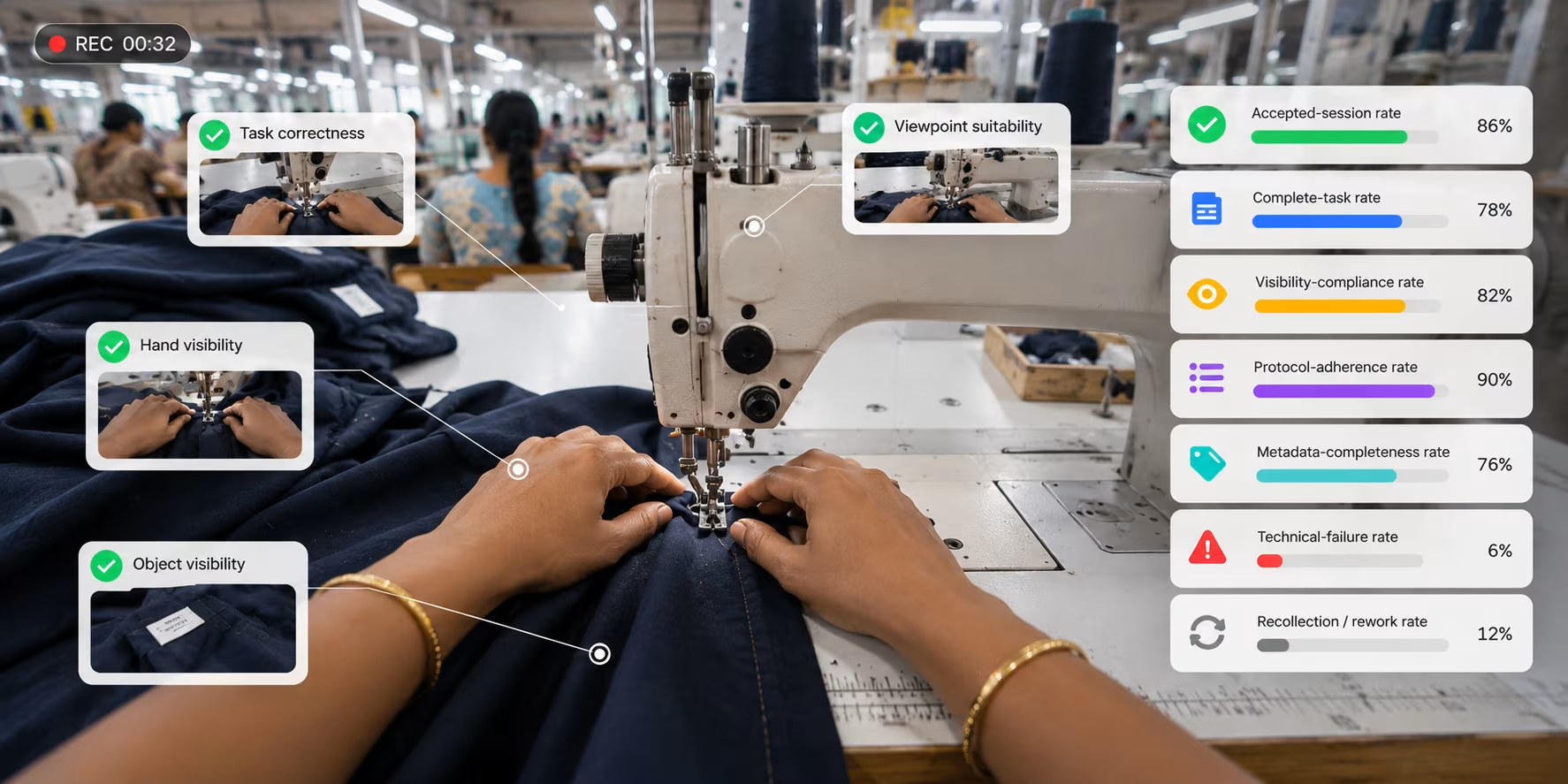
Checks can cover task correctness, completion, required hand and object visibility, orientation, capture usability, protocol compliance, metadata completeness, and technical issues.
Accepted assets can then be delivered in an organized, metadata-linked structure aligned with the client workflow.
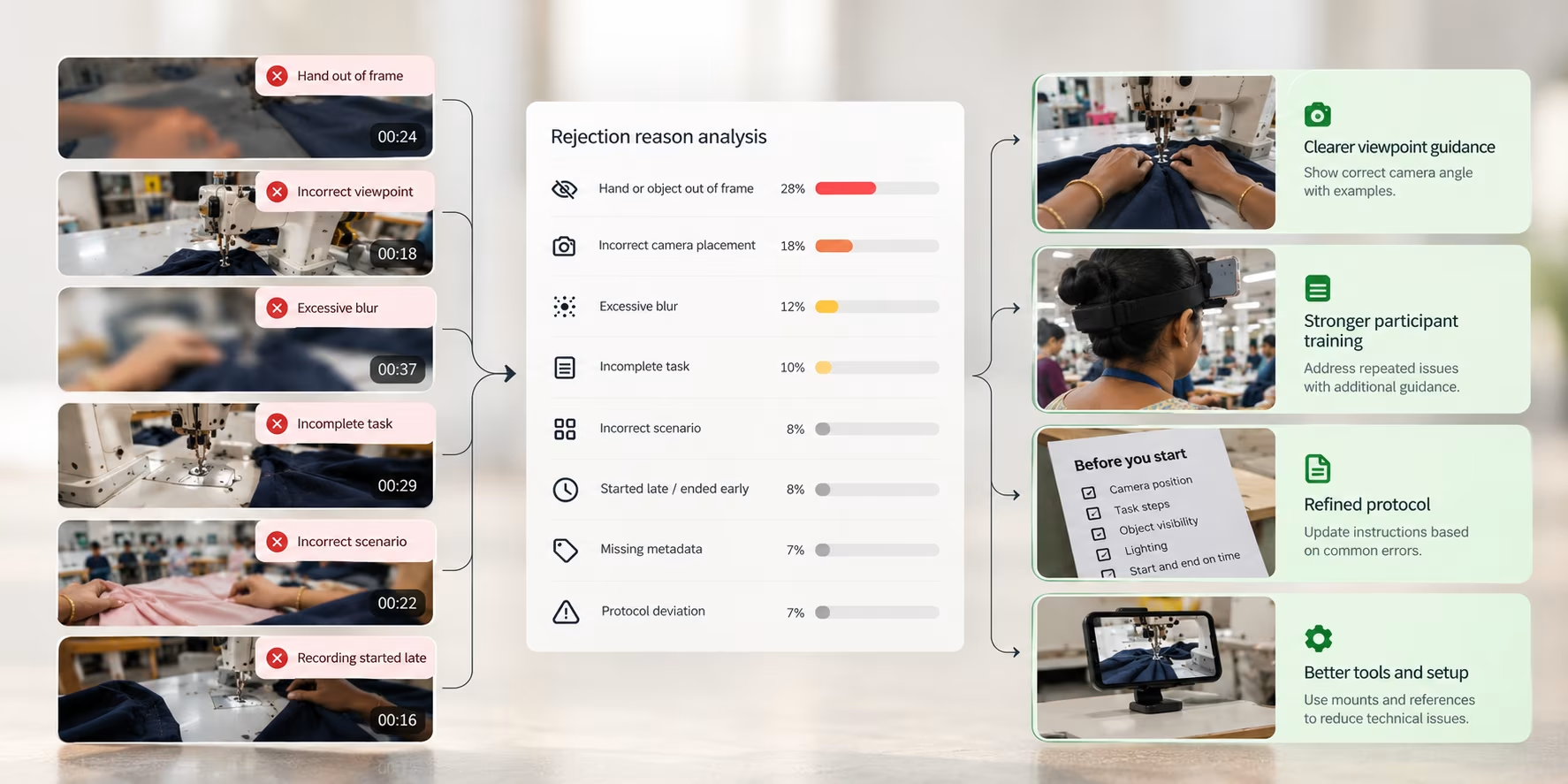
Rejected sessions should also generate useful information.
Tracking rejection reasons allows recurring problems to be identified upstream instead of repeatedly filtering the same error at final QA.
Define Quality Before You Start Recording
Source-data quality should not be reduced to resolution, frame rate, or whether a file opens successfully.
A technically clean video can still fail the dataset requirement.
If the relevant object leaves the frame during manipulation, the video may be unusable.
If the participant performs the wrong task, sharp image quality does not help.
If an important stage is missing, the recording is incomplete.
If the session cannot be linked to the intended conditions, its analytical value may be reduced.
For egocentric collection, useful quality criteria can therefore include task correctness, task completeness, viewpoint suitability, hand and object visibility, capture stability, visual clarity, protocol adherence, metadata completeness, and coverage of required task conditions.
Measure Source-Data Quality Directly
Collection quality should be measured with metrics that describe the collected data rather than with annotation accuracy or eventual model performance.
Metric
What it tells the project team
Accepted-session rate
How much collected footage meets the full specification
Complete-task rate
Whether required task stages are consistently captured
Visibility-compliance rate
Whether model-relevant hands and objects remain visible
Protocol-adherence rate
Whether sessions follow the approved collection rules
Metadata-completeness rate
Whether required session information is present
Technical-failure rate
How much data is lost to recording problems
Recollection / rework rate
How often sessions need to be repeated or corrected
The appropriate thresholds will vary by project.
What matters is agreeing on them before production so quality decisions do not change from batch to batch.
Turn Rejection Reasons Into Upstream Improvements
Rejected video should not simply disappear from the delivery set.
It can reveal where the collection process is failing.
Common reasons may include the relevant hand or object leaving the frame, incorrect camera placement, excessive blur, blocked views, incomplete tasks, incorrect scenarios, recordings beginning too late or ending too early, missing metadata, or deviations from the protocol.
If one participant produces the same failure repeatedly, additional guidance may solve the problem.
If many participants produce the same failure, the problem may be in the protocol.
This distinction matters.
A good QA workflow does not only identify bad data after collection. It helps reduce the production of bad data in later batches.
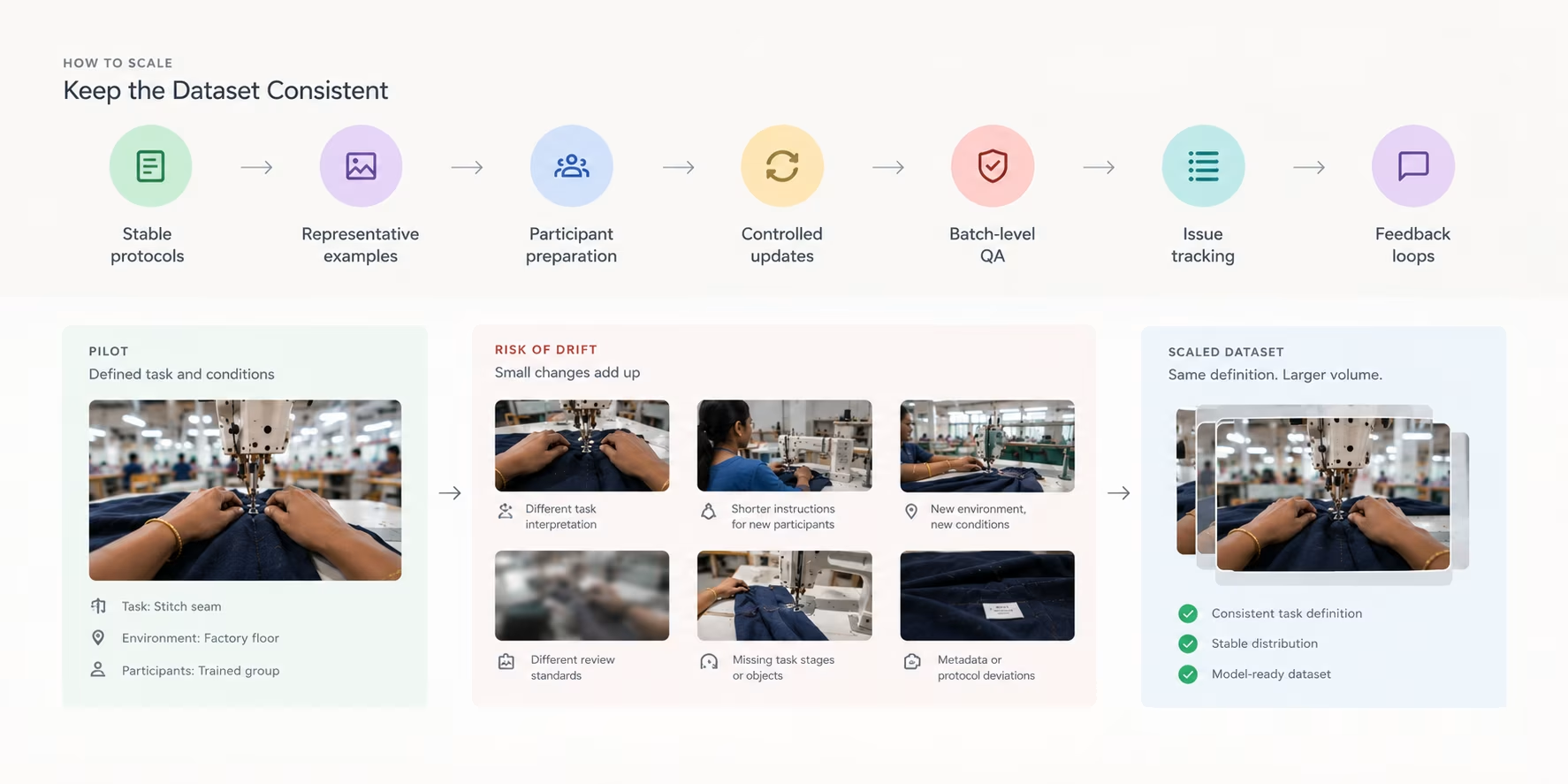
Scale Without Protocol or Distribution Drift
Scaling egocentric video collection introduces a less visible risk than technical failure: the dataset itself can gradually change.
A task initially defined one way may begin to be interpreted differently.
New participants may receive shortened instructions.
A new environment may add conditions that were not part of the accepted pilot.
Different reviewers may develop different ideas of what constitutes acceptable footage.
Each change may appear small. Together, they can alter the distribution of the dataset.
The objective is not simply to reproduce the pilot at a larger volume.
It is to scale without changing what the dataset means.
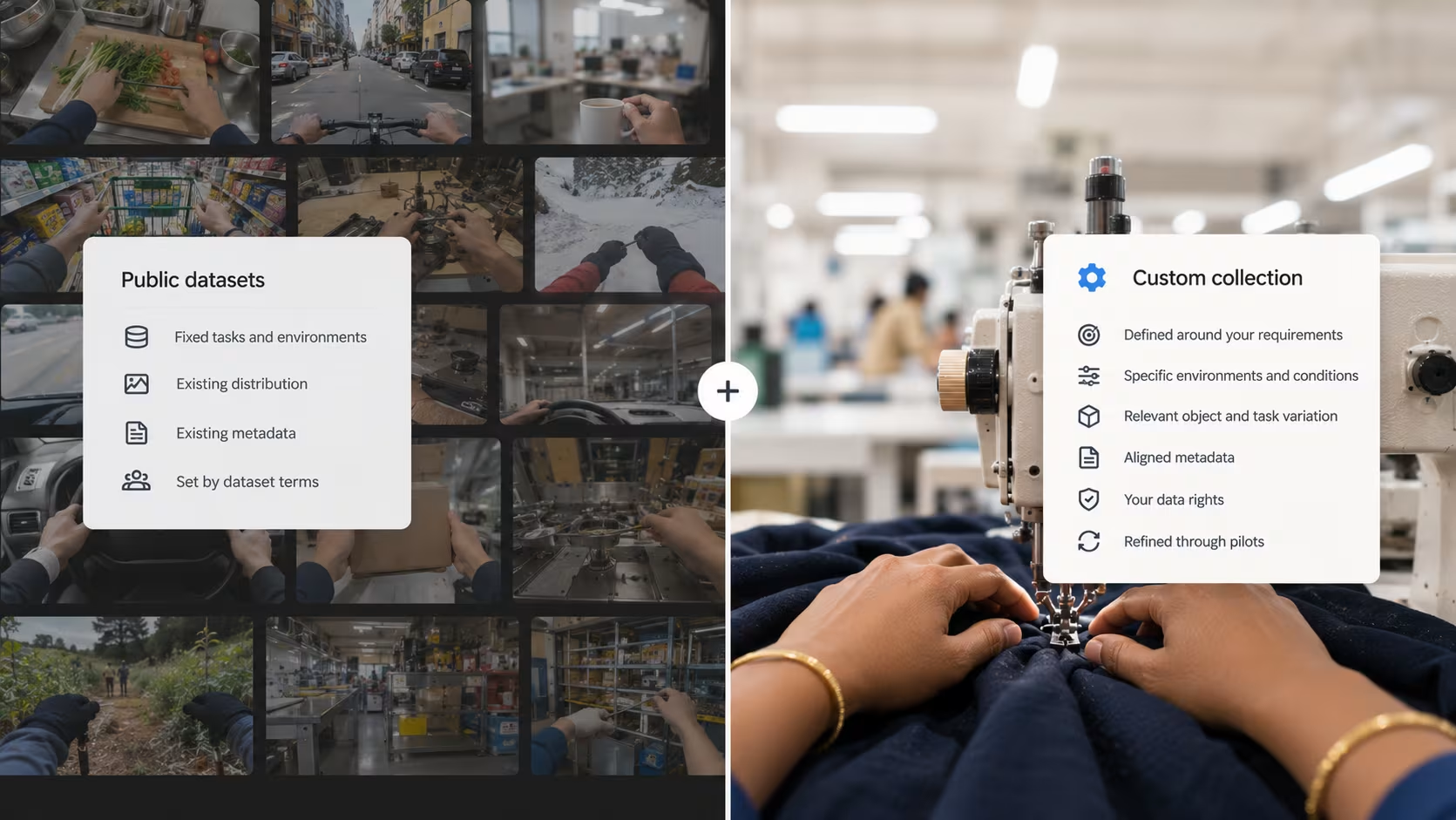
Public Egocentric Datasets or Custom Collection?
Public egocentric datasets can be valuable for research, benchmarking, experimentation, and pretraining.
Custom collection solves a different problem.
It becomes useful when existing data does not adequately represent the tasks, objects, environments, viewpoints, metadata, rights, or deployment conditions a project requires.
Requirement
Public datasets
Custom collection
Task selection
Fixed by the existing dataset
Defined around project requirements
Environment control
Limited to what has already been recorded
Can be specified where operationally feasible
Object and task variation
Existing distribution
Designed around relevant coverage
Metadata
Existing schema
Can be aligned to project needs
Data rights
Determined by dataset terms
Defined through the project agreement
Deployment match
Depends on overlap with available data
Can target known gaps
Iteration
Collection is usually fixed
Protocol can be refined through pilots
The choice does not have to be binary.
A robotics team may use public data for research or pretraining and then commission custom collection to fill specific coverage gaps.
The useful question is therefore not simply:
Do we need a custom dataset?
It is:
What is missing from the data we already have?
That missing distribution should shape the collection plan.
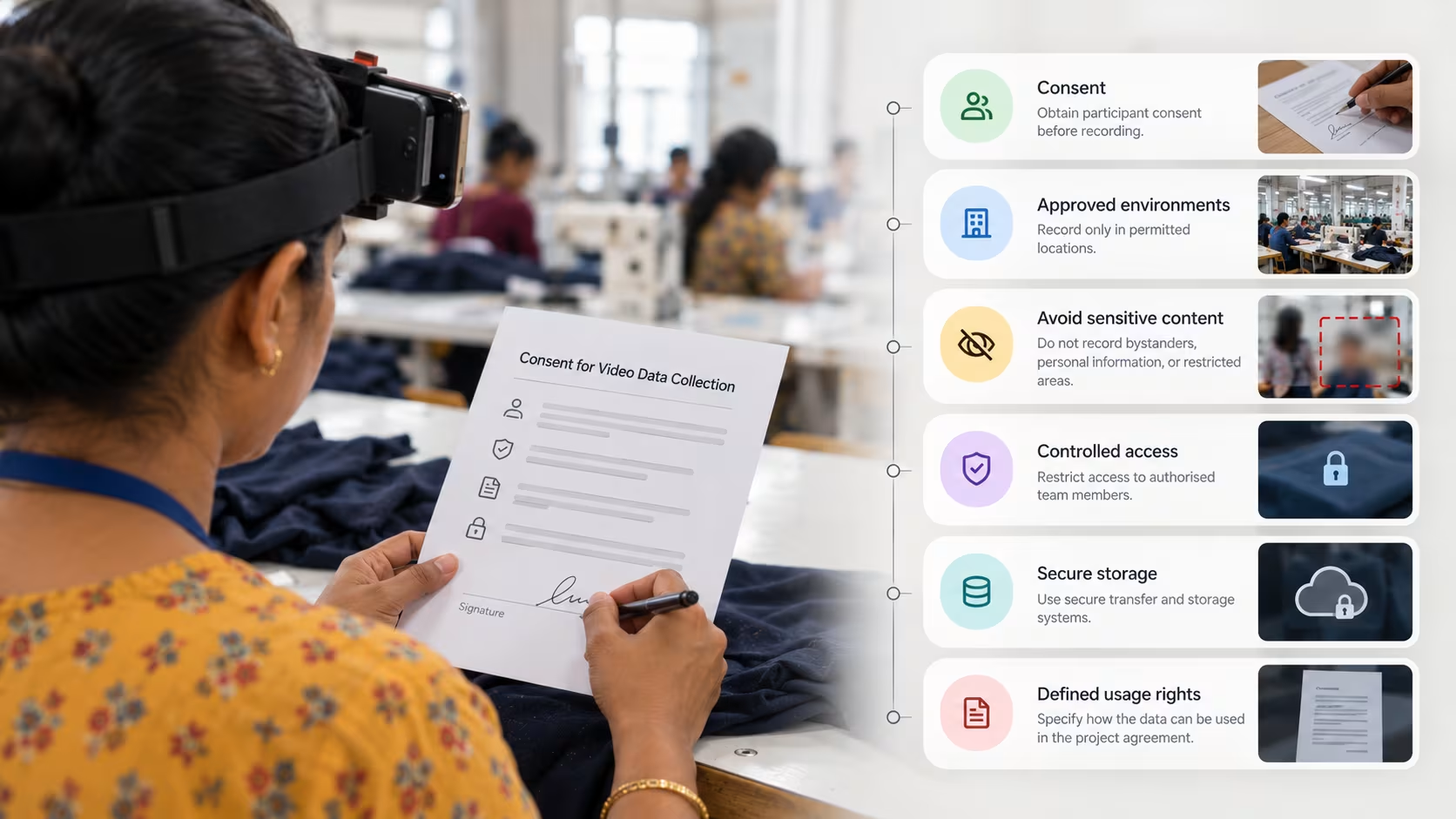
Consent, Privacy, and Data Rights Are Part of the Specification
First-person cameras can capture more than the intended activity.
Participants, bystanders, screens, documents, private spaces, voices, workplace information, or other sensitive material may enter the recording environment.
For that reason, consent and privacy requirements should be defined before collection begins.
Depending on the project, workflows can incorporate approved capture environments, participant consent requirements, project-specific usage permissions, controlled access, secure transfer and storage, and review or de-identification where required.
Capture protocols should also make clear what must not be recorded.
A visually usable dataset that cannot be used under the intended privacy or data-rights requirements is not a successful collection.
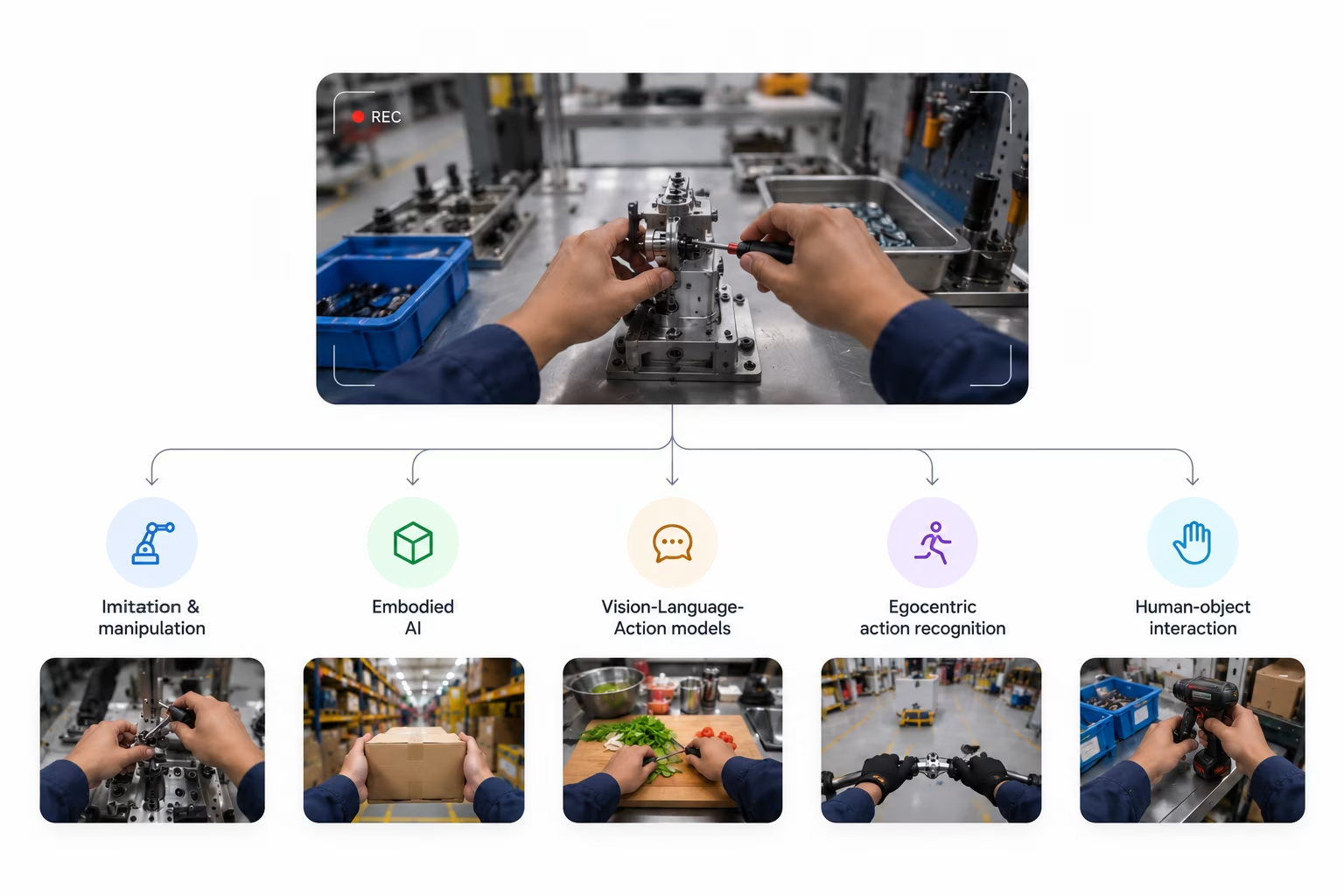
Where Egocentric Collection Fits in the Robotics Data Pipeline
Egocentric collection can support several model-development needs, but the dataset requirements differ between them.
For robot imitation and manipulation learning, capture may need to preserve complete physical demonstrations, hand-object relationships, tool use, task progression, and variation in execution.
For embodied and Physical AI, collection may focus on how actions change across relevant physical environments and task conditions.
For Vision-Language-Action models, demonstrations may need to preserve the relationship between task intent, visual context, action sequence, relevant objects, and outcome.
For egocentric action recognition, coverage may need to center on a defined action vocabulary and sufficient examples of each behavior under relevant conditions.
For human-object interaction understanding, the useful data may lie specifically around approach, contact, manipulation, release, and changes in object state.
The common principle is that the use case defines the dataset.
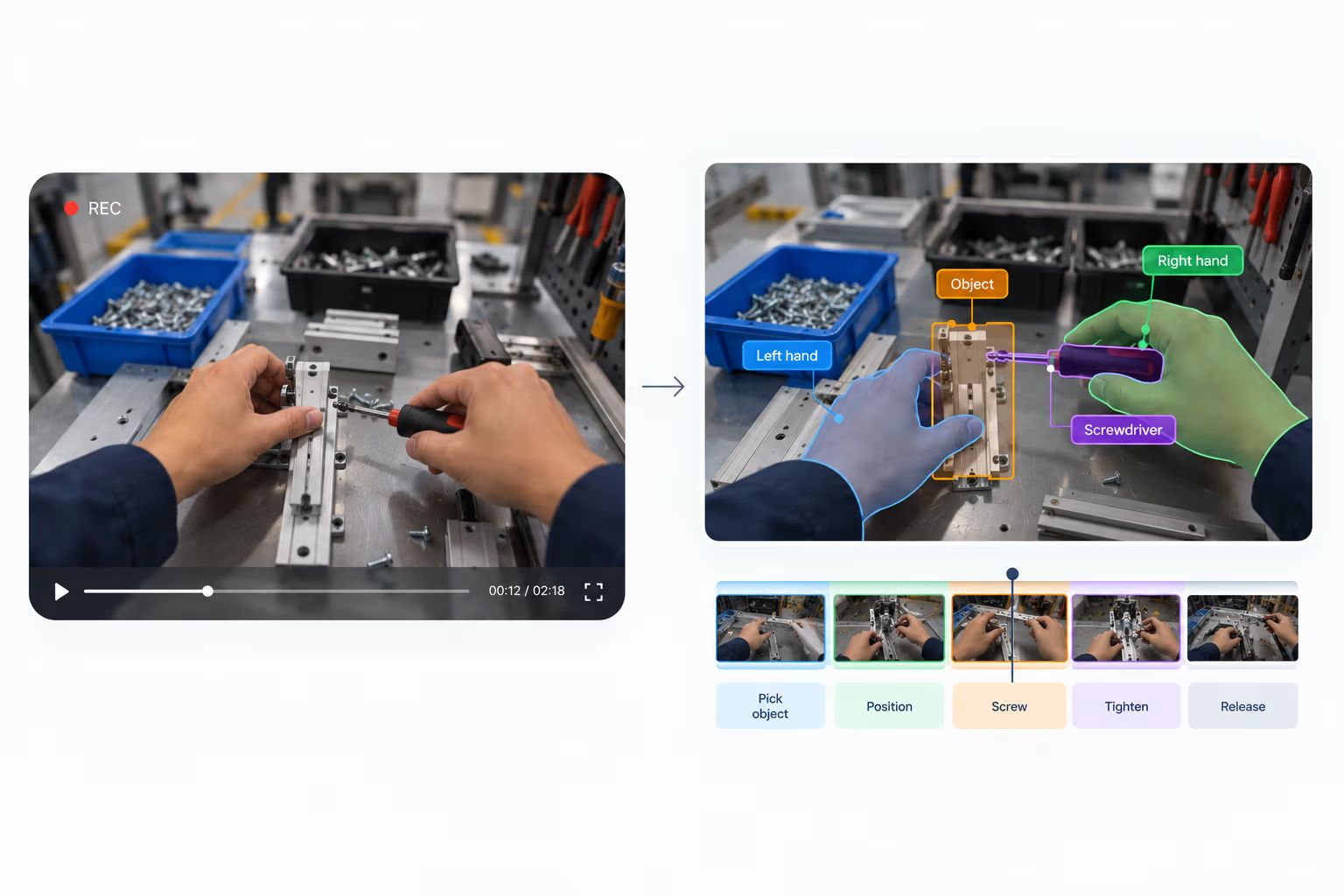
Once footage has been collected and accepted, it can move into a separate annotation workflow when structured labels are required.
Depending on the project, downstream work may include action segmentation, temporal labels, hand-object interaction labels, two-handed actions, tool or object-use labels, task stages, and other verified annotation types.
Collection and annotation should remain connected, but they are not the same production problem.
Capture determines what information exists in the source data.
Annotation determines how that information is represented for the model.
Why Teams Work With IndiVillage for Egocentric Data Collection
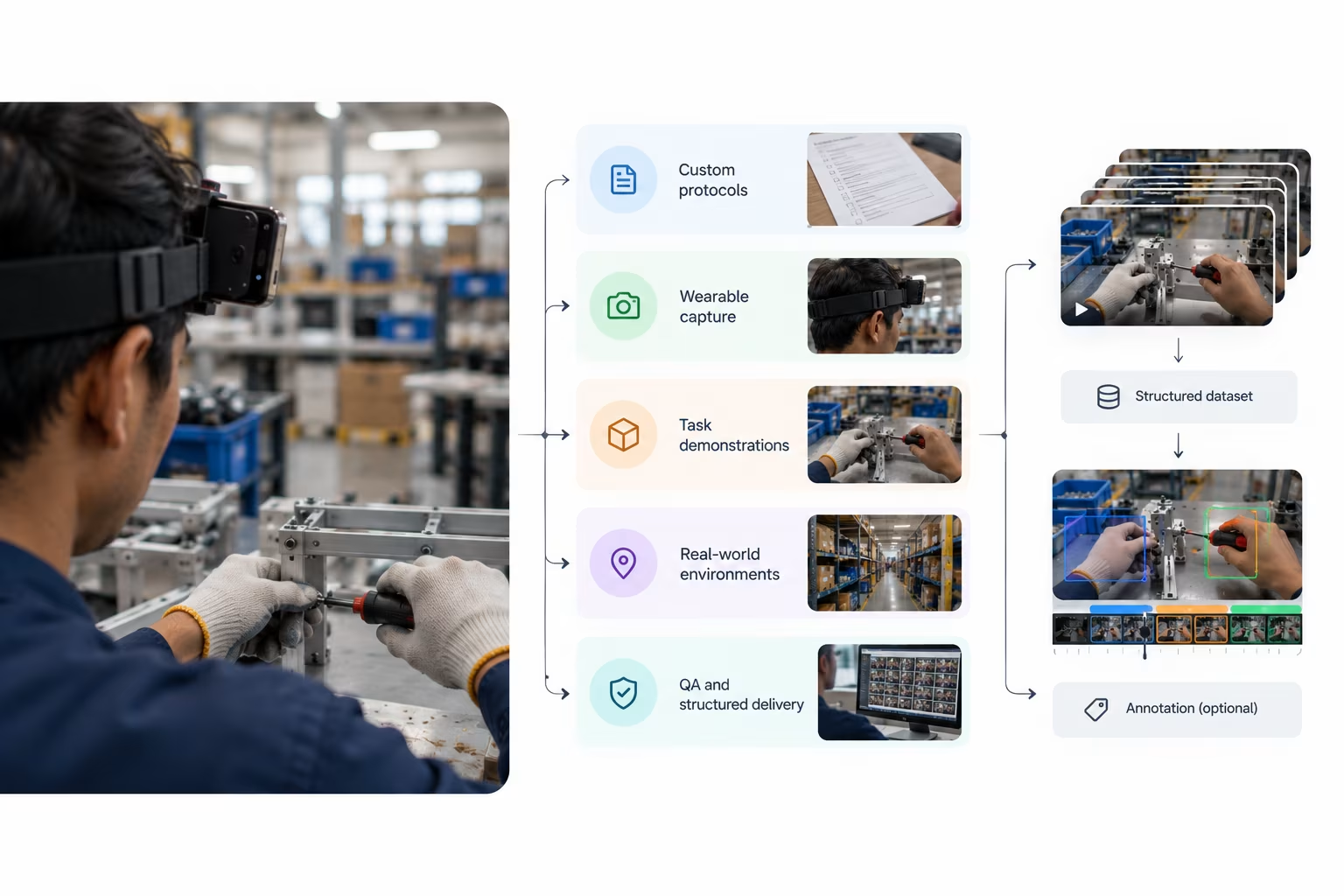
IndiVillage approaches egocentric video as a structured AI data operation rather than a generic video-sourcing exercise.
Our teams can support custom protocols aligned to model requirements, wearable and head-mounted capture, human-object interactions, task demonstrations, fine-motor and multi-step activities, relevant indoor and outdoor environments, participant and environment preparation, metadata-linked sessions, pilot programs, human-reviewed QA, structured delivery, and downstream annotation where required.
The workflow is designed around three questions.
Does the collection represent the behavior the model needs?
Can different participants and teams produce that data consistently?
Can the resulting dataset be reviewed, traced, filtered, and scaled without losing its original specification?
Those questions matter more than raw video volume.
Start Your Egocentric Video Data Collection Project
A useful scoping conversation begins with the behavior the model needs to learn or evaluate.
From there, the project can define the required actions, objects, environments, participant criteria, capture viewpoint, relevant variations, expected coverage, metadata, quality thresholds, privacy requirements, downstream annotation needs, output structure, and timeline.
Those requirements can then be converted into a controlled collection protocol and tested through representative pilot data before larger-scale production begins.
The first step is not pricing an hour of video.
It is defining what a useful hour of video needs to contain.
Frequently Asked Questions
1. What types of cameras are used for egocentric video data collection?+
Egocentric video can be captured using wearable and head-mounted camera configurations, depending on the task and project requirements. The appropriate setup depends on factors such as field of view, hand and object visibility, participant movement, task environment, and recording protocol. Representative footage should be reviewed before production to confirm that the required interaction remains visible.
2. Can you collect custom egocentric videos for our specific tasks?+
Yes, where the requested task and environment are operationally feasible. IndiVillage can translate project requirements into a capture protocol covering task steps, recording boundaries, viewpoint, environment, permitted variation, metadata, and acceptance criteria. A representative pilot can then be reviewed before the approved workflow moves into larger-scale production.
3. How much egocentric video data does an AI model need?+
There is no universal number of hours suitable for every model. Required volume depends on factors such as the number of tasks and actions, object diversity, environment variation, model stage, existing training data, evaluation requirements, and the level of coverage required. Dataset planning should therefore begin with the required task distribution rather than an arbitrary video-hour target.
4. Can we start with a pilot before scaling the collection?+
Yes. A pilot can validate camera placement, task definitions, participant instructions, environment setup, hand and object visibility, metadata requirements, and quality thresholds before production expands. It also helps identify recurring capture problems while they are still relatively easy to correct.
5. What metadata can be collected with egocentric video?+
Depending on the project, metadata can include task IDs, session IDs, environment labels, object lists, recording conditions, session notes, permitted participant or session identifiers, QA status, and file manifests. The appropriate metadata schema should be defined during project scoping so recordings remain traceable and easy to organize downstream.
6. How do you determine whether an egocentric video should be accepted or rejected?+
Acceptance criteria are defined before production begins. Depending on the project, review may consider task correctness, task completeness, required hand and object visibility, camera orientation, visual usability, protocol adherence, metadata completeness, and technical recording issues. Defining these criteria early helps maintain consistent quality decisions across batches.
7. How do you maintain consistency when egocentric data collection scales?+
Consistency depends on stable task definitions, controlled capture protocols, representative examples, participant preparation, documented updates, batch-level QA, rejection tracking, and feedback loops. The objective is to increase collection volume without allowing task interpretation, recording standards, or dataset distribution to drift over time.
8. When should we use custom egocentric data collection instead of a public dataset?+
Public datasets can be useful for research, benchmarking, experimentation, and pretraining. Custom collection becomes valuable when existing datasets do not adequately represent the tasks, objects, environments, viewpoints, metadata, data-rights requirements, or deployment conditions a project needs. The two approaches can also be complementary, with custom collection used to fill specific gaps in existing data.
9. How are privacy and consent handled during egocentric video collection?+
Privacy requirements should be built into the collection protocol because first-person cameras may capture participants, bystanders, screens, documents, private spaces, or other sensitive information. Depending on project requirements, workflows can incorporate participant consent, approved capture environments, controlled access, secure data handling, and review or de-identification where required.
10. Can the collected egocentric videos also be annotated?+
Yes. Once footage has been collected and accepted, it can move into a separate annotation workflow where structured labels are required. Depending on the project, this can include action segmentation, temporal labels, hand-object interaction labels, two-handed actions, task stages, and object or tool-use labels. IndiVillage’s Egocentric Video Annotation Services page covers the downstream annotation methodology in greater detail.