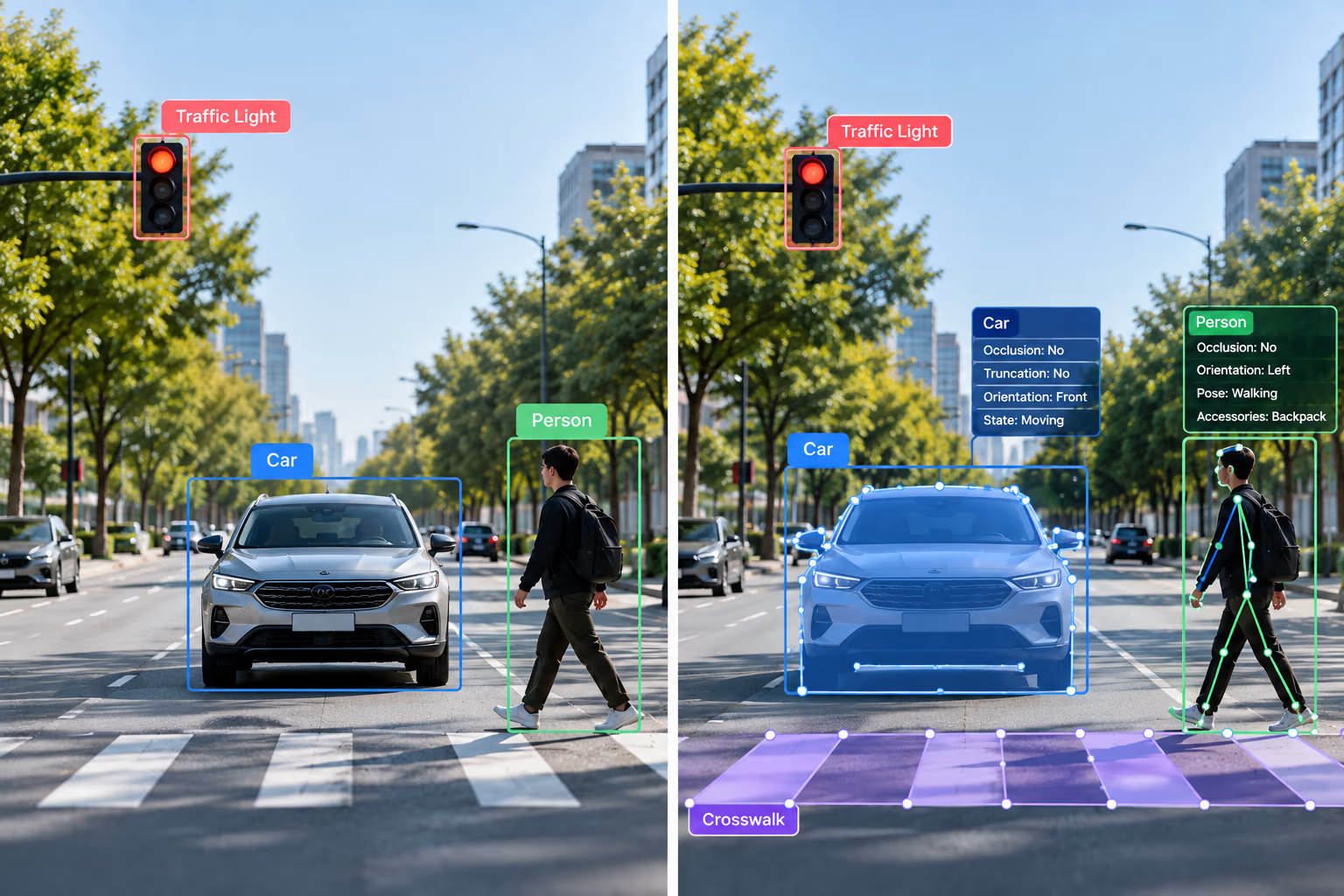

More labeled data does not automatically mean better training data.
The useful question is whether the dataset contains the information, examples, decisions, and edge cases the model actually needs to learn from.
IndiVillage provides AI training data services that turn raw or existing data into structured, human-reviewed datasets for model training, fine-tuning, validation, and evaluation.
Our work spans Data Annotation & Labeling, human-led Quality Assurance, AI Model Validation, and Pipeline Automation across text, image, video, and audio workflows. Each program begins with the model requirement and works backward into the data specification.
Model objective → data requirement → human judgment and annotation → validated training data → model training or evaluation
The goal is not simply to process more records. It is to build data that is relevant, consistent, reviewable, and fit for the intended model task.
What Are AI Training Data Services?
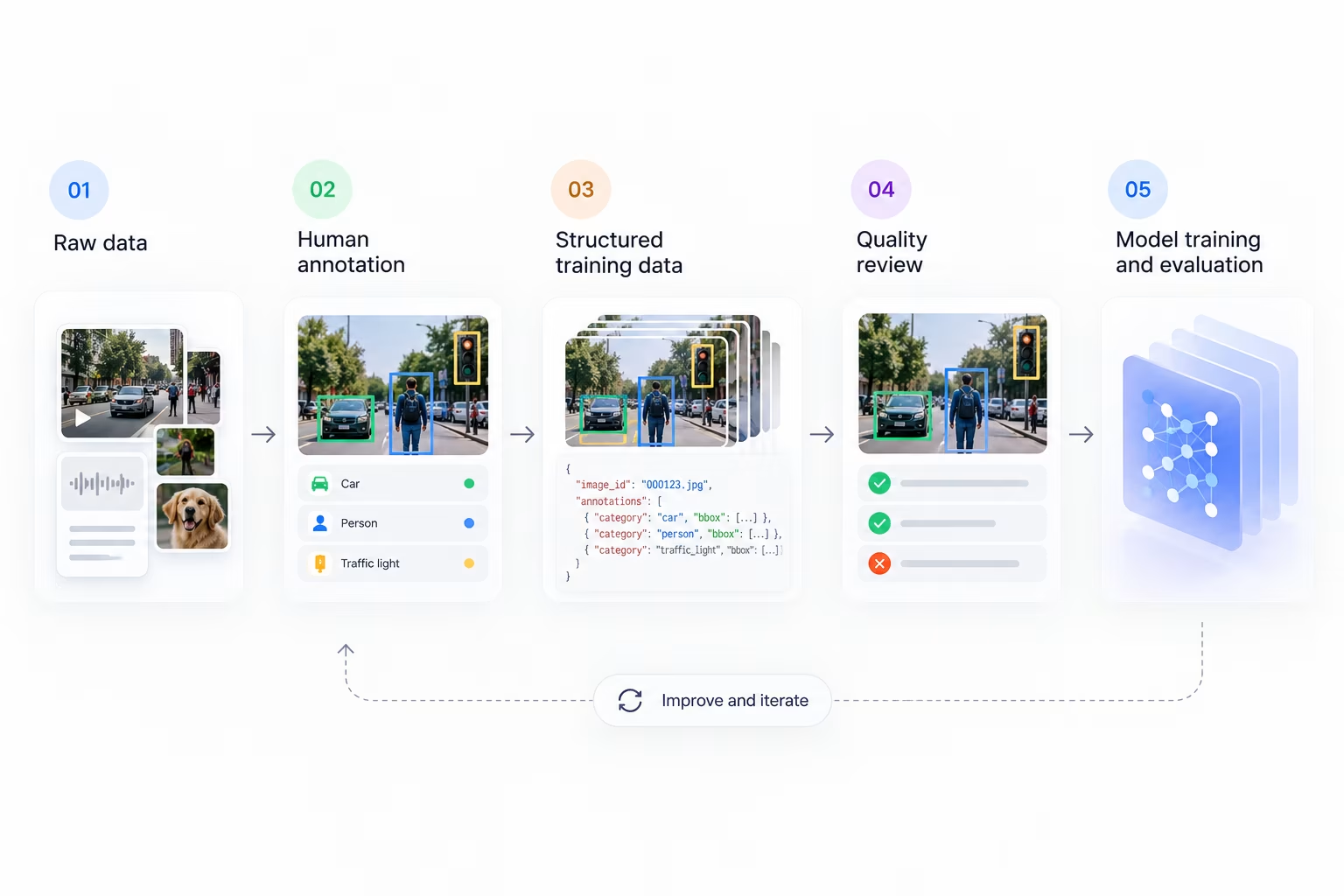
AI training data services prepare the structured evidence Artificial Intelligence and Machine Learning models use to learn, fine-tune, or be evaluated. Depending on the model, that work may involve classifying examples, identifying objects, transcribing speech, labeling intent, reviewing model responses, marking spatial relationships, validating outputs, or applying other task-specific judgments.
It helps to distinguish the terms. Raw data is the source material before model-specific preparation. Training data is data prepared for learning. Ground truth is the agreed reference against which a model learns or is evaluated. Evaluation data is used to measure how a model performs against defined criteria and should be designed to provide a reliable test rather than simply repeat the training distribution.
The operational challenge is making sure those layers reflect the problem the model is actually expected to solve.
What Makes Data Training-Ready?

A dataset does not become training-ready simply because every file has a label.
The labels need to encode the right information.
Consider an image dataset containing vehicles. Labeling every image as either “vehicle present” or “vehicle absent” may produce perfectly consistent labels. But that dataset will not train an object-detection model to locate vehicles because the ground truth does not contain location information.
The same principle applies across modalities.
A speech model may require speaker turns rather than transcription alone. A robotics dataset may need action stages and object interactions rather than generic activity labels. A Generative AI evaluation set may need a detailed rubric distinguishing factuality, instruction following, safety, and relevance rather than one overall “good/bad” judgment.
Training-ready data therefore depends on several dimensions.
Requirement | What it means |
Task relevance | Each example provides information connected to what the model must learn or evaluate |
Correct representation | Labels, attributes, rankings, boundaries, or judgments encode the required output |
Consistency | Equivalent cases are handled according to the same rules |
Representative coverage | Important classes, scenarios, conditions, and data slices are sufficiently represented |
Edge-case coverage | Difficult but meaningful situations are not systematically excluded |
Traceability | Data can be connected to the relevant guideline, dataset version, and review process |
Measurable quality | Acceptance is based on criteria appropriate to the data and model task |
This leads to a useful principle:
Training-data quality is model-specific.
There is no single annotation-accuracy percentage that can determine whether every dataset is suitable for every model.
What AI Training Data Services Does IndiVillage Provide?
IndiVillage supports the human and operational data layer around model development through connected services that can be used independently or as part of a broader workflow.
Data Annotation and Labeling
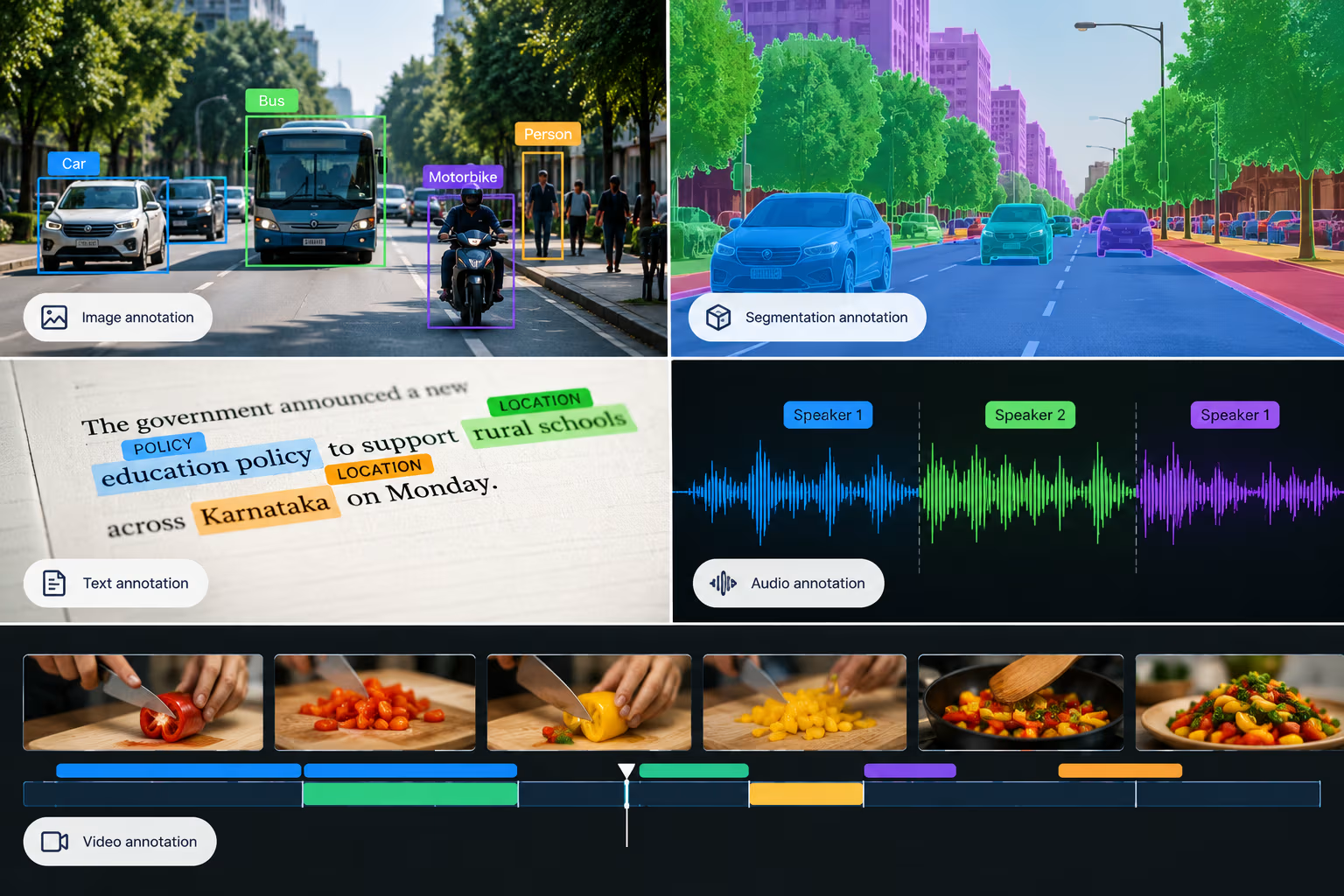
Raw text, images, video, and audio can be converted into model-specific labels, attributes, categories, spatial information, transcripts, metadata, and other forms of ground truth.
The annotation method depends on what the model needs to predict.
For computer vision, that may mean classification, bounding boxes, segmentation, keypoints, tracking, or other spatial labels.
For text and language models, it may involve categories, entities, relationships, intents, sentiment, prompt-response judgments, or structured human feedback.
For audio, requirements can include transcription, speaker segmentation, timestamps, intent, acoustic events, or other speech-related labels.
For video, annotation may need to preserve both visual and temporal information.
Read more about IndiVillage’s Data Annotation & Labeling services here.
For a deeper explanation of how annotation type should follow the model objective, see our [Computer Vision Data Annotation: Types, Process, Quality and Use Cases] guide.
Human Review and Quality Assurance
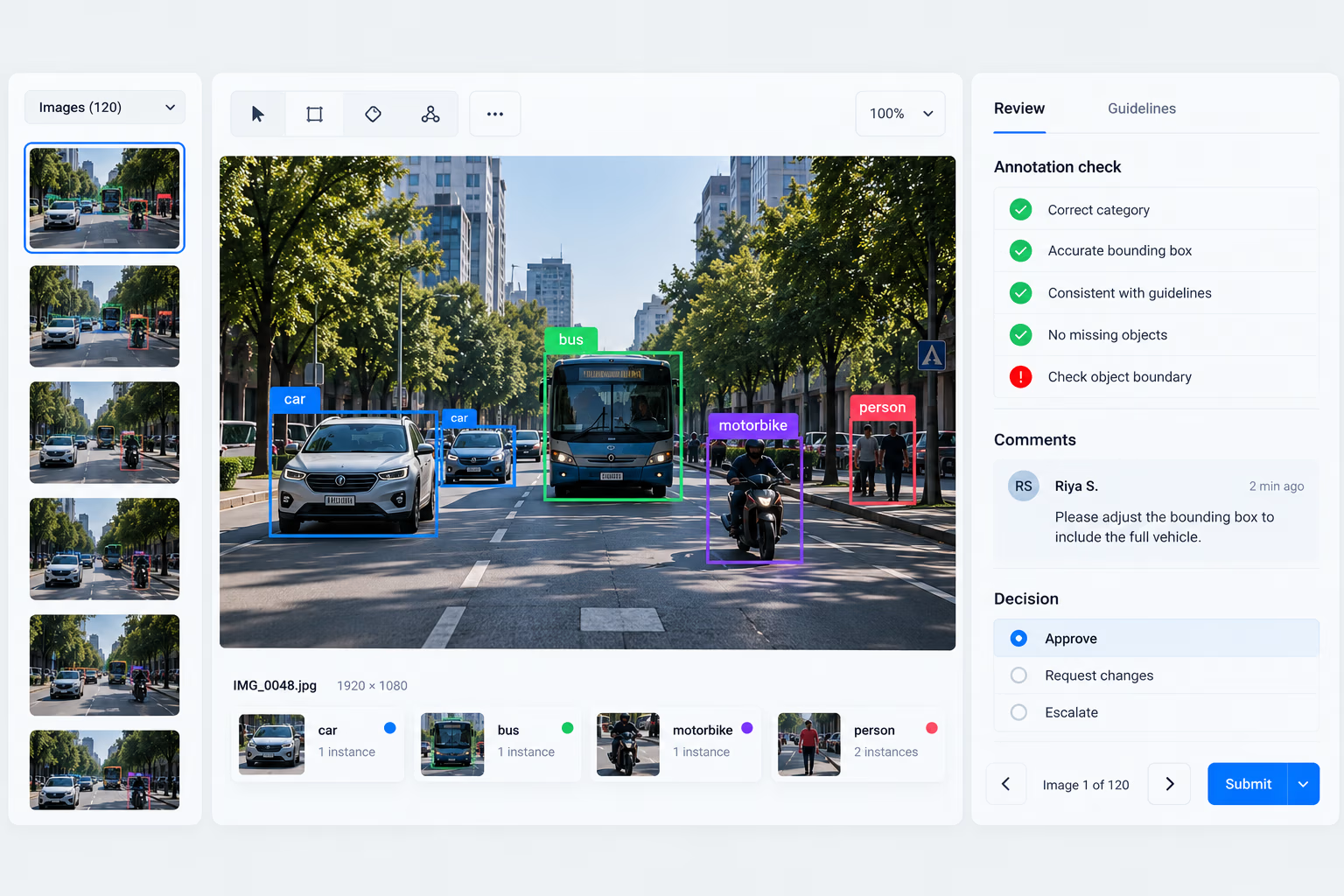
Quality Assurance should answer more than “Is this label correct?”
It should also ask whether the label follows the same specification applied elsewhere in the dataset.
IndiVillage workflows can incorporate reviewer calibration, guideline-based review, sampling, second-pass checks, disagreement resolution, feedback loops, and escalation for difficult or domain-sensitive cases.
The review structure should reflect the consequence and complexity of the task. A straightforward classification workflow may require a different QA model from clinical imagery, fine-grained agricultural annotation, or subjective Generative AI evaluation.
Quality therefore needs to be designed into the workflow before production rather than inspected only at the end.
AI Model Validation Feedback
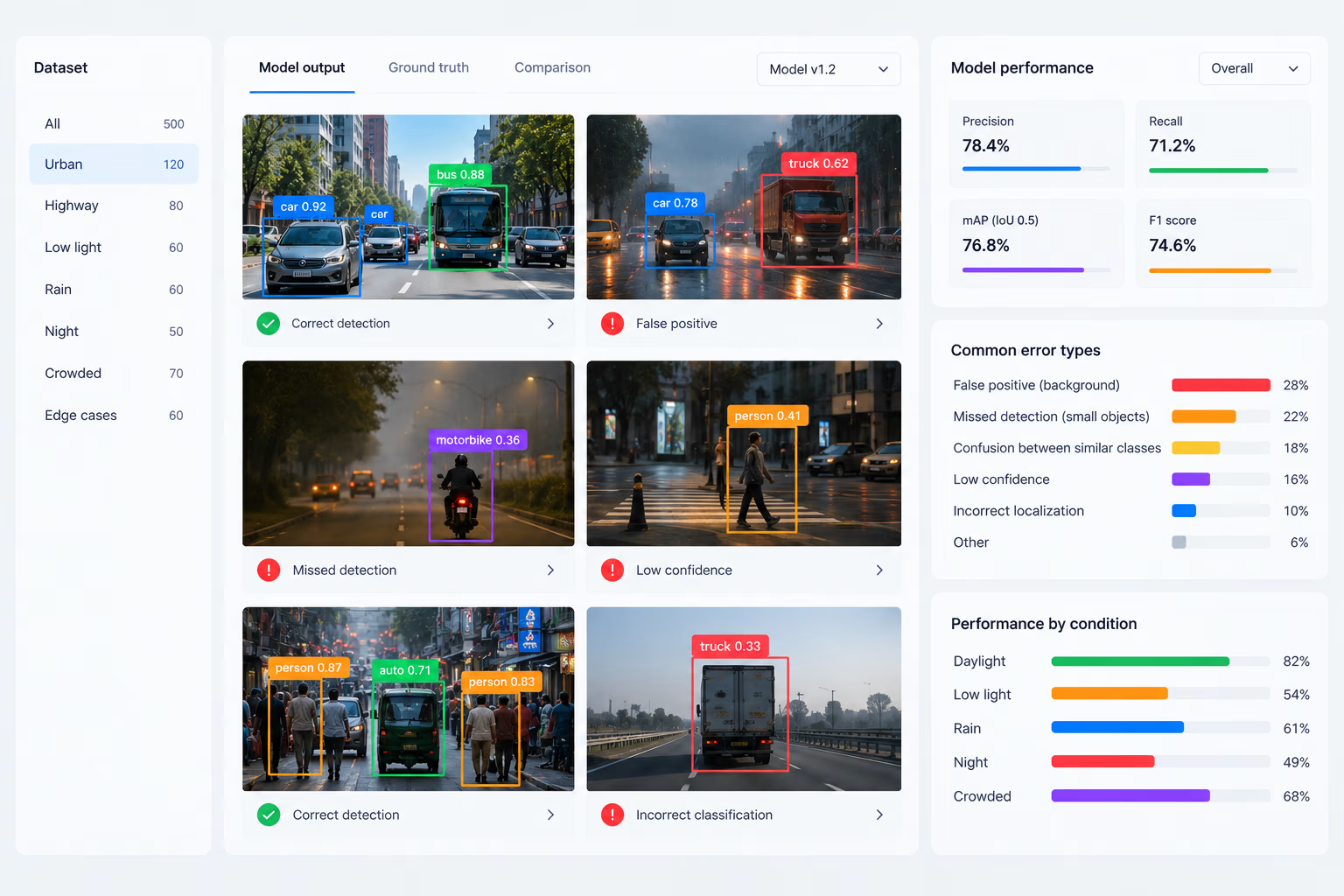
Training-data work does not always end when a dataset is delivered.
Reviewing model outputs can expose where performance remains weak.
False positives may cluster in one scenario. A model may consistently miss a particular class. Accuracy may fall for certain environments, accents, object types, image conditions, or other data slices.
These findings can help determine whether the underlying problem is related to training-data coverage, annotation consistency, model behavior, or another part of the system.
Where a verified data gap exists, model-validation feedback can inform targeted dataset improvement rather than indiscriminately adding more data.
IndiVillage's current AI Model Validation offering includes human-in-the-loop review, benchmarking, stress testing, and evaluation against real-world and edge-case conditions.
Pipeline Automation for Training Data Workflows
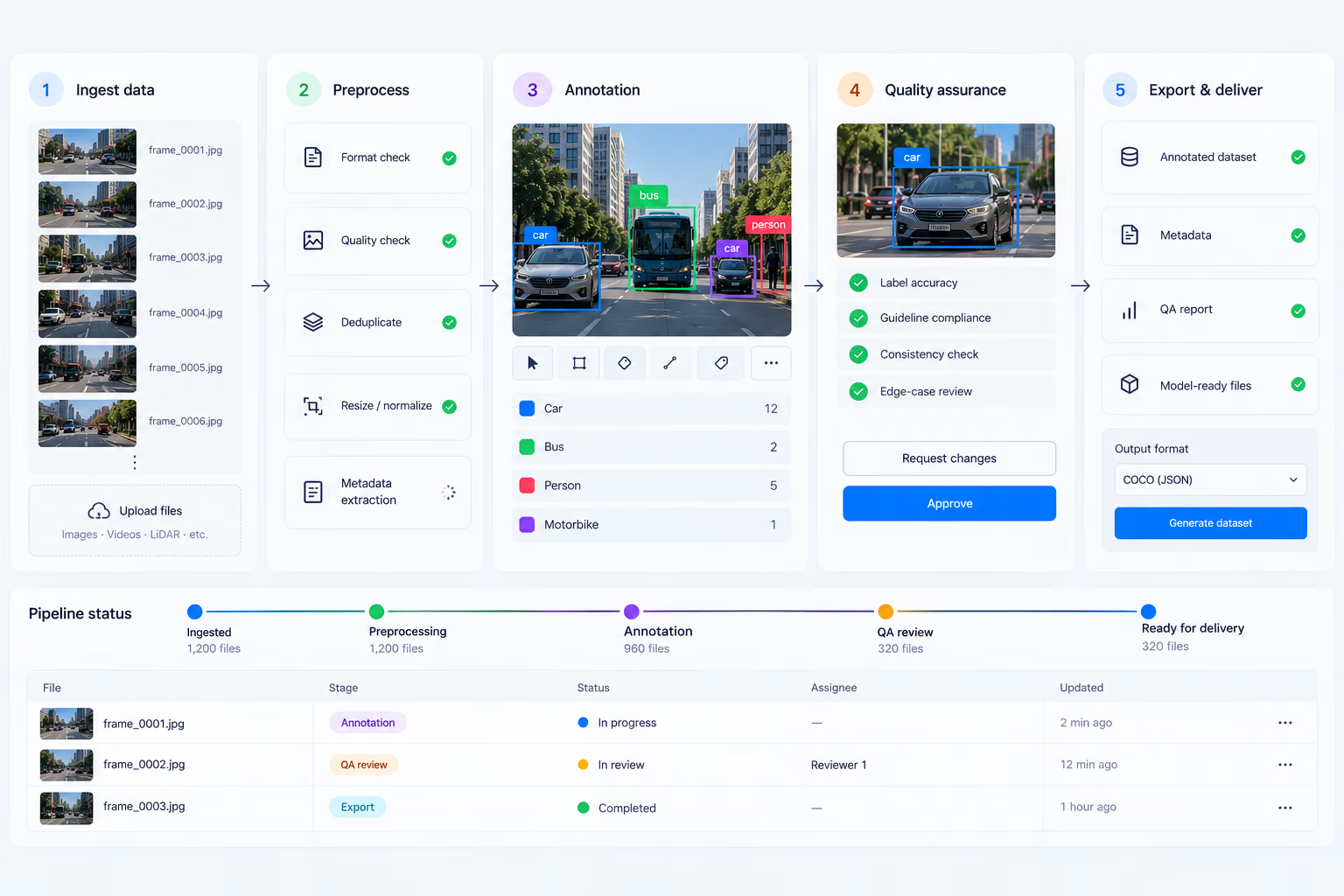
Some parts of training-data production are highly repeatable.
Files may need to be ingested, checked, routed, assigned, preprocessed, passed between annotation and QA stages, or prepared for delivery.
Pipeline Automation can reduce manual operational friction around these steps while preserving human review where interpretation, uncertainty, or consequence requires judgment.
The objective is not to automate every data decision.
It is to automate the predictable workflow around those decisions so human attention can be concentrated where it adds value.
IndiVillage currently positions Pipeline Automation around data ingestion, preprocessing, annotation workflows, QA, and human-in-the-loop oversight.
What Types of AI Training Data Can IndiVillage Support?
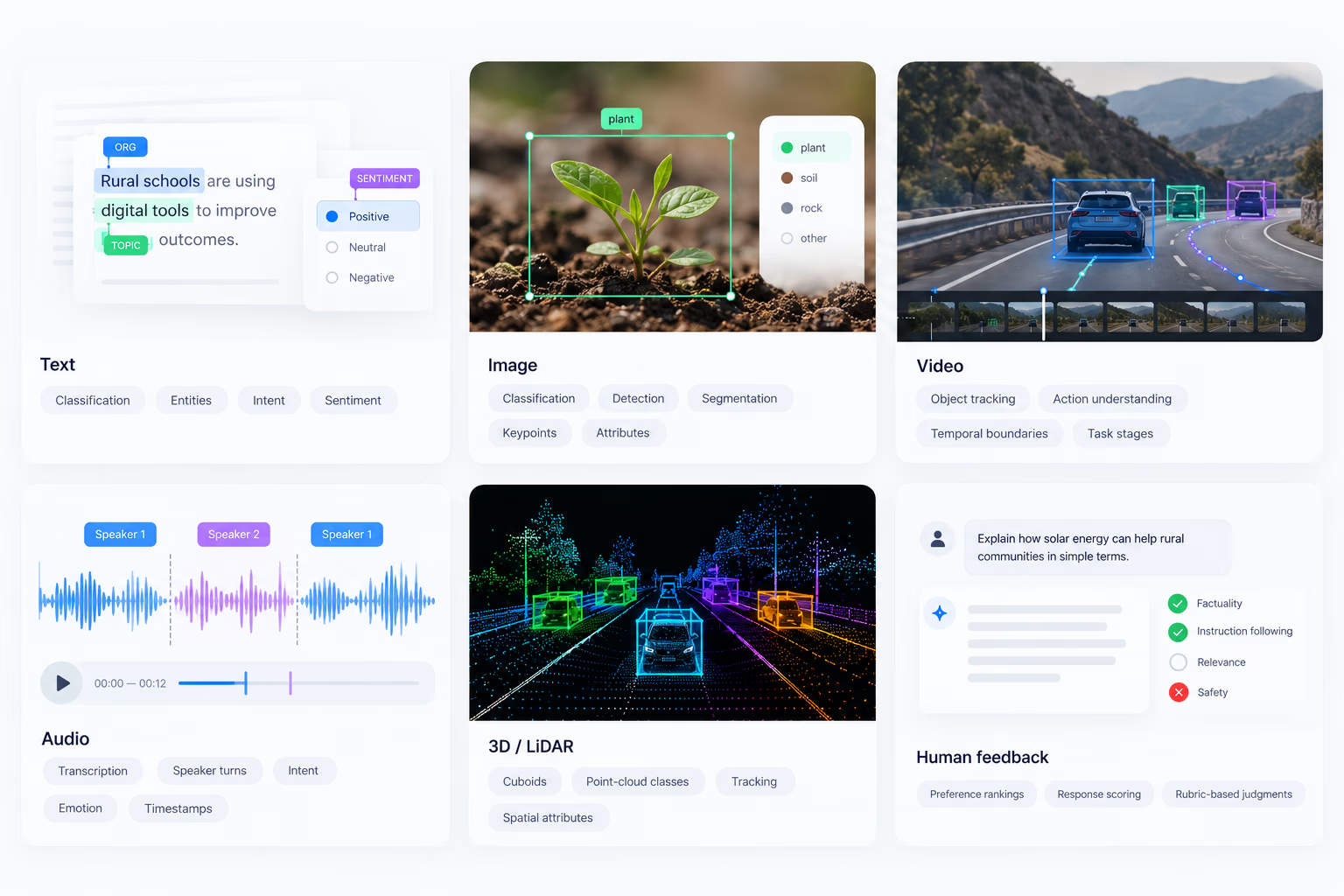
Different AI systems require different forms of training evidence.
Data modality | Typical AI task | Possible training-data requirement | Relevant IndiVillage capability |
Text | Classification, NLP, Generative AI | Categories, entities, intent, sentiment, relationships, human feedback | Data Annotation, Generative AI Data |
Image | Classification, detection, segmentation, visual recognition | Classes, boxes, polygons, masks, keypoints, attributes | Image Annotation, Computer Vision |
Video | Tracking, action understanding, robotics | Object identities, actions, temporal boundaries, task stages | Video Annotation, Egocentric Video |
Audio | ASR, Voice AI, conversational systems | Transcription, speaker turns, intent, emotion, timestamps | Voice AI Data Services |
3D / LiDAR | Spatial perception, autonomous systems | Cuboids, point-cloud classes, tracking, spatial attributes | LiDAR Annotation Services |
Human feedback | LLM and Generative AI training/evaluation | Preference rankings, response scoring, rubric-based judgments | Generative AI Data Services |
IndiVillage's current service positioning confirms core annotation capabilities across text, image, video, and audio, with specialist solutions extending into voice, Generative AI, LiDAR, and egocentric data.
How Do You Determine What Training Data an AI Model Actually Needs?
This is usually the most important decision in the entire project.
A request such as:
“We need 100,000 labeled examples.”
defines volume.
It does not yet define useful training data.
Before annotation begins, the project needs to establish what information those 100,000 examples must contain.
A practical framework works backward from the model.
Model task → required behavior → current failure or data gap → required modality → ground-truth representation → important data slices and edge cases → QA criterion → delivery schema
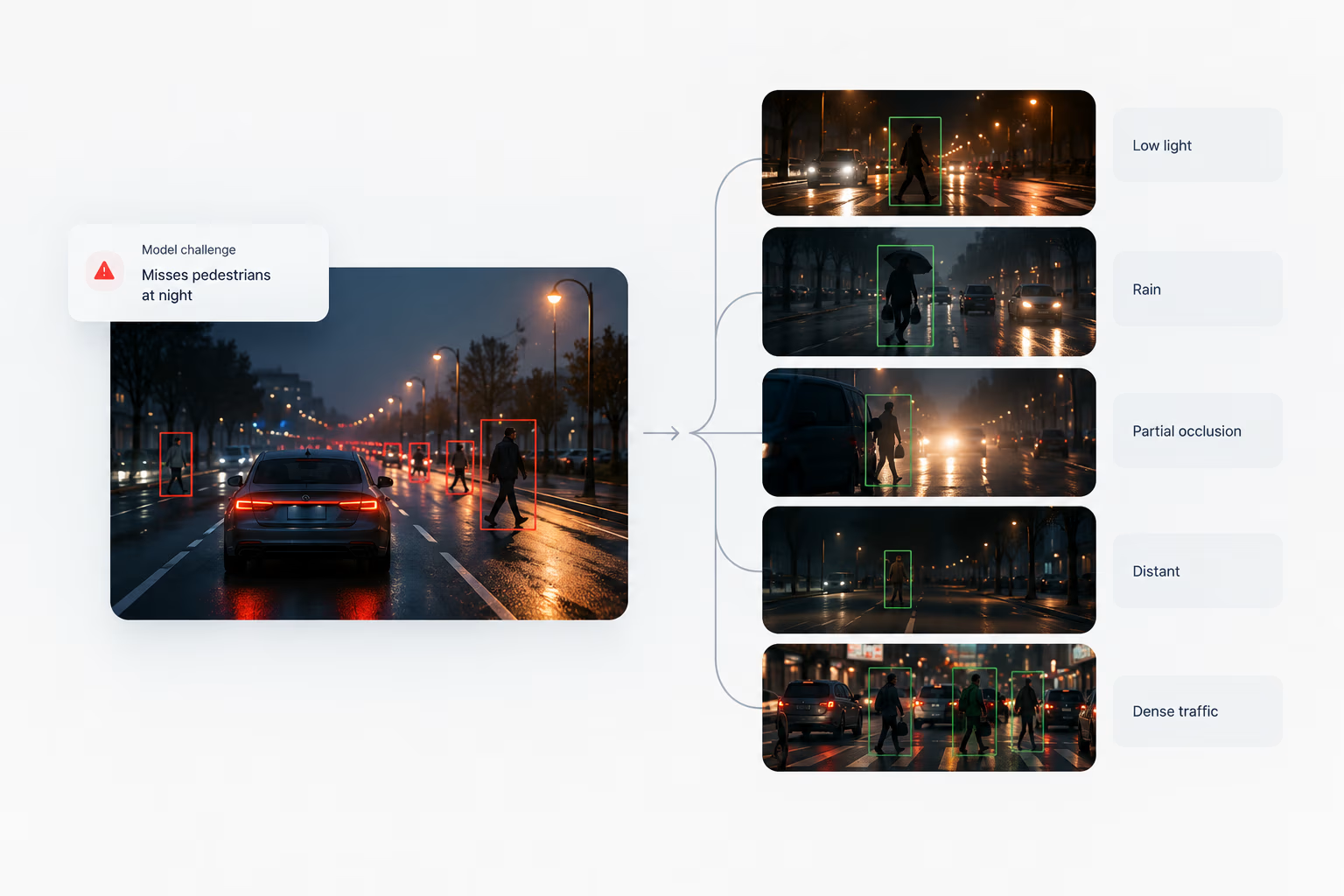
Consider a model that struggles to detect pedestrians at night.
Simply labeling another 100,000 daytime road images may increase dataset volume while doing little to address the failure.
The data requirement may instead involve identifying the specific conditions associated with poor performance: low illumination, partially visible pedestrians, glare, unusual clothing contrast, dense traffic, rain, distance, or combinations of those factors.
The project can then ask:
Does the existing dataset contain those scenarios?
Are they represented frequently enough?
Are they labeled consistently?
Does the annotation encode the information the model needs?
Are important examples being rejected as “too difficult”?
Does the evaluation set actually test the same conditions?
This is what turns an annotation requirement into a training-data strategy.
The goal is not the largest possible dataset.
It is a dataset whose information content corresponds to the model problem.
Should You Improve Existing Data or Create More Training Data?
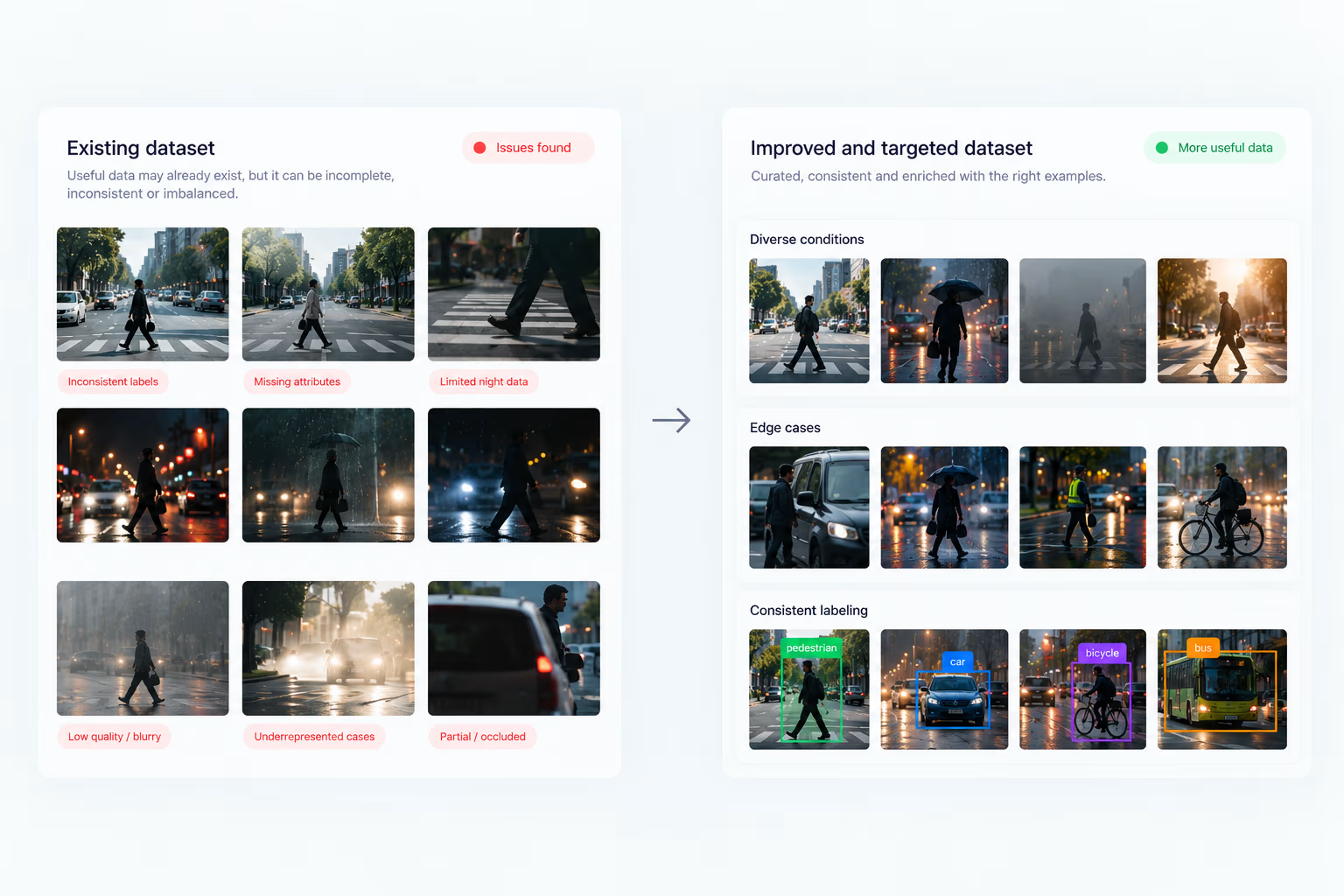
When model performance stalls, the instinct is often to request more data.
That may be the right answer.
But it should not be the automatic answer.
Before expanding the dataset, teams should examine whether the existing data already contains useful examples that are poorly structured, mislabeled, inconsistently labeled, underused, or difficult to retrieve.
Several different problems can look like a data-volume problem.
A required class may be underrepresented.
Edge cases may exist but use inconsistent labels.
Older batches may follow a previous ontology.
Important attributes may be missing.
The data may represent laboratory conditions while deployment happens in substantially different environments.
Duplicate or near-duplicate examples may inflate apparent dataset size without adding meaningful variation.
In these situations, relabeling, curation, rebalancing, targeted enrichment, or better dataset slicing may create more value than collecting another large undirected batch.
The first question should therefore be:
What information is missing?
Only then should the discussion move to how many additional examples are required.
How Does the AI Training Data Workflow Work?
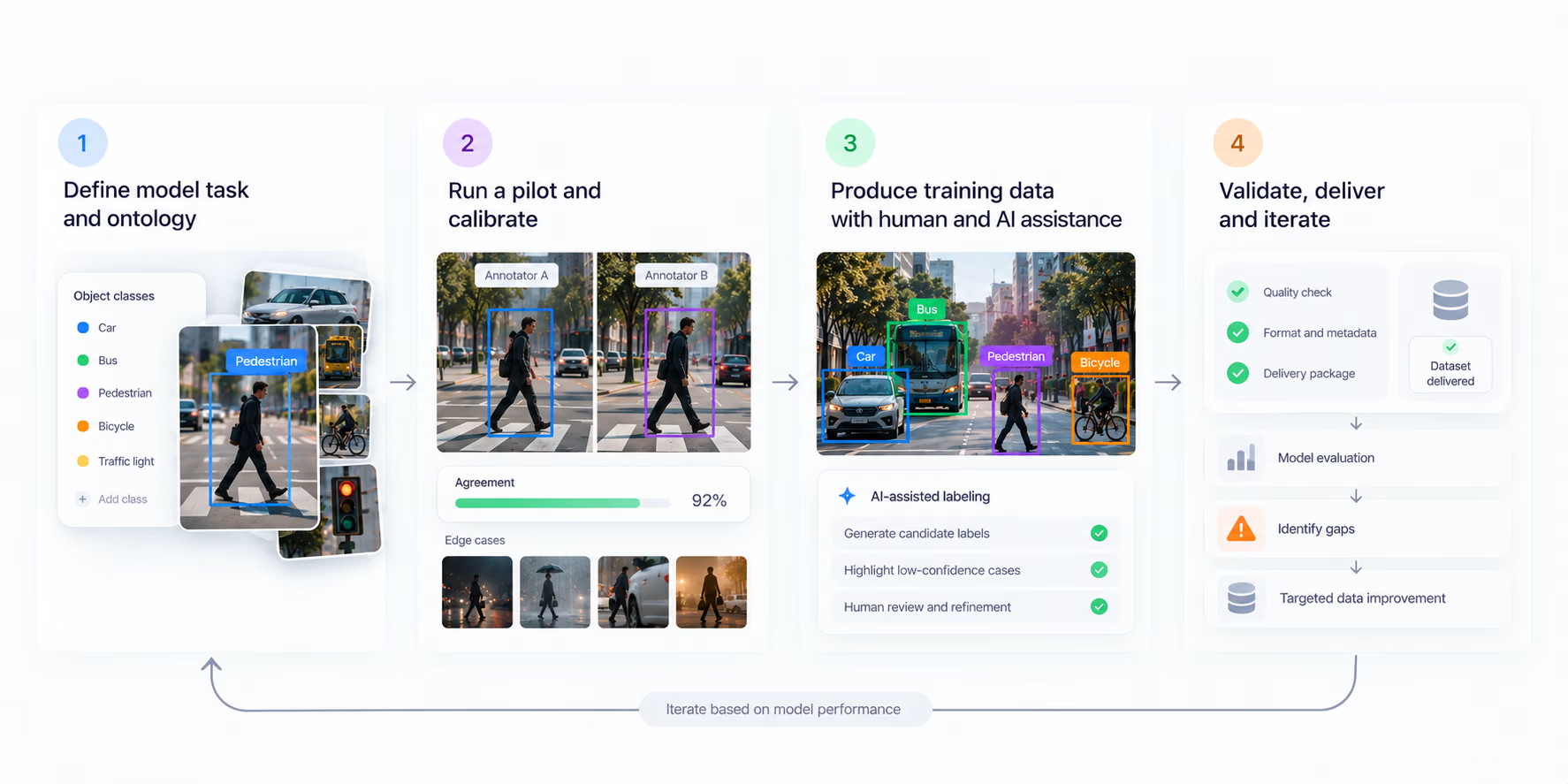
A production workflow should remove ambiguity before it scales.
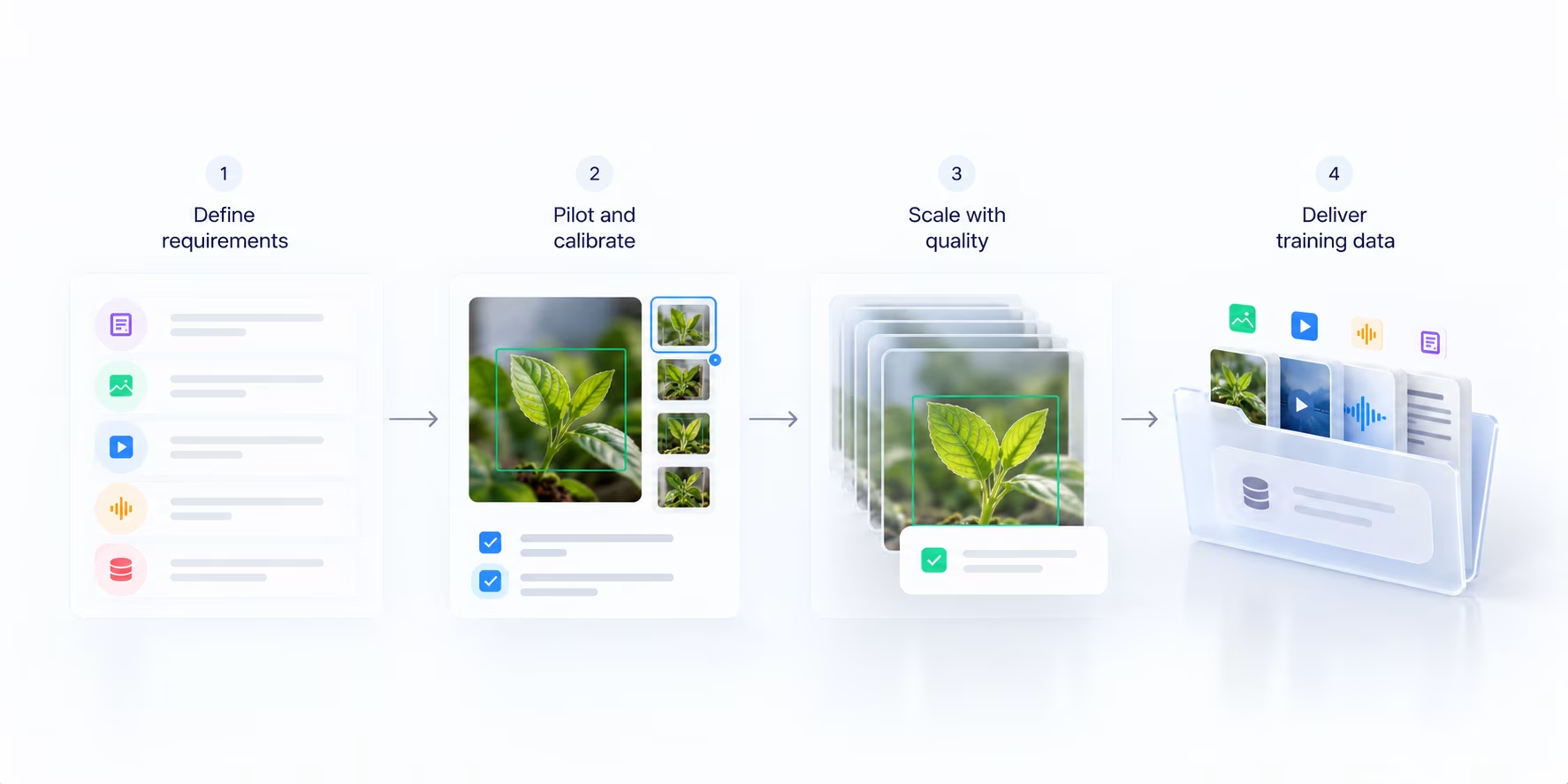
1. Define the Model Task, Ontology, and Quality Requirements
The project begins with what the model must predict, understand, rank, or evaluate.
From this, teams can define the ontology: the concepts, classes, attributes, relationships, and rules that determine what can be represented in the dataset.
The ontology is not the same thing as an individual label.
It defines what concepts exist.
The annotation applies those concepts to individual examples.
The specification should also address inclusion and exclusion rules, important data slices, difficult cases, output format, security requirements, and acceptance criteria.
If two categories cannot be distinguished consistently from the available data, that ambiguity needs to be resolved before production rather than multiplied across thousands of records.
2. Run a Representative Pilot and Calibrate the Team
A pilot should test the difficult decisions the full dataset will contain.
That means including ordinary examples as well as meaningful edge cases.
The objective is not simply to measure how quickly annotators work.
It is to determine whether different people interpret the specification in the same way.
Disagreement during a pilot can expose unclear categories, missing edge-case rules, inconsistent boundaries, conflicting examples, or gaps in the ontology.
Those are useful findings.
Resolving them during calibration prevents uncertainty from becoming label noise at production scale.
There is no universal pilot size. The right sample is one that sufficiently exercises the decisions the team will encounter later.
3. Produce Training Data With Human and AI Assistance
Training-data production can be manual, AI-assisted, or hybrid.
Automated or model-assisted tools can help with repetitive work such as generating preliminary labels, suggesting masks, propagating annotations between frames, routing high-confidence examples, or identifying obvious inconsistencies.
Human reviewers remain important where context, ambiguity, domain knowledge, or consequence requires judgment.
The operating principle should be simple:
Automation can propose or accelerate. The acceptance rules determine what becomes ground truth.
A model-generated label should not automatically become a trusted label simply because confidence is high.
Its validation requirement should depend on the task, model reliability, risk of error, and agreed quality threshold.
4. Validate, Deliver, and Iterate
Final QA determines whether the dataset meets the agreed specification before delivery.
Useful delivery records may include dataset or batch identifiers, annotation outputs, relevant metadata, the guideline or ontology version applied, and agreed quality evidence.
The dataset should remain traceable when later iterations occur.
If model evaluation subsequently exposes a verified weakness in a specific data slice, the next training-data batch can target that gap.
This creates a useful feedback loop:
training data → model → evaluation → identified weakness → targeted data improvement
But the relationship should not be oversimplified.
Not every model failure is a training-data failure, and not every model problem can be fixed by adding labels.
The purpose of the feedback loop is to identify where data intervention is actually justified.
How Is AI Training Data Quality Measured?
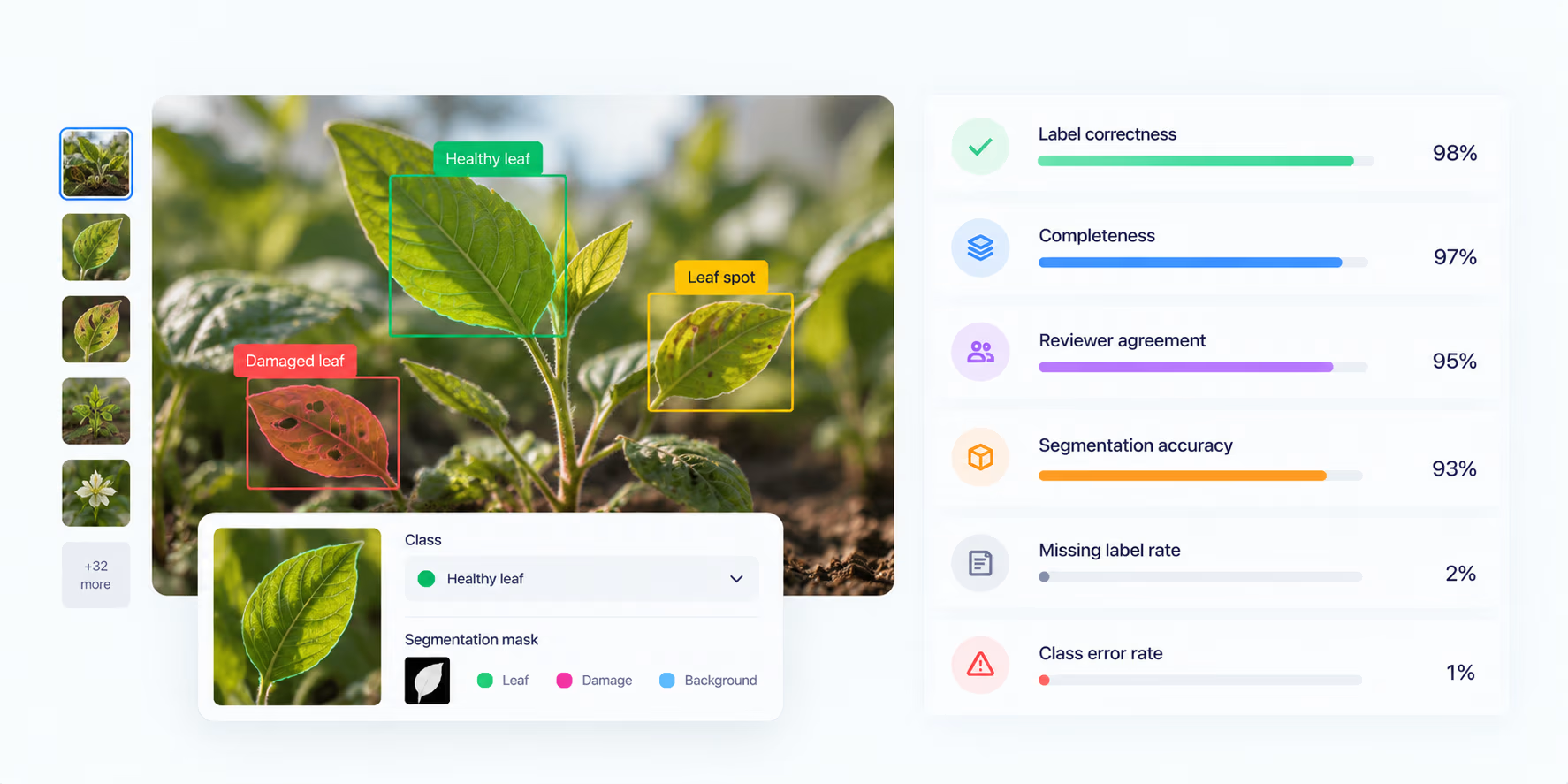
The best definition of training-data quality is fitness for the intended model task.
Different annotation types require different measurements.
For classification tasks, teams may examine label agreement, class-error rate, missing labels, or agreement with a gold or expert reference.
For bounding boxes or segmentation, spatial overlap and boundary quality may matter.
For video tracking, identity consistency can be important.
For human-feedback tasks, reviewer agreement, rubric compliance, escalation rate, and consistency across evaluation dimensions may matter more than geometric accuracy.
Useful quality signals can include correctness, completeness, reviewer agreement, expert-reference agreement, missing-label rate, class-error rate, geometric precision, audit-pass rate, escalation rate, and rework rate.
The appropriate measurement should reflect the error the model or evaluation process is sensitive to.
This is why a generic statement such as “99% annotation accuracy” cannot describe every possible AI training-data project.
The underlying question is:
99% agreement on what, measured how, against which reference, and for which task?
IndiVillage publishes company-level quality metrics on its website, but project acceptance criteria should still be defined according to the individual model and annotation requirement rather than treating a company-wide figure as a universal SLA.
How Are Ambiguous Data and Edge Cases Handled?
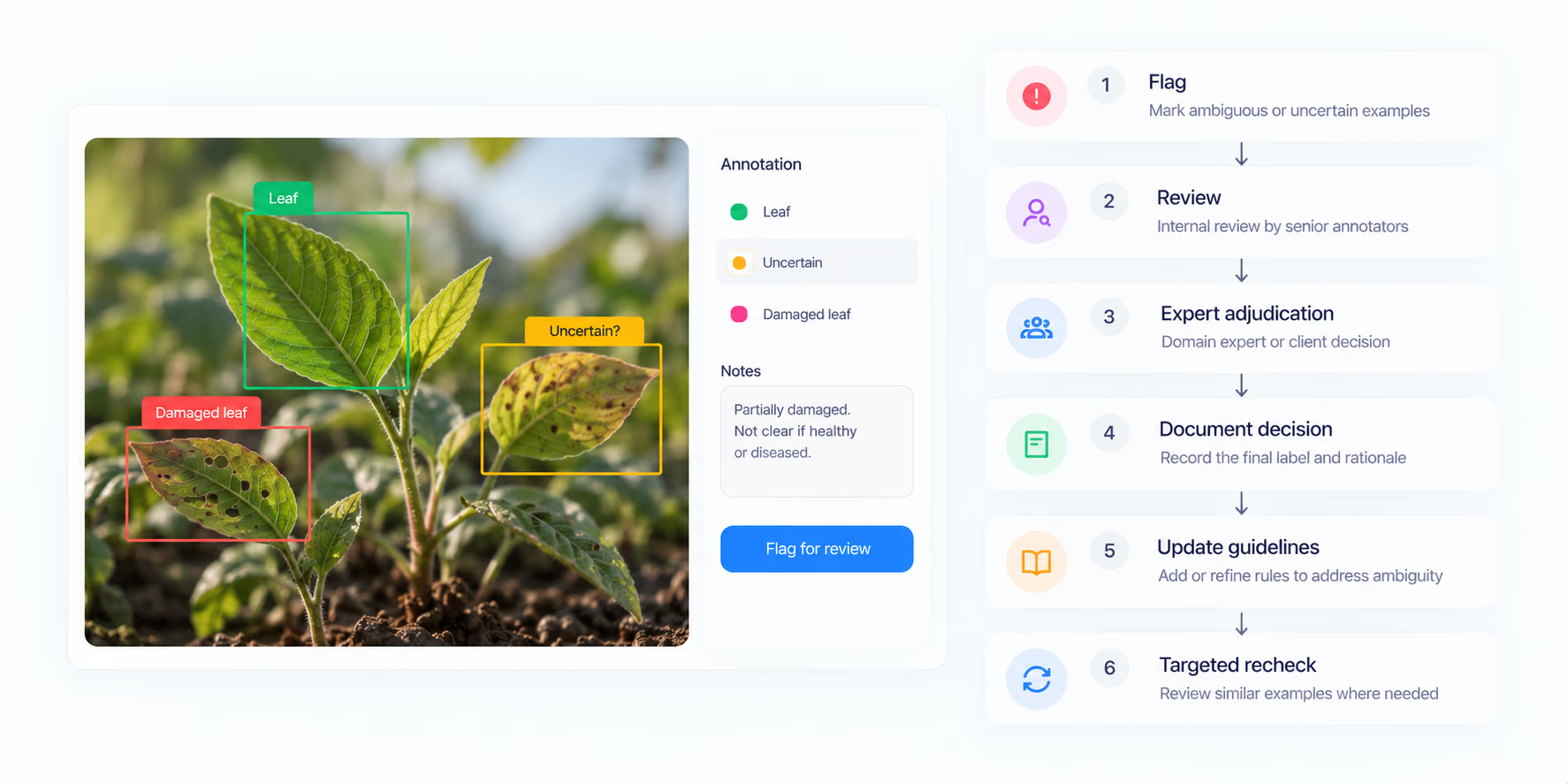
Ambiguity is not always an annotator error.
Sometimes it reveals that the specification does not yet contain an answer.
An image may fall between two classes.
A spoken utterance may carry more than one plausible intent.
An object may be too occluded to identify confidently.
A model response may satisfy one evaluation criterion while failing another.
The appropriate response is not to ask every annotator to make an independent guess.
A controlled workflow can follow:
Flag → review → expert or client adjudication → documented decision → guideline update → targeted recheck where required
If the same ambiguity appears repeatedly, that pattern is useful information.
It may indicate that two classes are insufficiently defined.
The ontology may be missing an “uncertain” or additional category.
The source data may not contain enough information to make the required distinction.
The project may need a domain expert rather than a generic reviewer.
Recurring disagreement should therefore trigger investigation into the specification itself rather than simply additional pressure on annotators to agree.
How Do Human Expertise and Automation Work Together?
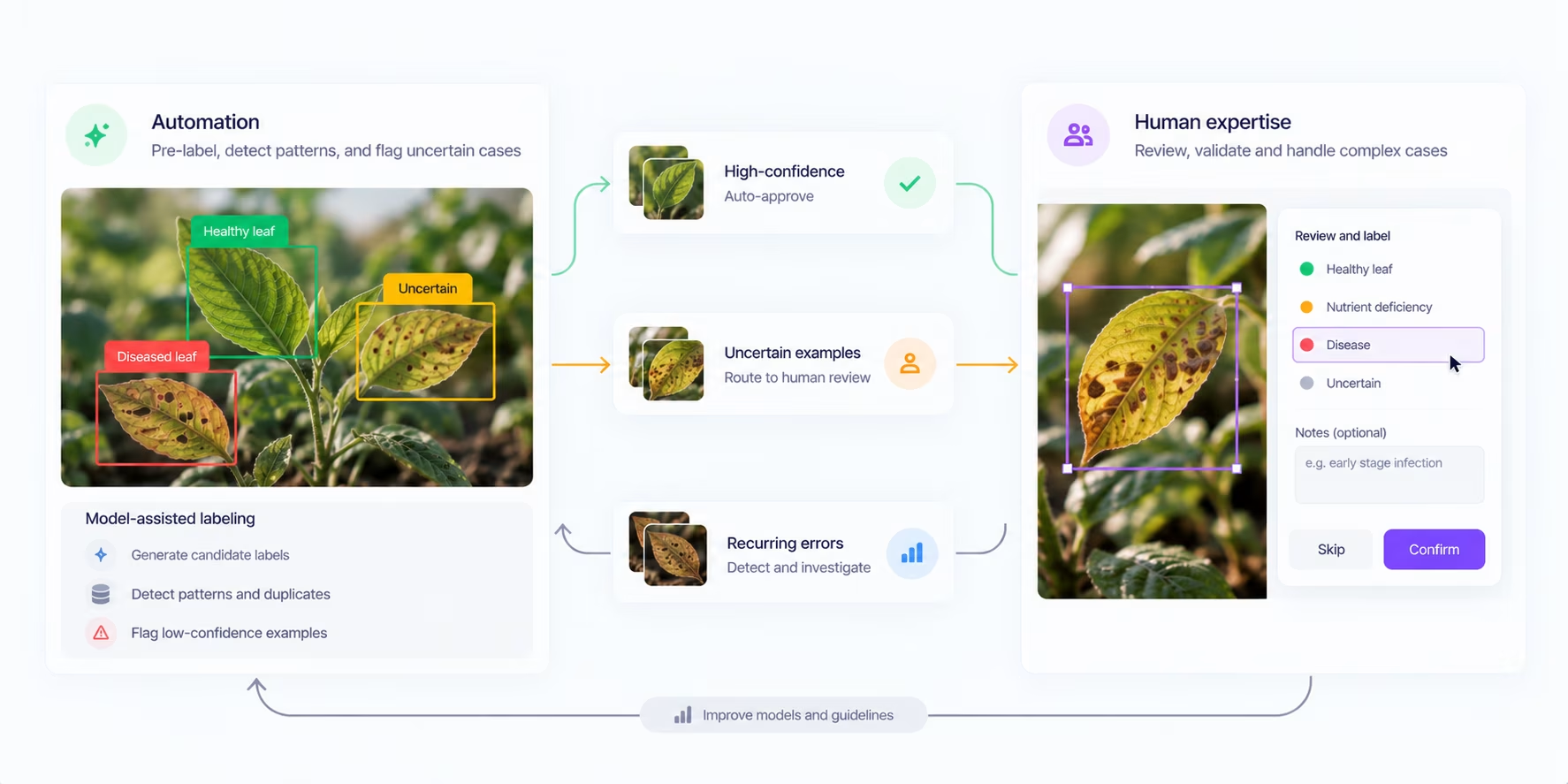
Human review and automation solve different parts of the training-data problem.
Automation is particularly useful where work is repetitive, rules are stable, and confidence can be measured.
Human judgment becomes more valuable as context, ambiguity, domain sensitivity, or consequence increases.
The strongest workflow is therefore not “human versus automation.”
It is deciding where each should operate.
High-confidence and repeatable steps can often be accelerated through automation.
Uncertain examples can be routed for human review.
Recurring errors can be detected automatically and investigated manually.
AI-generated preliminary labels can reduce repetitive effort while trained reviewers validate the cases where mistakes would propagate into ground truth.
IndiVillage's broader AI Data Operations positioning follows this hybrid principle, combining automation with human expertise and structured QA.
When Does Training Data Require Domain Experts?
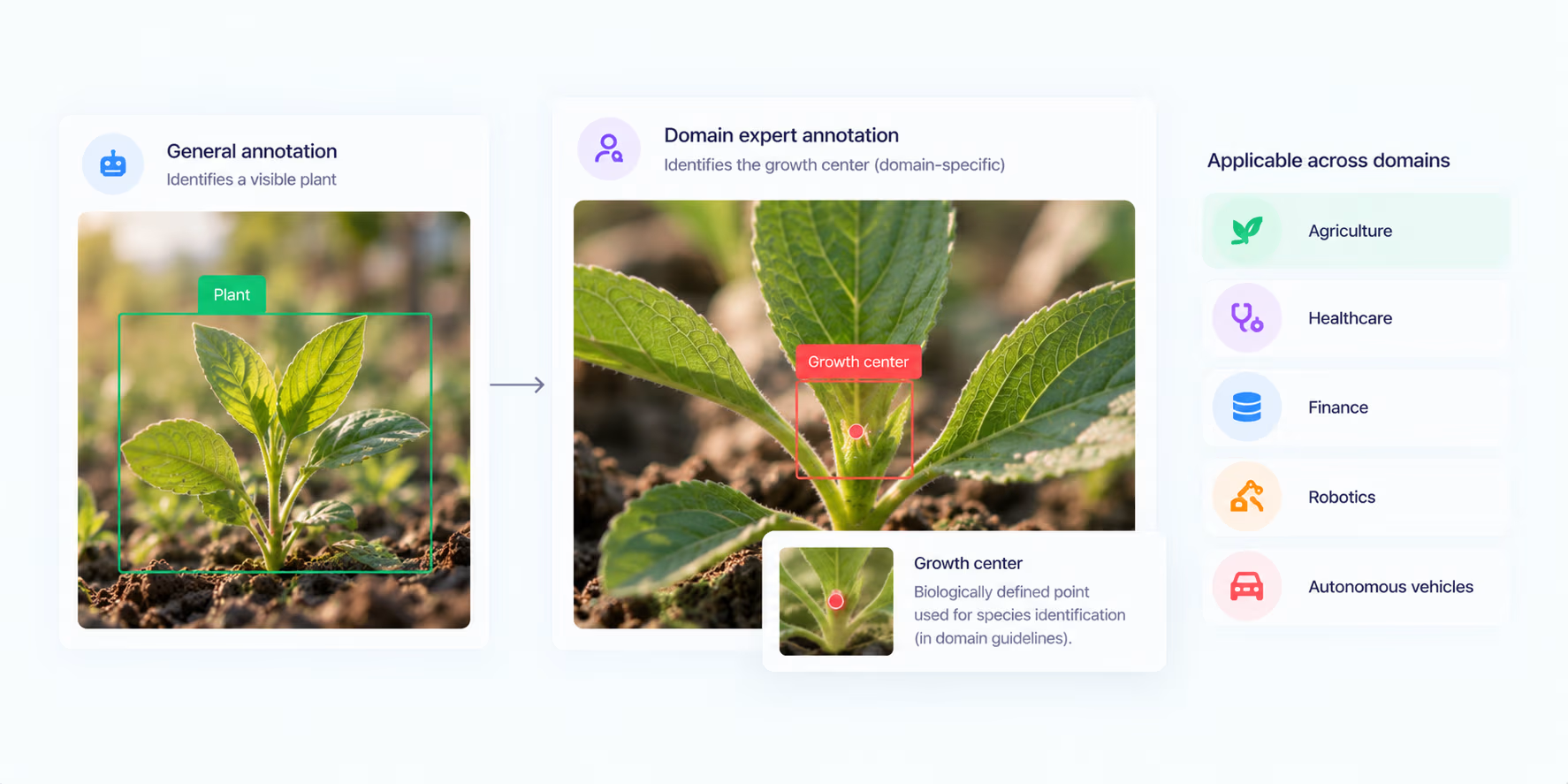
Some annotation decisions cannot be made reliably from generic visual, textual, or linguistic instructions alone.
Consider the difference between marking the center of any visible plant and identifying the biologically defined growth center of a particular weed.
Or between transcribing a clinical phrase and interpreting which medical concept that phrase represents.
The need for domain knowledge depends on the complexity of the decision and the consequence of getting it wrong.
Domain-trained teams or expert escalation can be valuable when projects involve specialized terminology, subtle visual distinctions, regulated contexts, technical taxonomies, or judgments that require knowledge beyond the annotation interface.
IndiVillage currently supports AI data operations across domains including healthcare, agriculture, finance, robotics, and autonomous vehicles, where task-specific training and review structures can be incorporated into project delivery.
How Is AI Training Data Kept Secure?

Training datasets can contain proprietary, commercially sensitive, personal, or regulated information.
Security therefore needs to be part of the operating model rather than an afterthought at delivery.
Project requirements can include controlled access, project-specific permissions, confidentiality procedures, secure transfer and storage, restricted production environments, and appropriate treatment of sensitive information.
The exact controls should reflect the type of data and the client's requirements.
IndiVillage's current public site lists secure, controlled delivery as part of its production AI operations and displays ISO 27001 and SOC 2 Type II among its security and compliance credentials.
Can AI Training Data Services Scale From Pilot to Production?
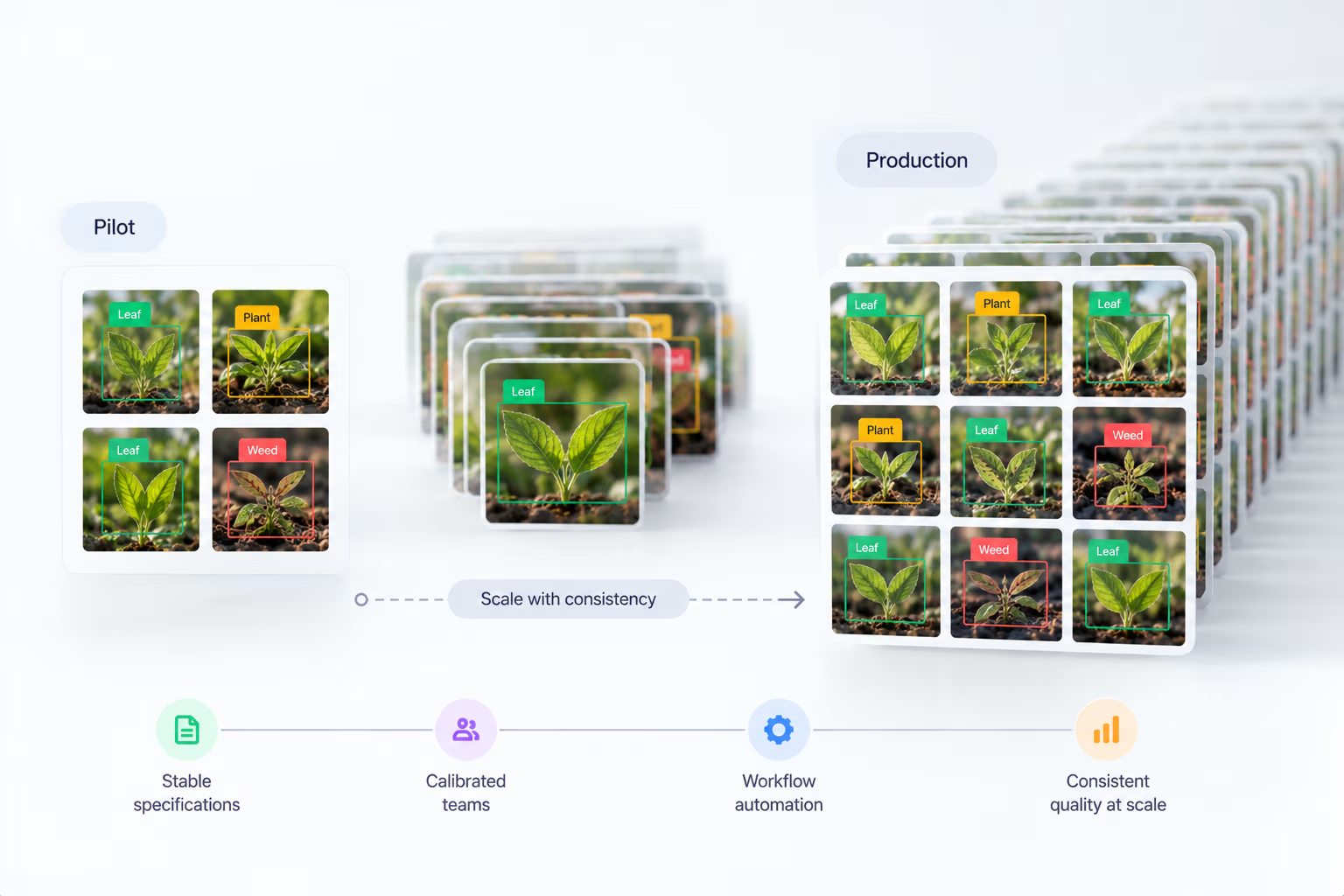
Scale is not simply more people labeling more examples.
Successful scale means increasing throughput without changing what the labels mean.
That becomes difficult as teams grow, batches change, new edge cases appear, guidelines evolve, and different reviewers begin resolving ambiguous situations differently.
Scaling therefore depends on stable specifications, calibrated teams, controlled guideline versions, representative examples, sufficient reviewer capacity, workflow automation, batch-level monitoring, and documented feedback loops.
A useful question during expansion is:
If the same example appeared in the pilot and in the hundredth production batch, would it still be interpreted the same way?
If the answer begins to change, the project has developed specification drift.
Production scale should increase output while preserving the semantic and quality standards established during calibration.
AI Training Data Case Studies
Human Review for Real-World Diagnostic AI

Audere needed structured data to support AI interpretation of Rapid Diagnostic Test imagery, where poor lighting, blur, faint result lines, cassette variations, and personally identifiable information created difficult review conditions.
IndiVillage supported the workflow through human-led image assessment, standardized tagging, feedback loops, second review for unclear cases, and escalation to medical professionals where required.
More than 185,000 standardized annotations were processed within the broader workflow, with the case study reporting up to 98% accuracy for certain RDT types in real-world scenarios. The project demonstrates why difficult medical training data requires more than label volume: uncertainty, image quality, privacy, and expert escalation all influence whether the resulting ground truth is usable.
Read more about IndiVillage delivering safe, AI-Powered HIV testing with 98% accuracy here.
Structured Ground Truth for AI-Powered Pest Detection

Our client needed reliable image tagging for AI models designed to detect and classify agricultural pests across changing field conditions.
IndiVillage's trained teams applied bounding boxes and pest-species labels using an expert-defined taxonomy, combining human annotation with AI-assisted review. The workflow also enabled human-versus-model benchmarking and iterative refinement.
The resulting AI platform has scaled across more than 300,000 hectares, with the case study reporting seven AI models and 96%+ precision in pest identification.
Read more about IndiVillage scaling pest detection with AI across 300K+ hectares here.
Keypoint Data for AI-Powered Laser Weeding

For an agri-tech company developing precision laser-weeding technology, the final annotation output was only a point.
The judgment behind that point was considerably more complex.
Annotators needed to identify the defined growth center of eligible weeds despite overlap, partial visibility, soil clutter, different growth stages, blur, and changing camera angles.
IndiVillage built a dedicated keypoint workflow around guideline alignment, difficult-case review, QA, and recurring edge-case feedback. Delivery scaled to approximately 800 images per week, providing quality-checked point-level training data for plant localization.
Read more about IndiVillage’s keypoint annotation for AI-powered laser weeding here.
These engagements illustrate the same underlying principle across different problems: the valuable part of AI training data is not the annotation tool or raw label count. It is the connection between what qualified humans can reliably identify and what the model needs to learn.
Why Choose IndiVillage for AI Training Data Services?
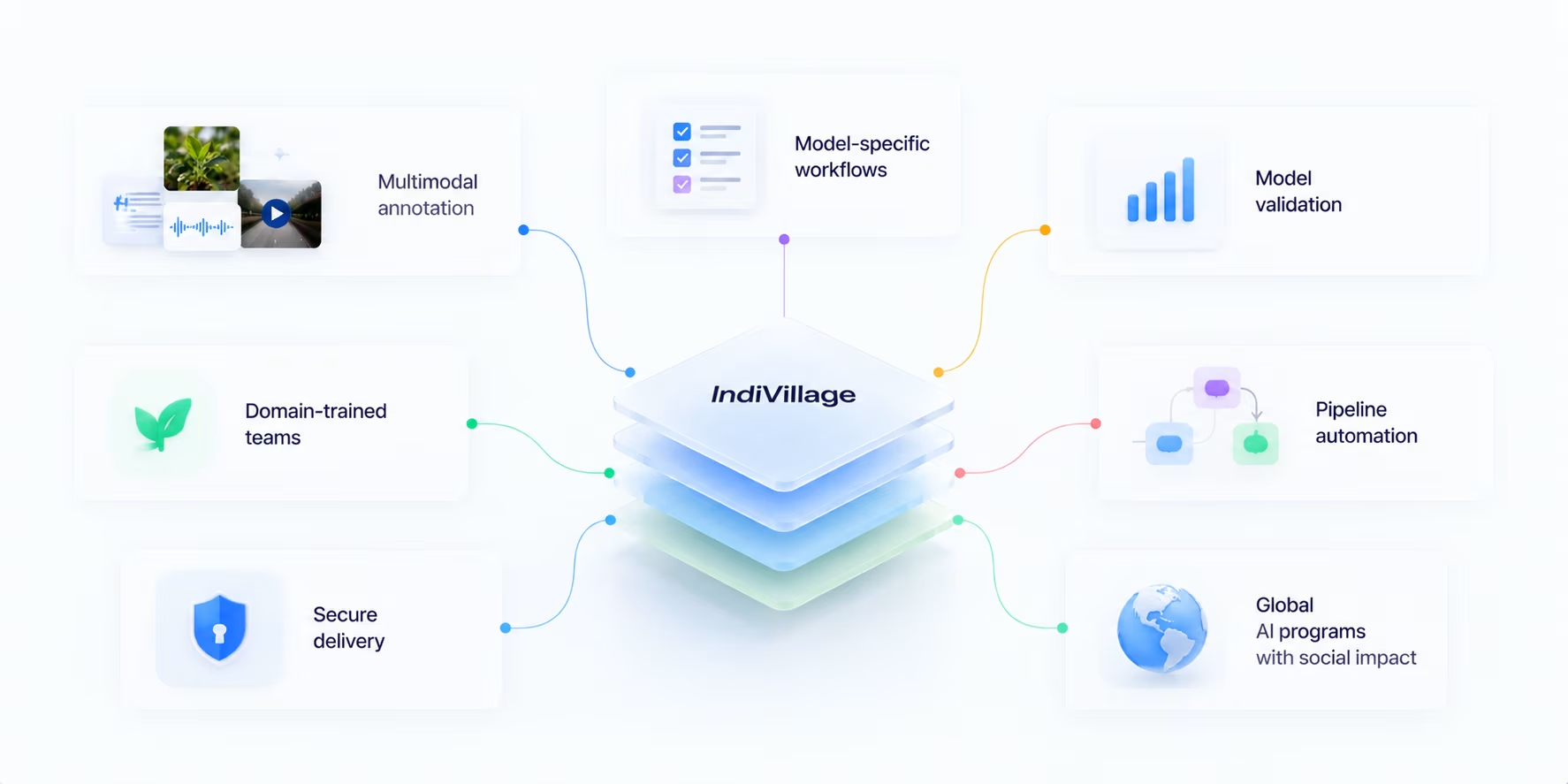
IndiVillage supports production AI teams through a combination of structured human judgment and managed data operations.
Our capabilities include multimodal annotation across text, image, video, and audio; model-specific guideline and QA workflows; human review and escalation; domain-trained teams; AI Model Validation; Pipeline Automation; specialist workflows for areas such as Voice AI, Generative AI, LiDAR, computer vision, robotics, and egocentric video; and secure, managed delivery.
The emphasis is on making training-data production repeatable.
That means translating model requirements into clear specifications, calibrating the people applying those specifications, building QA around the errors that matter, using automation where it reduces operational friction, and feeding verified model weaknesses back into targeted data improvement.
IndiVillage's impact-sourcing model adds a further dimension to that work by creating digital careers and economic opportunity while supporting global AI programs, but technical execution, quality, and delivery remain the foundation of the service.
Start Your AI Training Data Project
The most useful first conversation about training data does not begin with:
How much does it cost to label 100,000 records?
It begins with:
What does the model need those 100,000 records to teach it?
To scope a project effectively, it helps to understand the model type, target task, existing dataset, data modality, current failure or coverage gap, annotation or human-feedback requirement, ontology or existing guidelines, critical edge cases, required output format, quality criteria, domain-expertise needs, security requirements, approximate volume, and timeline.
From there, IndiVillage can help translate the requirement into a representative pilot and a scalable training-data workflow.
Frequently Asked Questions
1. What are AI training data services?
AI training data services prepare raw or existing data for use in model training, fine-tuning, validation, or evaluation. Depending on the model, this can include annotation, labeling, human feedback, transcription, Quality Assurance, data validation, and other forms of structured human judgment that create usable ground truth.
2. What types of AI training data does IndiVillage support?
IndiVillage supports training-data workflows across text, image, video, and audio, along with specialist use cases involving LiDAR, egocentric video, Voice AI, computer vision, robotics, and Generative AI. The exact workflow depends on the model task and required ground-truth representation.
3. How do you know what kind of annotation a model needs?
The annotation type should be derived from what the model must predict or evaluate. Classification may require category labels, object detection needs class and location information, segmentation requires detailed boundaries, Voice AI may require transcription or intent labels, and Generative AI may require human ratings or preference judgments. The model objective should define the data structure rather than the available annotation tool.
4. How much training data does an AI model need?
There is no universal number. Requirements depend on model type, task complexity, existing data, class distribution, scenario diversity, model maturity, target operating conditions, and desired coverage. A useful planning process defines which examples and data slices the model needs before estimating total volume.
5. Can IndiVillage improve an existing training dataset?
Yes, depending on the project requirement. Existing data can be reviewed for issues such as inconsistent labeling, missing classes, insufficient edge cases, weak representation, outdated ontologies, or quality problems. In some cases, targeted relabeling, curation, or enrichment may be more useful than collecting or annotating a completely new dataset.
6. How do you measure AI training-data quality?
Quality measurements depend on the task. They can include label correctness, completeness, reviewer agreement, expert-reference agreement, missing-label rate, class-error rate, geometric precision, audit-pass rate, and rework. The appropriate metrics and thresholds should be agreed before production rather than relying on one generic accuracy percentage.
7. How are difficult or ambiguous examples handled?
Ambiguous examples should be flagged rather than resolved through individual guesswork. A controlled process can route them through reviewer, domain-expert, or client adjudication, document the resulting decision, update the guideline where necessary, and recheck affected examples if the clarification changes earlier interpretations.
8. Can AI be used to speed up training-data annotation?
Yes. AI-assisted tools can support pre-labeling, label propagation, routing, preprocessing, and other repeatable tasks. Model-generated labels should still be validated according to the reliability of the system, complexity of the task, risk of error, and project acceptance criteria. Automation and human review are complementary rather than interchangeable.
9. Can you start with a pilot before scaling?
Yes. A representative pilot can validate the ontology, annotation guidelines, output format, team interpretation, QA methodology, and difficult-case handling before full production. It also gives both teams an opportunity to resolve ambiguity while the cost of changing the specification is still relatively low.
10. Can training data be improved using feedback from model validation?
Yes, when validation identifies a genuine data problem. Model-output review can expose weak classes, scenarios, environments, or other data slices that may benefit from targeted annotation, relabeling, or additional examples. However, not every model error is caused by training data, so the source of the failure should be established before expanding or modifying the dataset.